Unfortunately there is no honesty to be had in this sorry story. The Obama idol worshipers were always content to just worship and never cared about Obama’s policies. The president doesn’t really like black people very much and rarely passes up an opportunity to deliver mockery and insult. Astute observers knew that “hope and change” was always an elaborate marketing gimmick.
Even if the people who always claimed they wanted to make demands did so, their pleas would fall on deaf ears. The lame duck president will do as he has always done. He has always acted on his conviction that the system needs more deal making and not more change.
Obama was always conservative. He said so when he spoke of his admiration for Ronald Reagan. He said so when he said that black people were “90 percent of the way” towards equality. He said so in his first appearance before the American people in 2004 when he made the astounding assertion that “there is no black America, there is no white America.”
The Obama lovers have already fallen back on familiar terrain. Instead of asking hard questions they have chosen to blame the Democratic party for the defeat. Yet they absolve the man who leads the Democratic party of any blame. His absence from the campaign trail and unfunny jokes about cousins Pookie and Ray Ray were a sorry substitute for making a political case and Republican control is the result.
I really enjoyed the piece but do want to point out that (a) Marcia covered the terrain Sunday in "So Barack's sending more US troops into Iraq?" and C.I. was noting in 2008 that the people claiming they would hold Barack's feet to the fire (which included many White 'leaders' of the left) were lying and never would.
This is C.I.'s "Iraq snapshot" for today:
Human Rights Watch's Kenneth Roth Tweeted:
 Kenneth Roth
Many of # Iraq's ruthless Shia militias, which are driving Sunnis into the arms of ISIS, are backed by # Iran. http://trib.al/whYLgG4
US President Barack Obama's so-called 'plan' isn't accomplishing anything and isn't a plan.
It's also not legal.
Laura Koran and Ashley Killough (CNN) report US Senator Tim Kaine declared today at a Wilson Center panel discussion that "there's no legal authority for the current U.S. mission against ISIS in Iraq and Syria" and quotes him stating, "We have been engaged in a war -- that is not about imminent defense of the United States -- without legal authority." The reporters note the senator "has proposed a new, limited authorization specifically targeted to the current mission against ISIS."
So much pride in the bombings on the part of Congress -- among others.
Wise guys
Shy guys
And sly lover boys
With big bad bedroom eyes
I never loved a man I trusted
As far as I could pitch my shoe
-- "Lucky Girl," written by Joni Mitchell, first appears on her Dog Eat Dog
Wise guys, shy guys and apparently pee shy guys.
Listening to the spokespeople for the US government, the Canadian government, the British government, the Iraqi government, et al announce their daily 'kills' from bombings who knew the big swinging dicks would go all pee shy the moment they had to step up?
This morning, NINA reported Mosul Medical Center "received the bodies of 15 civilians, including six women and four children, [who] were killed in an air strike on the Mithaq area east of Mosul."
Yet night has fallen and none of the big swinging dicks have come out to brag.
Come on, 15 kills.
Why the sudden shyness?
Usually, 15 kills would have you all crowing about the 'terrorists' you killed.
But this time, when it's known before you can brag that the dead were civilians, so you clam up.
How many times, be honest, do you think these governments have crowed they killed 'terrorists' in Operatoin Inherent Bulls**t when, in fact, they killed civilians?
Lots?
Yeah, I'd go with that too.
RT observes today, "The US military has admitted that it is reliant on satellite images, drones and surveillance flights to try and get a better picture of what is happening on the ground. It has very few reliable sources on the ground which it can use to get up to date and precise information. The data gained from the air is also used to pinpoint possible targets where airstrikes can be carried out. "
The editorial board of the Oman Tribune offers:
At this point in time it is impossible for thousands of Iraqi troops to overwhelm even a few hundred well-trained, well-equipped and highly motivated fighters of the Baghdadi militia. The blame for this must go to the Americans. When Obama announced the end of the deployment of US forces in Iraq, not much was done to ensure that the country would be handed over to the safe hands of well-trained Iraqi forces with the latest armaments. It seemed at that time that the Americans were in a hurry to get out to justify the Nobel Prize for Peace that Obama won as soon as he became president. And today, Iraq is paying a heavy price for American myopia. Much more will now have to be done to ensure the war in Iraq turns against the extremists. Who knows as time passes, more and more American soldiers might be needed in Iraq. And Obama, under heavy pressure after the horrifying loss of his Democrats in the recent Congressional elections, will have no other option but to send more troops. Or else without having any legacy to shout about, he might become the most unpopular American president in recent times. Afghanistan, after the withdrawal of US forces at the end of the year, might add to his woes. But it may not be as bad as Iraq since about 10,000 western forces will remain to advice and train Afghan soldiers who are also said to be ill-trained and ill-equipped and without effective weapons. In fact, the Americans have destroyed a lot of military equipment there, fearing that ill-trained Afghan troops would lose them in battle to the Taliban.
In Iraq especially, it is doubtful if there will be a decisive outcome on the battlefield. Perhaps it is time the government of Prime Minister Haider Al Abadi works hard for a political solution. He has made a start by wooing disgruntled elements many of who support the Baghdadi militia and have even joined it. This task is going to be tough. But Abadi will have to try hard for the sake of ensuring that his country remains a single entity and enjoys peace in the long term. The Americans will have a role to play in this by being a reliable partner and provide stability to the government. Running away like the last time will mean more trouble for the Middle East. And, having a stake in the region, they will doubtlessly be hit hard.
Barack's non-plan stared with a few hundred US service members going into Iraq and rose to 1500. That's right 1500. Huffington Post needs to grasp reality. To mock Senator John McCain, they felt the need to say AP estimates it's 1400. Yes, but they don't include the 100 Special Ops service members the White House and the Pentagon have previously acknowledged were sent into Iraq.
So from a few hundred it went up to 1500 and last week Barack announced that figure would now double to 3,000. Bill Van Auken (WSWS) reports:
The Pentagon has dispatched at least 50 US troops, including “advisers” and “force protection” forces, to Iraq’s embattled western province of Anbar, 80 percent of which is reportedly under the control of the Islamic State of Iraq and Syria (ISIS).
The elements that arrived Tuesday are the advance team for a much larger deployment, which will include the bulk of the 1,500 additional troops whose dispatch to Iraq the Pentagon announced last week, effectively doubling the American forces on the ground in the country.
Anbar, which is predominantly Sunni, was the scene of the bloodiest fighting during the more than eight-year US war and occupation, which ended in 2011. It had risen in revolt against the Shia sectarian government of former Prime Minister Nouri al-Maliki last year, paving the way for the rapid advance of ISIS and routing of the corrupt and crumbling US-trained Iraqi army.
The US military’s advance team has been sent to the sprawling desert Al-Asad air base, which was a principal hub for US military operations during the 2003-2011 occupation before it was turned over to Iraqi security forces.
AFP notes, "The deployment raises the risk of potential American causalities if the Baghdadi militia group overruns an Iraqi air base there or if it manages to down an American helicopter with a shoulder-launched surface-to-air missile, though US officers insist those are remote scenarios." Jeff Schogol (Military Times) adds, "About 50 U.S. troops have deployed to Al-Asad Air Base conducting a site survey to see if U.S. advisers can use the installation to support the Iraqi military, said Navy Cmdr. Elissa Smith, a Defense Department spokeswoman."
Al-Asad Air Base . . . Why does that strike a chord right now?
Oh, yeah, Iraq's Speaker of Parliament is Saleem al-Jobouri was just there as he was visiting Anbar Province to examine conditions there. All Iraq News reports his bodyguards stopped an "assassination attempt in Ain al-Assad Military Base" today.
News of the assassination attempt on an Iraqi military base comes two days after the US government announced that F-16 training for Iraqis would no longer take place in Iraq but instead in Arizona. Gareth Jennings (Jane's Defence Weekly) explains, "Iraq has ordered 36 F-16C/D Block 52 aircraft in all, the first of which were due to be delivered to Balad Airbase earlier this year. However, the deteriorating security situation on the ground meant that the DoD had to evacuate its contractors at the base, and postpone handing over the jets."
What did AFP say again? Oh, right, "The deployment raises the risk of potential American causalities if the Baghdadi militia group overruns an Iraqi air base there or if it manages to down an American helicopter with a shoulder-launched surface-to-air missile, though US officers insist those are remote scenarios."
Adam Taylor (Washington Post) notes, "The U.S. military seems to have decided that Anbar must be a key ground for the fight against Islamic State. President Obama last week announced a dramatic increase in the number of U.S. soldiers being sent to Iraq, with officials adding that a new hub for U.S. military advisers would be set up in Anbar."
With all the military action, since Barack has declared that the only answer for Iraq is a political solution, you just know that the US government is leading on the diplomatic side, right?
Wrong.
And, in fact, diplomacy suffered a major setback today.
Note this exchange which took place at the US State Dept today in the press briefing moderated by spokesperson Jen Psaki.
QUESTION: Jen, there is a meeting that will take place tomorrow here in Washington by 200 military experts from 30 countries that will be discussing the next phase in the fight against ISIL. That might also include some ground troops. Are you aware of that or could you share with us any information that you might --
MS. PSAKI: Is the Department of Defense – I assume is engaged in this event or hosting it in some capacity. Or do you have more details on it?
QUESTION: Okay. I don’t have more details.
The spokesperson for the State Dept is asking a reporter for information about a DC meet-up
Because she knows nothing about it.
She knows nothing about it.
Two hours before she went to the podium, US Major Brian Fickel Tweeted this:

Counter-ISIL
Coalition meeting at CENTCOM 12-21 Nov. GEN Austin: "This gathering of
military planners from more than 30 nations is historic"
0 replies
30 retweets
11 favorites
US Central Command issued the following press release today:
November 12, 2014
RELEASE #20141109
FOR IMMEDIATE RELEASE
TAMPA, Fla. - U.S. Central Command will host military planners from more than 30 nations for an operational planning conference Nov. 12-21 at MacDill Air Force Base, Fla. The conference provides an opportunity for coalition partners to strengthen relationships and further develop and refine military campaign plans to degrade and defeat ISIL. The event is another milestone in U.S. and Coalition military efforts to work together with Iraq and other partners from around the world to eliminate the terrorist group ISIL and the threat they pose to Iraq, the region and the wider international community.
"This gathering of military planners from more than 30 nations is historic in many ways," said Gen. Lloyd J. Austin III, U.S. Central Command commander. "The nearly 200 participants represent the broad Coalition that has come together and is key to the success of our campaign to defeat ISIL. Indeed, it is the Coalition that our enemies fear most. And, it is the Coalition that will get the job done and done the right way, and as quickly as possible. I have every confidence that over the next several days this esteemed group will do tremendous work and through their efforts set the conditions necessary to ensure that ISIL is defeated and long-term security and stability is achieved throughout the Central Region."
Can someone get a copy of that over to the State Dept?
Let's go back to the press briefing.
QUESTION: Let me ask you about a poll that was conducted by the Arab Center for Research and Policy Study in Doha. They have a satellite office here in Washington that held a press conference today. And it shows that while a majority of Arabs support the fight against ISIS itself, they remain suspicious of U.S. intentions. Now, they also say that you don’t take into consideration Arab opinion in – when formulating U.S. policy, whether military or just policy. Do you have any comment on that?
MS. PSAKI: Well, I haven’t seen that poll and I’m not going to speak to a poll, but let me convey, though, that obviously, from the beginning we felt it was important for Arab countries to be partners militarily when we did our first airstrikes. We’ve been partnering and working closely with Arab countries and Arab leaders because we feel specifically that the voices of those leaders, the voices of religious leaders, of faith leaders, of government leaders in many of those countries is far more effective than the voice of the United States. So I think our actions just contradict the findings of that report.
QUESTION: Well, that’s the fact – that’s why they’re angry. Their beef is on this point, that you do consult with the leaders, but you don’t – you dismiss totally the sentiments of the so-called “Arab street,” the sentiments of the public, how they view your interventions and so on in the region.
MS. PSAKI: Well, I think our view, Said – and we’re not just talking to leaders; we’re talking to a range of civil society leaders, of religious leaders, of faith leaders, we’re communicating via social media. And a lot of this is done, though, through partnering with many high-level officials in these countries. We certainly feel that there is a view that ISIL poses a threat to the region. We’re taking on that threat with these countries, and I don’t know that there’s much disagreement about that particular challenge.
QUESTION: On the political dimension of your strategy against ISIS in Iraq, can we – have you made any progress in, for example, vis-a-vis Iraq’s Government’s efforts to reach out to the Sunni communities in Anbar?
MS. PSAKI: Well, there have been – Prime Minister Abadi has spoken to this, but he’s also taken a range of steps to meet with leaders, Sunni leaders and Sunni tribal leaders. He’s ramped up outreach to Sunni tribal leaders in Amman and Baghdad and stressed in public remarks that he is an advocate and will continue to be an advocate for all Iraqis regardless of ethnicity or religion. We know there’s quite a bit of history here and hard feelings given some of the events over the last several months prior to Prime Minister Abadi taking over, and we know it’s going to take some time to repair some of those relationships. But we’ve seen him take some steps to address them and we’ve seen him make efforts to both encourage the security forces to operate in a more inclusive manner, in a regulated manner, including the Shia militia, to reach out himself personally, which is what I just referenced.
QUESTION: What about the relationship between Baghdad and the KRG, Kurdistan Regional Government? Yesterday – or it was this weekend, actually, prime minister of Kurdistan, Nechirvan Barzani, slammed the Iraqi Government for failing to deliver on promises that it had made before forming the government in Baghdad.
MS. PSAKI: Well, are you --
QUESTION: It seems that people like the Kurds are frustrated with Baghdad, with Prime Minister Abadi’s new government, the same way that they were with al-Maliki’s government.
MS. PSAKI: Well, I don’t think it’s been put specifically in those terms. Obviously, there are discussions about everything from oil revenues to payments that are ongoing. And we’re certainly encouraging those to be – the Iraqi Government to resolve those issues, but those are negotiations that are ongoing. And there have been some back and forth on it between the Kurdish government and the central government. And we hope it will be resolved soon.
Regardless of how she'd put it, it's not new or just emerging. From the November 5th snapshot:
Tuesday morning, we noted:
Word is the Kurds have about had it with al-Abadi.
But you don't see that in the press do you?
Last week, not covered in the US or western press, former Iraqi President Jalal Talabani sent a delegation to Baghdad to speak about serious issues and how the rift between the KRG and the central government out of Baghdad was again widening. Among the issues resurfacing are the failure of al-Abadi to pass a budget for 2014 or 2015 (he inherited the failure to pass the 2014 budget) and the attempts to prevent the Kurds from selling their own oil.
At a time when the KRG is denied federal funds and when the KRG's fighters (the Peshmerga) are carrying a heavy load, Talabani's delegation expressed the opinion that now is not the time to be pursuing Nouri's failed politics.
Though pleasantries were exchanged, the delegation wasn't stupid enough to be mollified by pretty words. If the rift widens, look for things to get even worse in Iraq -- and who would have thought that was possible?
Matt Bradley and Ghassan Adnan (Wall St. Journal) report on the budgets (2014 and 2015) today and also on the conflict between the KRG and Baghdad while getting it right -- something few do -- about what came first (Nouri's withholding the 17% of the federal budget the Kurds are entitled to) in this economic battle.
Apparently those realities have also caught the State Dept by surprise. Alexander Whitcomb (Rudaw) reports today:
The Kurdistan Regional Government (KRG) is moving forward with legislation to further reduce its ties with Baghdad, as the cabinet put two oil and gas laws forward for parliamentary approval next week, KRG officials said.
The cabinet approved a bill at its session on Wednesday that would create a special account consolidating the region’s various sources of oil revenue to provide transparency.
A second bill would create a publicly-owned company to sign contracts for discovery, production, development, marketing and export.
Parliament is expected to vote on the measure after the energy committee convenes on Monday.
Don't tell Psaki, she might pass out.
As for the poll Said Arikat referred to, it was from The Doha Institute which issued a press release on the poll noting:
Findings from a survey by the Arab
Opinion Index team, within the Doha-based Arab Center for Research and
Policy Studies, and which were presented at near-simultaneous press
conferences in Doha and Washington, DC, have demonstrated the depth of
the Arab public’s distaste for the Islamic State in Iraq and the Levant
(ISIL). Findings from telephone interviews with 5,100 respondents in
seven Arab countries and in Syrian refugee camps located Lebanon, Jordan
and Turkey show that 85% of the Arab holds negative views of ISIL, to
varying degrees. This compares to only 11% of the Arab public whose
views towards the group were either “Positive” or “Positive to some
extent”.
When asked to explain the reasons for
the backing which ISIL enjoyed amongst its supporters, only 13% of
respondents cited the group’s adherence to Islamic principles. A much
larger group (55%) explains support for ISIL by citing a host of other
reasons: either due to its military achievements; its preparedness to
challenge the West; its opposition to Iran and the Syrian and Iraqi
regimes; or its purported support for the Sunni Muslim community in the
Levant.
In line with respondents’ negative
attitudes towards ISIL, 59% also voiced support for the military
campaign led by the international coalition set up to oppose the group.
Additionally, the public in the Arab region is supportive of Arab
participation in the coalition. In contrast, roughly one-third of the
Arab public forms an opposing camp who disagree either with the aims of
the international coalition against ISIL and/or the participation of
Arab countries within that coalition.
In the limited efforts at diplomacy, the State Dept's Brett McGurk Tweeted the following today:

W/PM Abadi yesterday in #Iraq. Today, he ordered key security reforms to advance #ISIL fight: http://pmo.iq/pme/press/12-11-20143en.htm …
W/PM Abadi yesterday in #Iraq. Today, he ordered key security reforms to advance #ISIL fight: http://pmo.iq/pme/press/12-11-20143en.htm …
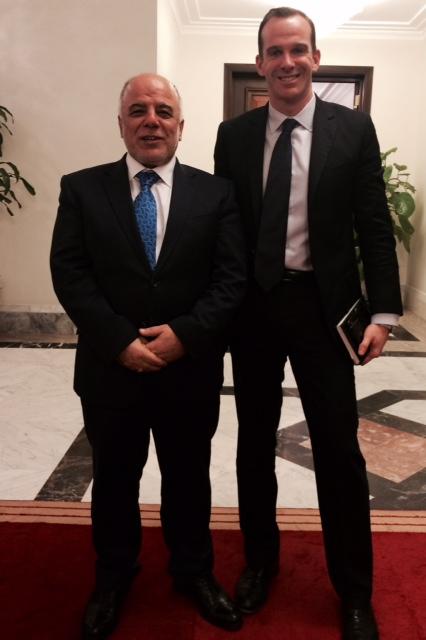
Psaki could have noted that (if she was aware of it). She might also have noted what Iraq's prime minister did today. The Iraq Embassy in DC issued the following today:
Prime Minister Dr. Haider Al-Abadi in his capacity as Commander-in-Chief of the Armed Forces visited Baghdad Operations Command on November 10, 2014 and held an extended meeting with commanders and officers from various units of the Armed Forces.
He hailed the efforts of Baghdad Operations Command, calling on its officers to firmly deal with organized crime and enforce severe measures against criminals who seek to undermine Baghdad’s security environment.
The Prime Minister also stressed the need to work hard to address serious challenges that threaten our society. He confirmed that the Ministry of Interior would resume responsibility for the management of security in Baghdad and noted the government’s determination to remove all concrete barriers in the city of Baghdad. The Prime Minister announced plans to remove road blocks that do not contribute to enhanced security and noted that the issue must be dealt with professionally and thoughtfully in order to ease traffic for the residents of Baghdad. In addition, the Prime Minister noted intentions to open access to parts of the Green Zone and stressed the need for vigilance against terrorists who seek to exploit these new measures.
Prime Minister Al-Abadi also discussed a number of issues related to living conditions and traffic accidents in the city of Baghdad, and issued several executive orders in this regard.
On November 12, 2014, the Commander-in-Chief of the Armed Forces Dr. Haidar Al-Abadi issued executive orders to relieve 26 military commanders from their posts and retire an additional 10 commanders. He also appointed 18 military officers to senior posts within the Ministry of Defense as part of ongoing efforts to professionalize Iraq’s military institutions and root out corruption in its various forms.
Prime Minister Al-Abadi also met in his office today a number of military commanders from the Armed Forces. During the meeting, he stressed the need for Iraq’s military leadership to exhibit efficiency, integrity and courage so that soldiers can rally behind their commanders and fight effectively, adding that any assessment of the armed forces should be based on these merits.
Prime Minster Al-Abadi said that the Iraqi Army’s losses were the result of many complicated internal, external and political factors, stressing the need to restore confidence in the security forces through real action and by combating corruption at the individual and institutional levels. He emphasized his strong support for this approach, stressing the need to act swiftly, particularly given that the military enjoys considerable political and popular support, in addition to backing from the religious establishments.
The Prime Minister noted that the army is the defender of the homeland, and in the near future will seek to limit its task to defending Iraq's borders, while transferring security responsibilities to the Ministry of Interior and other security agencies.
The Prime Minster highlighted the great victories achieved by our armed forces on various fronts and their determination to liberate every inch of Iraqi territory in cooperation with the people of the provinces.
Many outlets reported on the above -- AFP, the Associated Press, etc. But no one pointed out the obvious re: firing the commander over Anbar.
Since January, the Iraqi military has been bombing residential neighborhoods in Falluja (and in other Anbar cities, but Falluja's been bombed daily since the start of the year). September 13th, Haider al-Abadi announced that the bombings would cease. (The bombings fit the legal definition of War Crimes. They are collective punishment.) Despite that announcement, the bombings have continued.
Anbar's military command has refused to follow the orders of al-Abadi who is supposed to be commander in chief of the Iraqi military.
That's kind of a key detail and one that everyone left out in their so-called reports.
David D. Kirkpatrick (New York Times) reports on the firings and forgets the issue of the bombing of Falluja's residential areas. But he gets credit for noting that al-Abadi appears to have ignored the role Parliament is supposed to play in this sort of action and that he mirrors Nouri al-Maliki in that. He also gets credit for this:
Mr.
Abadi was elected three months ago, with strong American backing, on a
pledge to build a more inclusive and responsive government after the
divisive eight-year rule of Prime Minister Nuri Kamal al-Maliki.
Mr.
Maliki is a senior leader of a political faction based in the Shiite
Muslim majority, and he is widely blamed by many Iraqis and the White
House for cronyism, nepotism and police abuses that alienated the Sunni
Muslim population, opening doors to the Sunni extremists of the Islamic
State. As prime minister, he was a strongman who kept tight control of
the security services, and he stacked the military’s top ranks with
loyalists rather than the most competent officers, contributing to the
erosion of the military’s fighting ability.
It's a detail that, for example, AP leaves out. In fact, AP is defending Nouri and white washing his reign of terror in their useless 'report.'
I wish Kirkpatrick had addressed the residential bombings but at least his report was filled with skepticism and details and examples. It was a report. A solid one. Others can't make the same claim.
In addition to the violence already noted, Ahmed Rasheed, Saif Sameer, Michael Gregory and Andrew Roche (Reuters) report "suicide bombings and car bombs" have led to 23 deaths in Iraq today. That figure also does not include the 2 corpses National Iraqi News Agency reports were dumped "in the Hurriah area, northwest of Baghdad."
iraq
wsws
bill van auken
the new york times
national iraq news agency
the wall st. journal
matt bradley


 YouTube