Farrow’s big idea is that U.S. statecraft needs to be demilitarised. It’s hard to disagree with this slogan but what does it mean in say, Yemen, where a Saudi-led coalition, with U.S. weaponry, targeting and mid-air refueling, has bombed that nation into a humanitarian crisis with grave risk of epidemic and famine. Surely this is a theatre where fresh thinking from an American foreign policy up-and-comer is badly needed?
But looking to the index of Farrow’s book one finds that Yemen gets exactly one brief mention, the same number as “Hamlisch, Marvin” and “Jolie, Angelina.” And this despite the growing push among the Senate’s most conservative Republicans and progressive Democrats to cut off military aid to the Saudis!
OK, how about Libya? Surely Farrow has something interesting to say about how a diplomatic approach might have better addressed the insurgency against Gaddafi there, now that the Franco-British-American regime change operation has left the country in violent chaos? (This case ought to be doubly interesting for Farrow as the U.S. Secretary of Defense Robert Gates, a Republican, opposed that war whereas humanitarian diplomats like Secretary of State Hillary Clinton and Samantha Power backed it to the hilt.) But Libya too is mentioned only in passing, exactly once, as often “Portman, Natalie” and “Sorkin, Aaron.”
One looks in vain for any fresh thinking on how to demilitarise U.S. policy on Syria, let alone bold ideas for de-conflicting that internationalised civil war itself. What about full diplomatic recognition of Iran to induce them to retrench? A grand bargain with Russia including full rights to their dinky blue-water port at Tartus? Direct talks with Hezbollah? This diplomatic program of course does not carry any guarantee of success–but then neither does violent regime change. More importantly, all of these ideas bump up against domestic political constraints in the U.S.–like ending massive aid to Egypt, which Farrow judges as “not politically realistic.”
A strategic void
Diplomats used to talk about strategy: which alliances are worth keeping, which client-states are worth dropping, the costs of peace and war. You won’t find any of that in War on Peace where there is remarkably little questioning of the fundamental substance of American statecraft, a void that is echoed in the U.S. foreign policy discourse in general. For Farrow, diplomacy is mainly a matter of procedure, or governmental style, not of substantive goals and outcomes.. As for the content of U.S. diplomacy, they young man has faithfully internalised its precepts: of what is “not politically realistic.”
Farrow is good at pointing out the enormous differences between the statecraft of Obama and Trump. Alas, Farrow is even better at airbrushing over the continuities between the two presidencies, and these too are significant. Farrow chides Trump for giving local military commanders more discretion in Somalia, but it was the Obama administration that expanded the legal and military scope of that mostly ignored war in the last months of his presidency. And Trump’s escalation of a couple thousand troops in Afghanistan is not much compared to Obama’s “surge” of 30,000 soldiers in 2010, all with the backing of his diplo-humanitarian angel choir.
This is C.I.'s "Iraq snapshot:"
Friday, June 1, 2018. So many shade the truth -- the UN when it comes
to the monthly deaths in Iraq; NYT and it's Hobby Lobby journalist who
announce they're returning stolen items to Iraq out of the goodness of
their little old hearts when, in fact, the are returning the items
because the Iraqi government has ordered them returned. Ayi-yi-yi.
Let's get started.
With the start of a new month, the United Nations celebrates with yet another undercount of the deaths in Iraq.
Back in the real world, Margaret Griffis (ANTIWAR.COM) notes, "At least 1,906 people were killed or found dead, and 265 more were wounded during violent attacks in May. The number of casualties is close to April’s figures, when 1,970 were killed, executed, or recovered. Another 194 more were wounded then. These figures should be considered estimates, as the true number of casualties is impossible to know."
I can't believe that twenty or so years from now, the UN undercounts will enhance the body's image or reputation. No one should allow them then to dismiss their actions. It should always be remembered that they were called out in real time -- that it was known in real time that they were dishonest. Dishonesty helps perpetuate the war. That wasn't a concern for the UN. But they were happy to change their counts anytime they were criticized by the Iraqi government -- changes that repeatedly lowered the count.
Musical break, Rebecca Ferguson's "Uncrazy" (acoustic version).
Iraq held elections May 12th. Journalist David Bacon (LOBE LOG, IPS) offers this analysis:
The U.S. media quickly dismissed the results of Iraq's national elections on May 12. Journalists were puzzled by what the followers of Muqtada al-Sadr and the Iraqi Communist Party (ICP) might have in common, and even more, by why they garnered more Iraqi votes than any other electoral list.
Al-Sadr's Mahdi Army fought the U.S. early in the occupation, and his political base is mostly among poor and disenfranchised Iraqis, especially in Baghdad's Sadr City. This vast neighborhood of 3.5 million people, half the population of Baghdad, was known originally as al-Thawra, or Revolution, built for poor people migrating from the countryside by radical nationalist Prime Minister Abdul Karim Qassim in 1959. For many years it was a stronghold of the ICP. Later, after the Baathist coup that overthrew Karim Qassim and eventually brought Saddam Hussein to power, it was renamed Saddam City. Then, after the 1999 assassination of Muqtada al-Sadr's father, Ayatollah Mohammad Sadeq al-Sadr, it became popularly known as Sadr City.
The New York Times labeled Muqtada al-Sadr's partners in the Sairoon coalition "Iraq's moribund Communists, Sunni businessmen and pious community activists." Actually, besides al-Sadr and the ICP, Sairoon (meaning Forward or the Alliance for Reforms) includes the Youth Movement for Change Party, the Party of Progress and Reform, the Iraqi Republican Group, and the State of Justice Party.
Oversimplifying politics and ignoring history, however, is not just a matter of names. It reveals blindness to the long process in which Iraqi civil society has been rebuilding itself, to the popular anger that has motivated this, and to the growing support for the political alternative this alliance proposes.
The 329 parliamentary deputies chosen in the May election will vote for a new prime minister. Sairoon won the most 55 deputies, with 1.3 million votes. It was followed by the Fatah Party of Hadi al-Amiri, whose base rests on militias with ties to Iran, with 47 seats and 1.2 million votes. Voters rejected the parties of both the current Prime Minister Haidar al-Abadi (Victory Coalition with 40 seats) and former Prime Minister Nouri al-Maliki (State of Justice Party with 25). Turnout was low, at 44% nationwide and only 33% in Baghdad itself (where Sairoon won 23%, almost twice that of any of its rivals).
The program of the Sairoon alliance calls for an end to the system that divided political positions and government support along sectarian lines, a system imposed by the U.S. after its occupation of Iraq in 2011. Basing a governmental structure on sectarian political parties led to a system of patronage and division of spoils, and consequently enormous corruption. Al-Sadr explained, "I'll say this despite the amama [turban] on my head. We tried the Islamists and they failed miserably. Time to try independent technocrats."
Sairoon also called for independence from foreign domination by the U.S. and Iran. In advance of the election, a senior Iranian politician, Ali Akbar Velayati, visited Iraq and threatened Iranian reprisals if voters chose Sairoon: "We will not allow liberals and communists to govern in Iraq," he said. Many secular politicians condemned the statement as interference in Iraq's internal affairs.
Following the election, because no group got anywhere near a majority, negotiations began between Sairoon and two runners-up, al-Amiri's Fatah bloc and al-Abadi's Victory Coalition. Inside Sairoon this has produced tension between the Sadrists and the ICP. Some coalition members are calling for it to go into opposition rather than agree to power-sharing with parties and politicians still committed to the hated sectarian quotas.
Thierry Meyssan (VOLTAIRE) offers:
The programme of Chiite religious leader Moqtada al-Sadr is simple – the withdrawal of all foreign presence (except diplomatic), whether from the the USA, Turkey or Iran. Without taking into account what might become of the Turkish troops illegally stationed in Bachiqa, and aware of the fact that the Iranians have no need to send troops into Iraq in order to be represented there, this message is addressed in priority to the 100,000 US personnel still present, a fifth of whom are regular soldiers.
The other message of Moqtada al-Sadr – who is supported by the Communist Party – is the end of sectarianism. It appears that Iraqis have assimilated the idea that in the absence of a despotic régime like that of Saddam Hussein, only national union can enable the defence of the country. This is why, before the vote, Moqtada al-Sadr turned to Saudi Arabia and to the other Sunni powers in the Persian Gulf. He describes himself as a nationalist in the sense of original Ba’athism – not as an Iraqi nationalist, but as an Arab nationalist.
It is also the reason why voters did not offer massive support to the Prime Minister’s « Victory Alliance ». By referring to his victory over [the Islamic State], Haider al-Abadi rejected the ex-Ba’athists who had supported the terrorist organisation by default [2].
The propaganda broadcast by the Bush administration had assimilated Saddam Hussein’s Ba’athists with the Nazis. Washington had qualified the Iraqi Ba’ath Party as a « criminal organisation » and forbade its members from taking part in politics. Fifteen years later, this decision is still the primary cause of the troubles which destabilise the country. To that we must add the sectarian constitution, drawn up by the Israëlo-US Noah Feltman and imposed by the Pentagon, which maintains the fear of the division of the country into three distinct States (Chiites, Sunnis and Kurds). In any case, the time has passed when the CIA could organise civil war in secret and channel anti-US anger into communitarian persecution.
We said earlier this week of the elections that so-called 'experts' in the west forgot the reality that all elections are local. CSIS' Anthony Cordesman gets at that in his analysis:
Some statistics on the elections.
With the start of a new month, the United Nations celebrates with yet another undercount of the deaths in Iraq.

UNAMI Retweeted UNAMI
UNAMI added,

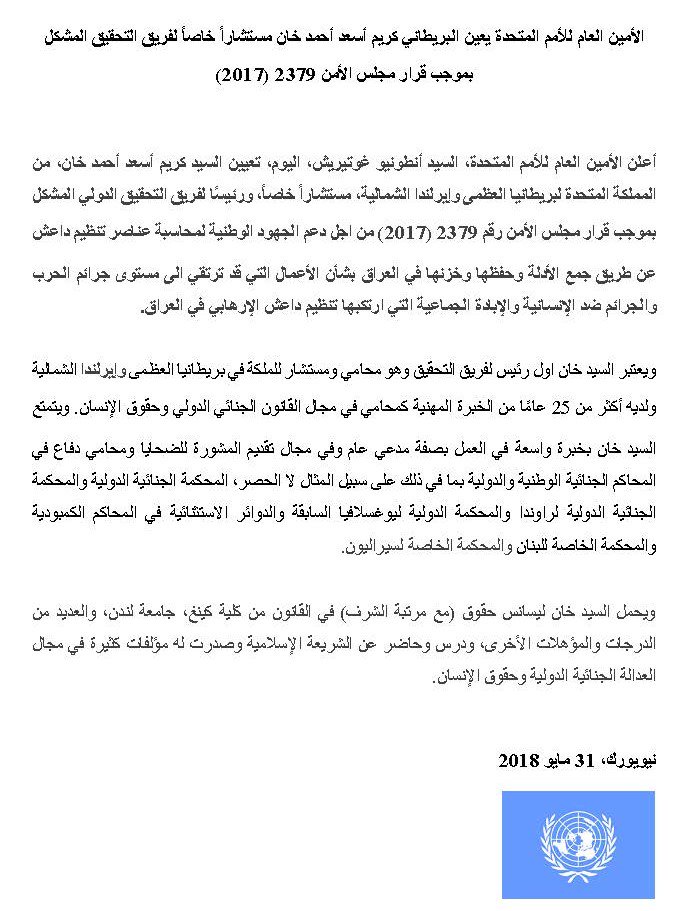
الأمين العام للأمم المتحدة يعين البريطاني كريم أسعد أحمد خان مستشاراً
خاصاً لفريق التحقيق المشكل بموجب قرار مجلس الأمن 2379 (2017)
#العراق
Back in the real world, Margaret Griffis (ANTIWAR.COM) notes, "At least 1,906 people were killed or found dead, and 265 more were wounded during violent attacks in May. The number of casualties is close to April’s figures, when 1,970 were killed, executed, or recovered. Another 194 more were wounded then. These figures should be considered estimates, as the true number of casualties is impossible to know."
I can't believe that twenty or so years from now, the UN undercounts will enhance the body's image or reputation. No one should allow them then to dismiss their actions. It should always be remembered that they were called out in real time -- that it was known in real time that they were dishonest. Dishonesty helps perpetuate the war. That wasn't a concern for the UN. But they were happy to change their counts anytime they were criticized by the Iraqi government -- changes that repeatedly lowered the count.
Musical break, Rebecca Ferguson's "Uncrazy" (acoustic version).
Iraq held elections May 12th. Journalist David Bacon (LOBE LOG, IPS) offers this analysis:
The U.S. media quickly dismissed the results of Iraq's national elections on May 12. Journalists were puzzled by what the followers of Muqtada al-Sadr and the Iraqi Communist Party (ICP) might have in common, and even more, by why they garnered more Iraqi votes than any other electoral list.
Al-Sadr's Mahdi Army fought the U.S. early in the occupation, and his political base is mostly among poor and disenfranchised Iraqis, especially in Baghdad's Sadr City. This vast neighborhood of 3.5 million people, half the population of Baghdad, was known originally as al-Thawra, or Revolution, built for poor people migrating from the countryside by radical nationalist Prime Minister Abdul Karim Qassim in 1959. For many years it was a stronghold of the ICP. Later, after the Baathist coup that overthrew Karim Qassim and eventually brought Saddam Hussein to power, it was renamed Saddam City. Then, after the 1999 assassination of Muqtada al-Sadr's father, Ayatollah Mohammad Sadeq al-Sadr, it became popularly known as Sadr City.
The New York Times labeled Muqtada al-Sadr's partners in the Sairoon coalition "Iraq's moribund Communists, Sunni businessmen and pious community activists." Actually, besides al-Sadr and the ICP, Sairoon (meaning Forward or the Alliance for Reforms) includes the Youth Movement for Change Party, the Party of Progress and Reform, the Iraqi Republican Group, and the State of Justice Party.
Oversimplifying politics and ignoring history, however, is not just a matter of names. It reveals blindness to the long process in which Iraqi civil society has been rebuilding itself, to the popular anger that has motivated this, and to the growing support for the political alternative this alliance proposes.
The 329 parliamentary deputies chosen in the May election will vote for a new prime minister. Sairoon won the most 55 deputies, with 1.3 million votes. It was followed by the Fatah Party of Hadi al-Amiri, whose base rests on militias with ties to Iran, with 47 seats and 1.2 million votes. Voters rejected the parties of both the current Prime Minister Haidar al-Abadi (Victory Coalition with 40 seats) and former Prime Minister Nouri al-Maliki (State of Justice Party with 25). Turnout was low, at 44% nationwide and only 33% in Baghdad itself (where Sairoon won 23%, almost twice that of any of its rivals).
The program of the Sairoon alliance calls for an end to the system that divided political positions and government support along sectarian lines, a system imposed by the U.S. after its occupation of Iraq in 2011. Basing a governmental structure on sectarian political parties led to a system of patronage and division of spoils, and consequently enormous corruption. Al-Sadr explained, "I'll say this despite the amama [turban] on my head. We tried the Islamists and they failed miserably. Time to try independent technocrats."
Sairoon also called for independence from foreign domination by the U.S. and Iran. In advance of the election, a senior Iranian politician, Ali Akbar Velayati, visited Iraq and threatened Iranian reprisals if voters chose Sairoon: "We will not allow liberals and communists to govern in Iraq," he said. Many secular politicians condemned the statement as interference in Iraq's internal affairs.
Following the election, because no group got anywhere near a majority, negotiations began between Sairoon and two runners-up, al-Amiri's Fatah bloc and al-Abadi's Victory Coalition. Inside Sairoon this has produced tension between the Sadrists and the ICP. Some coalition members are calling for it to go into opposition rather than agree to power-sharing with parties and politicians still committed to the hated sectarian quotas.
Thierry Meyssan (VOLTAIRE) offers:
The programme of Chiite religious leader Moqtada al-Sadr is simple – the withdrawal of all foreign presence (except diplomatic), whether from the the USA, Turkey or Iran. Without taking into account what might become of the Turkish troops illegally stationed in Bachiqa, and aware of the fact that the Iranians have no need to send troops into Iraq in order to be represented there, this message is addressed in priority to the 100,000 US personnel still present, a fifth of whom are regular soldiers.
The other message of Moqtada al-Sadr – who is supported by the Communist Party – is the end of sectarianism. It appears that Iraqis have assimilated the idea that in the absence of a despotic régime like that of Saddam Hussein, only national union can enable the defence of the country. This is why, before the vote, Moqtada al-Sadr turned to Saudi Arabia and to the other Sunni powers in the Persian Gulf. He describes himself as a nationalist in the sense of original Ba’athism – not as an Iraqi nationalist, but as an Arab nationalist.
It is also the reason why voters did not offer massive support to the Prime Minister’s « Victory Alliance ». By referring to his victory over [the Islamic State], Haider al-Abadi rejected the ex-Ba’athists who had supported the terrorist organisation by default [2].
The propaganda broadcast by the Bush administration had assimilated Saddam Hussein’s Ba’athists with the Nazis. Washington had qualified the Iraqi Ba’ath Party as a « criminal organisation » and forbade its members from taking part in politics. Fifteen years later, this decision is still the primary cause of the troubles which destabilise the country. To that we must add the sectarian constitution, drawn up by the Israëlo-US Noah Feltman and imposed by the Pentagon, which maintains the fear of the division of the country into three distinct States (Chiites, Sunnis and Kurds). In any case, the time has passed when the CIA could organise civil war in secret and channel anti-US anger into communitarian persecution.
We said earlier this week of the elections that so-called 'experts' in the west forgot the reality that all elections are local. CSIS' Anthony Cordesman gets at that in his analysis:
The
U.S. has largely abandoned efforts to help Iraq develop and improve its
governance since 2011, but Iraq's civil development raises equally
important issues. Since late 2013, U.S. strategy in Iraq has focused on
the threat from IISS, Iranian influence and the internal divisions
between Iraq's sectarian and ethnic factions. It has focused on fighting
ISIS and rebuilding Iraq security forces. The Iraqi election, however,
has highlighted the fact that the near defeat of ISIS has led Iraqis to
focus on their own internal concerns, the economic problems they face,
the poor performance of the government, the lack of national unity, and
the corruption and self-seeking nature of much of Iraq's political
leadership. Civil issues have become as important as security ones, and
no policy or strategy towards Iraq that ignores its civil side, and
emphasize security alone, can succeed.
You can access the complete report here.
Some statistics on the elections.

New statistic from Iraq's elections. Here's the return rate of the 329 parliament members:
- 215 of newly elected MPs (65% of overall members) are first-timers.
- 69 are two-time winners.
- 32 are three-time winners.
- 13 are four-time winners.
miqpm.com/new/News_Detai…
Of those numbers, RUDAW reminds, "Prior to elections, Ayatollah Ali al-Sistani, the highest religious authority for the Shiites in Iraq advised his countrymen not to choose those who have already been tried."
Now a new development about Rukmini Callimachi and her trashy ways. We long noted the 'journalist' for THE NEW YORK TIMES was worse than Judith Miller. More recently, we've taken to calling her the Hobby Lobby of journalists after she stole thousands of documents.
The paper of no record can't afford anymore criticism so they've announced they will return the stolen documents. ALJAZEERA reports:
The New York Times plans to return thousands of documents its journalists "recovered" from Iraq.
The newspaper, which came under fire for removing
the documents from the country, also said it would digitise the files
and make them available to the public.
According to a statement
on Thursday, NYT correspondent Rukmini Callimachi, who has been
covering the Islamic State of Iraq and the Levant (ISIL, also known as ISIS), noted that the newspaper is "seeking a partner to digitize" the documents and make them publicly available online.
Before you think everything's now going to be alright, this is THE NEW YORK TIMES so there are still problems.

NYT conceals the ID of the perpetrator but publish the biographical information of the victims. Aren't Iraqi civilians worthy of the same kindness the NYT bestows onto ISIS? The ISIS files are in the hands of reckless journalists & must be returned to Iraq
Also, this is NYT so it turns out that they got their (own) story wrong. They didn't just decide to return it, they were ordered to by the Iraqi government:

EXCLUSIVE:
I've obtained a letter from Iraq's National Intelligence Service requesting that the @nytimes returns the 15,000 "ISIS Files" illegally seized and smuggled out of #Iraq by @rcallimachi and her team.
NYT said today that they plan to "donate" the files back to Iraq.

Good think they eliminated their public editor post -- that could've made for a messy column.
The following community sites updated: