Monday, November 14, 2011

Congress' insider trading scandal

This is Isaiah's The World Today Just Nuts "Occupy" from last night.

occupy


I really enjoyed that. Also last night, Steve Kroft did a report on 60 Minutes about members of Congress and insider trading. I am calling it "insider trading"; however, it is legal for Congress to do it. It should not be.

Here is the link to the 60 Minutes story and it is text and video:

The next national election is now less than a year away and congressmen and senators are expending much of their time and their energy raising the millions of dollars in campaign funds they'll need just to hold onto a job that pays $174,000 a year.

Few of them are doing it for the salary and all of them will say they are doing it to serve the public. But there are other benefits: Power, prestige, and the opportunity to become a Washington insider with access to information and connections that no one else has, in an environment of privilege where rules that govern the rest of the country, don't always apply to them.

Questioning Pelosi: Steve Kroft heads to D.C.
When Nancy Pelosi, John Boehner, and other lawmakers wouldn't answer Steve Kroft's questions, he headed to Washington to get some answers about their stock trades.

Most former congressmen and senators manage to leave Washington - if they ever leave Washington - with more money in their pockets than they had when they arrived, and as you are about to see, the biggest challenge is often avoiding temptation.

It is a very important story. Remember you can stream it online if you missed the show last night or you can read the transcript. On the same topic, today M.J. Lee (POLITICO) reports:


Peter Schweizer, whose book detailing allegations of insider trading among members of Congress to be released this week has already stirred up Washington, D.C., says some lawmakers have offered the “ridiculous excuse” that they don’t make enough money.

Asked on CBS on Monday morning whether members of Congress try to deny or justify allegations of insider trading made against them, Schweizer, a research fellow at the Hoover Institution, said it was a combination of both.


I agree with Mr. Schweizer. I know he is a right winger and I am supposed to disagree with him for that reason. But I happen to think he is right and I would assume that Congress' approval ratings are about to drop even lower.


This is C.I.'s "Iraq snapshot" for today:

Monday, November 14, 2011. Chaos and violence continue, an Iraq War veteran serving in Iraq as a contractor dies, the US gives Turkey drones, mercenaries needed for Iraqi skies. the State Dept continues to believe it doesn't have to explain to the American people how it spends their money, and more.
Is this the moment America begins to start tracking the death of US contractors in Iraq? Lewis Griswold (Fresno Bee) reports, "Sean Ferguson of Visalia, who earned two Purple Hearts for his military service in Iraq, died there Saturday of natural causes, a friend of his family said today. Ferguson, 29, is the son of Tulare County Superior Court Judge Darryl Ferguson." KMPH notes, "He joined the U.S. Army in August 2001 and retired eight years later as a Staff Sergeant after he was hurt in combat. He returned to Baghdad to work for Triple Canopy, a private contractor that provides security and mission support services to government agencies and other organizations. [. . .] A memorial service will be held at the Church of Jesus of Latter-day Saints chapel located at the corner of Caldwell Ave. and Chinowth St. in Visalia on Saturday, November 19, at 10 a.m." Lemor Abrams (KMPH) offers a video report here.
1st Lt Dustin Vincent was the most recent US military fatality in the Iraq War. Amber Fischer (The 33 News, CW33) reported Saturday evening that the 25-year-old had been laid to rest earlier that day at Dallas-Fort Worth National Cemetery and she quoted his friend Jared Griggs stating, "He and I talked a lot. He's part of the reason I joined the army myself. You couldn't be mad, you couldn't be sad around Dustin. You couldn't even really be serious around Dustin. There was only two things that he was really serious about, and that was the Lord and serving his country." Vallari Gupte (University of Texas at Arlington's Shorthorn) noted:

Vincent, who graduated from UTA in 2009, was from Mesquite. Vincent, a 1st Lieutenant, was assigned to the 1st Battalion, 5th Field Artillery of the 1st Infantry Division in Fort Riley, Kan. Vincent leaves behind a wife and daughter.
Kinesiology senior Christopher Harris was a freshman when he met Vincent in UTA's ROTC program. Harris was a cadet and Vincent was an officer of that year's battalion.
"He was my leader," Harris said. "He would teach me some stuff and I would learn."
When Harris learned about Vincent's death, he grieved.
"It is hard to feel anything else right now. Just grief," he said.


Cynthia Vega and Steve Stoler (WFAA -- link has text and video) report that Dustin Vincent was on his first deployment to Iraq and "just six months into his deployment when the enemy threw a deadly grenade at his convoy." Yesterday, Mohammed Tawfeeq and Chelsea J. Carter (CNN) reported that 3 soldiers serving with Dustin Vincent testified in an Iraqi court Sunday:

The November 3 shooting of 1st Lt. Dustin D. Vincent -- one of the last U.S. casualties in the more-than-eight-year Iraq war -- was chronicled by insurgents who captured the sniper shooting on video and posted it online.

Inside a crowded courthouse, one of the soldiers who were with the 25-year-old Vincent the day he was killed told the investigative judge that a "few days later a video was posted that claimed the killing of the 1st lieutenant, and it shows the same location we were that day."

In other news, Al Mada reports that US President Barack Obama is saying the Iraq War is "about over" and that the US government is down playing the concerns of the Sadr bloc over the decision to use Kuwait as a staging platform for US forces. This will be in addition to the forces under the US State Dept's control. Spencer Ackerman (Wired) reports:

The State Department has already requisitioned an army, part of the roughly 5,000 private security contractors State is hiring to protect diplomats stationed in Iraq. Now, State is hiring someone to provide a little help from the air: an "Aviation Advisor" responsible for "Search and Rescue (SAR), medical evacuations (ME), transporting Quick Reaction Forces (QRF) to respond to incidents, and provid[ing] air transportation for Chief of Mission personnel." It's not a familiar job for the diplomatic corps, which is why State is seeking to bring in someone from the outside.

The State Department put out this notice on Nov. 4. That's 58 days before the withdrawal of U.S. troops. Fifty-eight days before State has the skies over Iraq to itself.

In related news, Dylan Welch (Sydney Morning Herald) reports the Australian government is surprised that security costs for their embassies and staff in Iraq and Afghanistan "has quadrupled in less than 12 months to almost $40 million a year" and they are now "paying two private security companies a total of $82 million for the two years to 2012." How is it related? Cost overruns happen very frequently. Presumably the Australian government properly budgeted for their mission and unexpected details led to such a huge increase. In the US, please remember, that the State Dept refuses to share concrete information with the Congress or with the office of the Special Inspector General for Iraq Reconstruction or with the Government Accountability Office. In fact, the GAO's last report on the State Dept's contracts in Iraq and Afghanistan was entitled what? [PDF format warning] "Iraq and Afghanistan: DOD, State, and USAID Cannot Fully Account for Contracts, Assistance, Instruments, and Associated Personnel." So if the US cost overruns mirror those of Australia, who's going to be held responsible?
The White House? Don't make me laugh. And their fall guy will be gone because Hillary Clinton has stated she is a one-term Secretary of State. So the US tax payers will be screwed and who's going to be held accountable?
And it's time to get very real about something. The Senator Al Frankens with their "thank you for your service"? It's past time they greeted every tax payer with, "Thank you for your dollars." This country has gone into debt for an illegal war and not only do we see the debt today but future generations will as well. And clearly Congress doesn't give a damn since they refuse to scream bloody murder over the State Dept requesting money for Iraq (and Afghanistan) and being unable and unwilling to provide an accounting of how that money will be spent. Last June, Peter Van Buren wrote a piece for Le Monde in which he noted:
In its post-"withdrawal" plans, the State Department expects to have 17,000 personnel in Iraq at some 15 sites. If those plans go as expected, 5,500 of them will be mercenaries, hired to shoot-to-kill Iraqis as needed, to maintain security. Of the remaining 11,500, most will be in support roles of one sort or another, with only a couple of hundred in traditional diplomatic jobs. This is not unusual in wartime situations. The military, for example, typically fields about seen support soldiers for every "shooter." In other words, the occupation run by a heavily militarized State Department will simply continue in a new, truncated form -- unless Congress refuses to pay for it.
Unless Congress refuses to pay for it? At present, that seems highly unlikely. PeterR.S. Kalha explores the realities of the relationship between the governments of Iraq and the US in "Is America Finally Withdrawing From Iraq? -- Analysis" (Eurasia Review):

Having spent at least about US$ 3 trillion, taken thousands as casualties both dead and wounded, the Americans are not going to give up that easily. The Shiite Iraqi PM Nourie al-Maliki is slated to visit the White House on December 12, 2011, just a few days before the deadline runs out. If he changes his mind and signs the status of forces agreement with the US, it will certainly not be out of character and in tune with the Iraqi political temperament. Nevertheless, the Americans are not taking any chances and have already made alternative plans.
The US Embassy in Baghdad is going to be strengthened and will have about 17,000 personnel on its rolls. Situated in the 'Green Zone' on a 104 acre plot with its own electricity, water and sewage, it is one of the most expensive and largest US Embassies in the world and its entire requirements are supplied from Kuwait under armed guard. US Consulates exist in Basra, Mosul and Kirkuk, each about 1,000 strong with its own security personnel. The US Embassy also has an 'Office for Security Co-operation' under which will come all US army trainers, private contractors and assorted military personnel -- all under the cover of diplomatic immunity. Presently about $ 10 billion worth of arms deals are under negotiations. Once the negotiations are completed, additional US military personnel will arrive to train and 'co-ordinate' with their Iraqi counterparts. These large numbers of 'trainers' will also be under US Embassy cover.
Presently the Iraqi air force is non-existent. This means that the air space over Iraq will be controlled by the US for the foreseeable future. The US will continue to fly drones over Iraq targeting any potential enemy. It also means that the US can reinforce its residual troops under the 'cover' of the US Embassy as and when it is required without any serious hindrance. It also means that the Shiite-led Iraqi government cannot move its troops without US concurrence since they would have no air cover. And to make it absolutely certain that matters do not go out of hand, the present day Iraqi forces are commanded by a Kurdish officer General Zebari. The Americans have made an assessment and quite rightly so that of the three communities in Iraq, the Kurds will remain the most loyal. In any case the Kurdish dominated areas of Iraq are outside the political control of the Iraqi government and even the Kirkuk question remains unresolved.
Thus President Obama has very skilfully reaped the political benefits of ordering a 'technical' withdrawal and ending the US mission there, whilst not only retaining the substance of the US posture and presence but immeasurably strengthening it.

Meanwhile Aswat al-Iraq notes, "The Legislature of the so-called White al-Iraqiya Bloc in the Iraqi Parliament, Aliya Nuseif, has demanded the Iraqi government to carry out a complete account for security contractors, in charge of protecting the American Embassy in Baghdad." And we're back to Peter Van Buren who, at his blog, notes the move and asks, his voice dripping with sarcasm, "So really, what are 16,000 people going to do everyday in Iraq on behalf of the US government?" Peter Van Buren is the author of the new book We Meant Well: How I Helped Lose the Battle for the Hearts and Minds of the Iraqi People (American Empire Project). Bob Kustra (Idaho Statesman) reviews the book and notes, "Van Buren has served with the Foreign Service for more than 23 years. Before arriving in Baghdad, his response was not new to him, but war was. [. . .] There are few bright spots in this painful and gripping story of mismanagement. The first account of our blunders from a State Department inisder, 'We Meant Well' is thought-provoking and hard to put down." Also reviewing the book is Dan Simpson (Pittsburgh Post-Gazette) who concludes, "The book is short, very readable and has humor as well as profound points in it."

In other news, Chen Zhi (Xinhua) reports General Babker Zebari, Chief of Staff of the Iraqi Joint Forces, headed an Iraqi delegation to Tehran where they met " with the commander of Islamic Revolution Guards Corps (IRGC) Ground Forces Brigadier General Mohammad Pakpour." The Tehran Times adds, "In a meeting in Tehran on Sunday, Iraqi Chief of Staff General Babakr Zibari and IRGC Ground Forces Commander Mohammad Pakpour stressed the need for closer ties between Tehran and Baghdad. Commander Pakpour, who hosted General Zibari and his accompanying delegation, hoped the trip will help strengthen bilateral ties. Pakpur said the Iraqi people have endured many problems and difficulties over the past ten years, however, a gradual withdrawal of foreign forces from Iraq has created an opportunity in which Iraqi people and officials can directly govern their country." Fars News Agency continues:


The general expressed the hope that Iraq and its armed forces could gain increasing success after the end of the 8-year-long occupation which he described as a hard and cumbersome era for the Iraqis.
The IRGC Ground Force commander further noted the profound political and cultural commonalities of Iran and Iraq as two Muslim and friendly neighboring nations, and stressed, "We hope that the existing commonalities pave the ground for cooperation, coordination and expansion of all-out relations."

There is (and has been) alarm and concern by some US officials (military and civilian) over what happens between Iran and Iraq? David S. Cloud's piece for the Los Angeles Times is part of that:
In Iraq and other trouble spots, Iran is handing out money and weapons, often in secret, in an effort to expand its clout and stay ahead of the political changes sweeping the region since the start of the "Arab Spring," U.S. officials say.
The Islamic Republic still faces severe challenges, however. If opposition forces in Syria manage to topple President Bashar Assad, Iran could lose its closest ally in the region.

It's cute the way Cloud rushes to draw a line between the Pentagon and the White House. Cloud's missed all of Barack Obama, Joe Biden and Hillary Clinton's recent remarks about Iran?

No one knows what will happen. If there's concern on the part of the White House (and their comments last week indicate there is), then they shouldn't have backed Nouri al-Maliki for a second term (which meant they overruled Iraqi voters when they did). Setting Nouri aside, the others involved wouldn't necessarily rush to embrace a partnership with Iran that was more of a partnership than what they have with their other neighbors. There's some concern in the administration over clerics. That's a possibility. But so are turf wars. An Iraqi cleric embracing Tehran is one reducing their own sphere of influence.
CNN's Wolf Blitzer is among those convinced Iran's getting a boost in Iraq. He notes that 18 countries recently voted to put Syria on suspension from the Arab League but that Iraq didn't vote:
Despite the enormous sacrifie of U.S. blood and treasure, in liberating Iraq from Saddam Hussein, the Shiite-led government in Baghdad din't have the guts to stand with the overwhelming majority in the Arab world and side against the Damascucs regime of Bashar al-Assad.
The Iraqi government is still apparently most concerned about overly upsetting its friends in Iraq, which has strongly sided with the Syrian government.
He may be right. I may be wrong. Some fear a war with Iran is in the making. It's a good time to look at the weak ass. George McGovern's a sad man who will never live down 2008 which only brought forth the scars of sexism regarding his campaign in Miami back in 1972. Now our 'antiwar voice' can be found saying what? Kristi Eaton (AP) reports he declared today that the US should think twice about going-it-alone on Iran and needs to instead build international support. For those who don't remeber, that's the actual garbage George McGovern offered ahead of the Iraq. War. He's always loved to strut and pose and pretend. But you don't have to take my word for it or check the archives. Eaton quotes McGovern explaining, "We invaded Iraq with very little support in the rest of the world." Yes, that was his 'anti-war' stand. As it is today.
For those who can't get it, NO WAR ON IRAN! is an anti-war statement. "Hey everybody, let's build a coalition for war!" is not an anti-war statement. On the move towards war on Iran, here's Justin Raimondo (Antiwar.com):
The War Party is bound and determined to drag us, kicking and screaming, into a military conflict with Iran -- and they have constructed a vast network of agents inside both parties, and inside the government, to accomplish exactly that.
The nexus of this network is the government of Israel and its intelligence services, which is coordinating an increasingly frantic campaign to bring the Iran issue to a head. From all indications, it appears as if the goal is to ignite the conflict before the 2012 presidential elections.
Back to Iraq, AFP reports John Kirby declared at the Pentagon today that the US was deploying some of the predator drones in Iraq to Turkey to give "support to the Turkish military to deal with the specific threat posed by the PKK on their southern border." Reuters adds that the program "involves four US predator unmanned aircraft". Greg Jaffe (Washington Post) observes, "Moving them to Turkey could strengthen the diplomatic alliance with the United States, but it also risks putting the United States in the middle of a regional conflict between Turkey and Iraq, two putative allies. Pentagon officials declined to say whether the four Predator drones being flown out of Incirlik Air Base, a joint U.S. - Turkish military installation, would be allowed to cross into Iraqi air space." And how is Iraq going to feel knowing Turkey has a spy view on them? Not the US which is bad enough. But Turkey's a neighbor. There's really no chance Turkey won't use the drones to their own advantage? John Reed (Military.com News) adds, "In what could be an effort to head off the popular discontent seen in other countries that have hosted U.S. drones, Davotugu claimed that the American UAV missions would be overseen by the Turkish military."
In Iraq yesterday, northern Iraq was again attacked by the Turkish military. Reuters reports that the PKK's spokesperson Dozdar Hamo stated the bombing lasted for about an hour. Since August 17th, the latest waves of attacks have been taking place. The back and forth between the PKK and the Turkish government has been going on forever and, in fact, the Turkish government's oppression of the Kurdish minority in Turkey bred and spawned the PKK. The issue of Turkey's military attacks was raised last when Amar C. Bakshi (CNN -- link has text and video) interviewed KRG Prime Minister Barham Salih:

Amar C. Bakshi: Let's switch gears to Turkey -- an important regional neighbor that over the past few months has intervened in northern Iraq to go after Kurdish nationalist forces who have used terror to kill Turkish soldiers, numerous civilians. Now is the Kurdistan Regional Government cooperating with Turkey in its interventions into northern Iraq?


Prime Minister Barham Salih: These issues cannot be solved by military means, these issues cannot be solved by violence. There has to be a political track. This initiative that the Turkish government has started, the democratization process, needs to be enhanced, deepened, in order to ensure that this long-standing conflict is resolved in a different way.

Today AFP reports, "Iraq's top Kurdish leaders are mediating between Turkey and Kurdistan Workers' Party (PKK) separatists with bases in northern Iraq to bring their conflict to an end, an official said. Iraq's president Jalal Talabani and Iraqi Kurdistan regional president Massoud Barzani 'Are leading mediation efforts between the Turkish government and the PKK, to end the battles in the border area between Iran, Turkey and Kurdistan,' said a spokesperson for Talabani's Patriotic Union of Kurdistan." Lale Kemal (Today's Zaman) stateswonders , "Turkey is understood to have warned Barzani that 'if the PKK continues its violent attacks, your region [northern Iraq] will also be affected,' and asked him to tell the number two of the separatist organization that it should declare a ceasefire and ask its terrorists to lay down their arms."
Meanwhile Al Rafidayn notes the continued disputes over Exxon's contract with the KRG and how the government out of Baghdad remains upset over it. Hurriyet Daily News adds, "The regional administration in northern Iraq is urging the country's central government for a quick resolution to the dispute over rights to natural resources, the nation's biggest wealth source, as it insists on implementing deals undersigned earlier. The regional administration confirmed yesterday it had already signed a long-debated deal with U.S.-based oil major Exxon Mobil on Oct. 18 for six exploration blocks within its area of control." Reuters adds, "Iraq's central government, which has long-running disputes with the Kurdish region over oil and land, has said Baghdad would consider a deal between Exxon and the KRG illegal and a violation of the company's contract to develop Iraq's 8.7-billion-barrel West Qurna Phase One oilfield in the south."
Stuart Kemp (Hollywood Reporter) reports, "The Kurdistan region in Iraq is to launch its first British film festival in partnership with representative from the U.K. movie industry. Organizers said a program of films would unspool in the region's capital city of Erbil later this month. [. . .] During this festival, the U.K.'s National Film and Television School (NFTS) is planning to run a series of workshops for young Kurdish filmmakers wanting to tell their stories." Andreas Wiseman (Screen Daily) adds that the festival is to run from November 26th through November 28th, "The event is expected to host around 15 films, screening in an Erbil conference centre. Admission will be free for the general public. The final programme has yet to be announced." British counsul-general in Erbil Chris Bowers states, "It's fascinating to note that many of the films we are programming have strong female role models (The Queen, Pride and Prejudice, Made in Dagenham), or that tackle social stereotypes (Billy Elliot) or discuss the Holocaust (The Boy in Striped Pyjamas). The Kurdistan Region is on a dash for modernity and that comes through in the type of films that people want to see here in Erbil." Wiseman notes that films were popular in the KRG before the wars and that "at least two large cinema complexes are due to oepn in Erbil". London's Bankside Films is co-sponsoring the festival.
Turning to some of today's reported violence, Reuters notes a Baghdad sticky bombing injured a government worker, a Baghdad roadside bombing left one person injured, a second Baghdad roadside bombing leaving two police officers injured, 1 corpse was discovered in Mosul (killed by a bullet to the head), a Mosul roadside bombing claimed 1 life and left three more men injured, an Iskandariya rocket attack on the US Kalsu base left two people injured (Iraqi civilians), a third Baghdad roadside bombing left two people injured, 1 'suspect' was shot dead by the Iraqi military in Baghdad, two police officers were injured in a Baghdad shooting, a fourth Baghdad roadside bombing left two people injured and "Omar al-Dulaimi, the head of a journalists' association in Diyala province" was shot in Baquba and seriously injured.
John Drake
johnfdrake Last week was one of the quietest I've recorded in #Iraq.
And he Tweeted:
johnfdrake While last week was very quiet in #Iraq, militants appear to have been making up for things over the past two days.
Of course, part of the quiet -- not noted in a Tweet -- was there really no press in Iraq. Who notes violence? What outlet that issues reports in English notes violence? That would be Reuters. And they really didn't do FactBoxes last week. If you checked Aswat al-Iraq, you saw that violence continued. Aswat al-Iraq was doing three and four news items (violence and other) a day. That was it. That was more than Al Mada, Al Rafidayn, Dar Addustour, Al Sabbah, etc. were doing. They all shut down for the holiday. Aswat al-Iraq reduced its coverage for the holiday. With actual press coverage, would have been so 'quiet'? That's an important question to ask.

Friday, November 11, 2011

Solyndra

Isaiah's The World Today Just Nuts "Portions" was a bonus comic for Veterans Day.
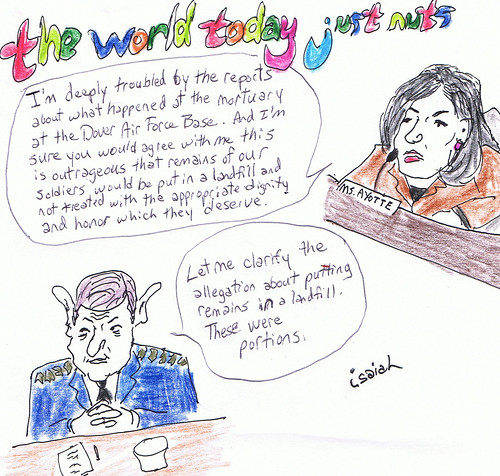
portions

It is not a humor comic. And we should all be appalled by the fact that (a) the remains of the fallen were dumped in a landfill, (b) that when whistle blowers raised the issue they were fired, and (c) while claiming he takes responsibility, Air Force General Schwartz Norton Schwartz (in the comic above) has yet to discipline those who punished the whistle blowers.

Alright. Solyndra. If you do not know what it is, you will in a second. This is from today's Diane Rehm Show (NPR -- link goes to transcript and you can also stream audio):

REHM10:13:54On Veterans Day, indeed, for all those who serve and have served our country. Let's turn to the question of Solyndra and what we have learned from the emails that were released by the House Energy and Commerce Committee that's investigating Solyndra. Sheryl.

STOLBERG10:14:18Well, the committee is investigating Solyndra, and this week, it released a package of emails. The Republicans on the committee are trying to show that an Obama donor, George Kaiser, tried to pull strings to get the loan that -- loan guarantees that went to Solyndra. Now...

REHM10:14:34535 million.

STOLBERG10:14:35Right. Now, Republicans on the committee say that these emails, which show some correspondence about this, prove that Kaiser was, in fact, pulling strings. Democrats say the emails don't show the whole story. They say that, in fact, George Kaiser sat next to Obama during a lengthy dinner in Las Vegas and the subject of these loans never even came up. So I guess what, you know, it depends on where you sit, you know, what it proved.

REHM10:15:06But is this...

STOLBERG10:15:07I will see next week. Steven Chu will testify...

REHM10:15:10Steven Chu, yeah.

STOLBERG10:15:10...on this. So there'll be more to come.


I thought that was a very fair and reasoned discussion (applause for Ms. Rehm and guest Sheryl Gay Stolberg); however, it continued bringing in Susan Page and Reid Wilson who seemed less interested in facts and more interest in fretting over Barack Obama. I believe it is called "the news round up" and not "Presidential glorification."

Remember Ms. Stolberg said she would wait to hear Mr. Chu's testimony? Well Patrick Reis (POLITICO) reports, "Months before Solyndra’s collapse, a former high-ranking official in President Barack Obama’s 2008 campaign called for Steven Chu’s ouster, saying the Energy secretary lacked the chops for turning green technology into green jobs." Maybe we will find out if Mr. Chu was aware of this. If he was, when he became aware of it. Bob King (POLITICO) reports:

White House and Solyndra officials spent weeks this spring discussing a forthcoming Washington Post investigation of President Barack Obama’s visits to clean-energy companies, according to internal administration emails released Friday afternoon.

The officials also repeatedly stressed that politics and campaign donations have nothing to do with decisions to send the president to companies like Solyndra, whose California factory Obama toured in May 2010.

And be sure to check out Darren Samuelsohn's report as well.


This is C.I.'s "Iraq snapshot" for today:

Friday, November 11, 2011. Chaos and violence continue, it's Veterans Day in the US, we examine a Senate hearing on whether or not the National Guard deserves a spot on the Joint-Chiefs, Exxon and the KRG get closer, Iraqiya switches its position on provinces becoming semi-autonomous, and more.
On this Veterans Day, the Pentagon finds itself in another scandal. Last night, David Martin (CBS Evening News with Scott Pelley -- link has text and video) reported on the Air Force's landfill scandal. Here's a transcript of the first minute of the report.

Scott Pelley: Just when you thought the scandal over mishandled remains of fallen American troops at Dover Air Force Base couldn't get any worse. It did today. David Martin has been reporting on the investigation that led to a career ending letter of reprimand for the commander of the mortuary and tonight David is at the Pentagon with new developments.

David Martin: A landfill is no one's idea of a fitting resting place for a soldier fallen in battle.

Gari-Lynn Smith: No service member, no human being at all, should be placed into a landfill -- no matter if it's a finger nail, a foot or an entire body

David Martin: Yet that is what happened to Gari-Lynn Smith's husband, Sgt 1st Class Scott Smith, who was blown apart by a roadside bomb in Iraq in 2006. Without her knowing part of his body was incinerated and disposed of as medical waste in this Virginia landfill. She found out two years after his funeral.

Gari-Lynn Smith: I have honestly no idea what we buried of him because they forbid me to see him in the casket.
The issue was raised by Senators Kelly Ayotte and Claire McCaskill in yesterday's Senate Armed Services Committee hearing. We noted the hearing in yesterday's snapshot in terms of Ayotte and McCaskill's remarks and questions on the disrespect shown to the remains of the fallen (Isaiah's The World Today Just Nuts "Portions" notes Ayotte's exchange). That was a needed topic and one more senators could have explored. But the topic of the hearing was whether or not the Chief of the National Guard should be a Joint-Chief of Staff.
Senator Lindsey Graham: Now, Mr. Johnson, headlines are made at every hearing. Is the headline from this hearing "Obama Administration Opposes Putting the National Guard Bureau Chief on the Joint-Chiefs"?
Defense Dept General Counsel Jeh Johnson: Uhm, uh, Senator, you've, uh, heard the best military advice from --
Senator Lindsey Graham: Well I'm going to tell you what Vice President [Joe] Biden said in 2008 when he spoke to the National Guard Conference in Baltimore, "It's time for change. Change begins with giving the Guard a seat at the table -- that table in the Pentagon where the Joint-Chiefs sit." President [Barack] Obama's campaign document, Blueprint for Change, page 55, if you want to read it, I haven't read it, I'll be the first one to admit to it, but this part I do like. Obama will restore the readyness of the National Guard and Reserves. He will permit them adequate time to train and rest between deployments, provide the National Guard with equipment they need for foreign and domestic emergencies. He will also give the Guard a seat at the table by making the Chief of the National Guard a member of the Joint-Chiefs of Staff." Has he changed his mind?
Defense Dept General Counsel Jeh Johnson: Uhm, the, uh, uh, not to my knowledge
Senator Lindsey Graham: Don't you think when he said that, he thought long and hard about this and he came to conclude as a prospective commander-in-chief this would be a good idea? And you're not here to tell us he's wrong, are you?
Defense Dept General Counsel Jeh Johnson: The president and the vice president are above my pay grade.
Appearing before the Committee was the Defense Dept's General Counsel Jeh Johnson --noted above -- as well as the Chair of the Joint Chiefs of Staff Gen Martin Dempsey, Vice Chair of the Joint Chiefs of Staff Adm James Winnefeld Jr., the Army Chief of Staff Gen Ray Odierno, Chief of Naval Operations Adm Jonathan W. Greenert, Commandant of the Marine Corps Gen Jame Amos, Chief of Staff of the Air Force Gen Norton Schwartz and the National Guard Bureau Chief Gen Craig McKinley. Senator Carl Levin is the Chair of the Senate Armed Services Committee. Senator Scott Brown is also an attorney with the Judge Advocate General's Corps of the Massachusetts Army National Guard.
Senator Scott Brown: I'm looking at a letter from General Amos and Chief Greenert. In paragraph three of the letter says that "CNGB does not represent a branch of service nor is CNGB responsible for manning and training and equipping the National Guard to the extent of the service chiefs." And I've got to respectfully disagree. Pursuant to the DoD directive as to the responsibilities of what the Guard in fact does, they are responsible for entire cradle to grave planning program budgeting and execution of these budgets. Provides the President's budget for each of the APPN, which goes to Congress, validates those requirements, provides the annual financial reports to Congress. It's in fact the service chiefs that don't have any of that budget responsibility. Is that -- Was there a mistatement in your letter there?
Gen James Amos: Well, senator, the point we were -- that I was making was making in the letter, we-we the service chiefs, testify to -- are held accountable to the Congress for the execution of those budgets as well. We have budget submitting offices -- pardon me -- in the Navy who do similarly that you just listed there.
Senator Scott Brown: But you said specifically, they have -- they have, they're not responsible at all. And, in fact, that's not correct. That being said, I'd like to just shift gears a little bit. Um, on -- Mr. Johnson, you indicated that you felt that maybe it would create confusion as to who represents the Army and Air Force and I've referenced letters -- General Odierno's "confusion and balance," obviously General Schwartz' confusing lines of authority and you, sir, Adm Greenert, complicated unity of command. I mean, it is really any question as to what the chain of command is with the Joint Chiefs? Obviously General McKinley would go through General Odierno and obviously General Schwartz to General Dempsy. There's no chain of command breach at all. I think it's very clear. And in addition to that, it would -- it would -- I don't think there's any question that the command authority, the Title X Command Authority wants to change. I don't believe the Guard or General McKinley in his capacity is seeking a seat wants to change that at all. He wants -- he wants -- and I believe, I don't -- I guess I'll just ask you, sir. You don't want to change the Title X Command Authority at all, do you?
Gen Craig McKinley: No, sir. As I said in my opening remarks, it's working well for us.
Senator Scott Brown: There's no confusions as to who you have to go through in the chain of command, is there?
Gen Craig McKinley: I-I-I have no confusion.
Senator Scott Brown: And with regard to the total force integration, do you feel that that would be benefitted by you having a seat at the table?
Gen Craig McKinley: It's improved greatly as the service chiefs have testified. It can only get better.
Senator Scott Brown: And is there any question that you in your capacity of having a seat at the table would be the person that could best advise not only in any capacity through any of the service chiefs or the president or anybody on the domestic mission and what the non-federalized units would be able to do? Espececially the homeland security issues that we're facing? Is there anyone else better quaified than you in your capacity to do that?
Gen Craig McKinley: Sir, I think it's my role and responsibility to be that person.
Senator Scott Brown: I would agree with you and just to follow up on what Senator Inhoff said, General Schwartz, on the fighter aircraft issue, is it a fair statement that due to the effort to save money with the Air Force, the Guard units are going to be eviscerated when it comes to aircraft. And especially, I've heard and others have commented that the TAGS can't gain access to the plans as to what wings will be effected and how many of the aircraft are going to be lost and isn't that another reason to have somebody like General McKinley at the table that can advise those TAGS and others what the plan is for the aircraft --
General Schwartz: Senator Brown, that's not a role of the Joint Chiefs, but beyond that, the reality is that if the Air National Guard is going to be eviscerated so will the active duty and the reserve. We are getting smaller together. That is what's underway here. And I would emphasize the point that -- that we are now the smallest Air Force that we've ever been and so -- And because of that, those reductions that occur because of diminishing resources -- which we all face -- will be shared by all the components.
Senator Scott Brown: Well you know that's interesting. You know, that is another reason why we all need to get back to the table and get this select committee to work so sequestration doesn't come in and dramatically effect this more.
Senator Kelly Ayotte noted that the record indicated that in 1978 the then Joint-Chiefs opposed the Commandant of the Marines becoming a member of the Joint-Chiefs of staff. Gen Amos agreed that the change had not hurt the Joint-Chiefs but stated he was not aware of the positions in 1978.
If there was a valid reason not to make the Chief of the National Guard, it wasn't expressed in the hearing by the witnesses. What they offered repeatedly came off as, "If someone else is promoted to our level, our level becomes less special for us." If all them together couldn't come up with one solid reason then either verbal skills are sorely lacking in military leadership or else there is no solid reason to deny it.
An important point: The Guard is not being used as it was in the last century. Under Bush the Guard became another unit of the military to be deployed to war overseas. If that's what the Guard now is, then, yes, they need to be represented in the Joint-Chiefs. Their role has changed and they suffer a tremendous burden and carry more than their weight. That largely went unsaid except for Senator Daniel Akaka who noted it and how it calls for some adjusments such as elevating "the Chief of the National Guard bureau to the Joint-Chiefs of Staff is something that is overdue and will show our guardsmen and their families that they are a true partner. It will also let them know that their voices and views will be represented at the highest levels of government."
Long before he became a senator, Lindsey Graham was serving in the Air Force and today he serves in the US Air Force Reserves and is a Senior Instructor at the Air Force JAG School.
Senator Lindsey Graham: General Amos, pound for pound, do you agree the Marine Corps is the best fighting force in the world?
Gen Jame Amos: Yes, sir. We celebrate that today on our birthday.
Senator Lindsey Graham: Okay. Good. I agree with you. Do you agree with me that the only thing older than the Marine Corps when it comes to defending America is the citizen-soldier?
Gen Jame Amos: Sir, I believe that's true.
Senator Lindsey Graham: Well okay. So I'm here to tell everybody I appreciate it but the citizen-soldiers' day has come. You're going to get a seat at the table, General McKinley, if I have anything to say about it. We're long into this fight as a nation. The first shot was fired by a citizen-soldier, it is time for the citizen-soldier to be sitting at the table -- not for political reasons, but for substantive reasons.
The most vocal opponent was Senator Jim Webb who had no real reason to explain why he opposed it today or why, when he was 25-years-old, he wrote an article expressing the belief that the National Guard should have a seat on the Joint-Chiefs.
In Iraq, things are heating up over an oil deal. Hassan Hafidh and James Herron (Wall St. Journal) report, "ExxonMobil Corp. could lose its current contract to develop the West Qurna oil field in Iraq if it proceeds with an agreement to explore for oil in the Kurdistan region of the country, an Iraqi official said. The spat highlights the political challenges for foreign companies operating in Iraq" as Nouri's Baghdad-based 'national' government attempts to rewrite the oil law over the objection of the Kurdistan Regional Government. Tom Bergin and Ahmed Rasheed (Reuters) offer, "Exxon declined to comment, and experts speculated the move could indicate Baghdad and the Kurdish leaders are nearing agreement on new rules for oil companies seeking to tap into Iraq's vast oil reserves." UPI declares, "The breakaway move into Kurdistan, the first by any of the oil majors operating in Iraq under 20-year production contract signed in 2009, could cost Exxon Mobil its stake in the giant West Qurna Phase One mega-oil field in southern Iraq." Salam Faraj (AFP) speaks with Abdelmahdi al-Amidi (in Iraq's Ministry of Oil) declares that the Exxon contract means that Exxon would lose a contract it had previously signed with Baghdad for the West Qurna-1 field. Faraj sketches out the deal with the KRG beginning last month with Exxon being notified that they had "48 hours to make a decision on investing in an oil field in the region." Exxon was interested but sought an okay from the Baghdad government only to be denied.
Nouri al-Maliki and the Kurdish politicians (with the exception of members of Goran) are in conflict and have been for some time now. Over the weekend, Al Mada noted that the country is in the midst of a political crisis with no end in sight. This is Political Stalemate II. Nouri's refusal to abide by the outcome of the election (Iraqiya, led by Ayad Allawi came in first; Nouri's State of Law slate came in second) and surrender the post of prime minister caused Political Stalemate I which only ended (November 2010) when the political blocs met up in Erbil and ironed out an agreement where everyone made concessions. This agreement is known as the Erbil Agreement. Upon all parties signing off, Parliament held their first real session in over eight months and Nouri was named prime minister-designate (Jalal Talabani would wait over a week to name him that 'officially' in order to give Nouri more time to put together a Cabinet.) Upon getting what he wanted, Nouri went on to trash the agreement. This is the start of Political Stalemate II which has continued since. The National Alliance, Iraqiya and the Kurdish politicians (except for Goran) have called for a return to the Erbil Agreement.
Among the things that Kurds want is to see the Constitution followed. The 2005 Constitution outlined how disputed regions would be settled: A census and a referendum. Nouri became prime minister in the spring of 2006. The Constitution called for the census and referendum to be held by the end of 2007. Nouri operated in violation of the Constitution and continues to do so. In the US, such an action could lead to impeachment. Kirkuk is an oil-rich region that's in dispute with both Baghdad's central government and the KRG claiming it. Another big concern for the Kurds was Nouri's recent effort to rewrite the oil law by proposing a new draft which would result in the KRG losing their claims on many oil fields. The Exxon back and forth today is only the latest in a string of back-and-forth volleys between the KRG and Nouri.
In addition to those conflicts, the KRG is also seeing the mountains in the north bombed by the Turkish military with the Turkish government insisting that they're only targeting the PKK -- a group of rebel Kurdish fighters created in response to the severe and historical disenfranchisement of Kurds within Turkey. Amar C. Bakshi (CNN -- link has text and video) interviews KRG Prime Minister Barham Salih:
Amar C. Bakshi: Let's switch gears to Turkey -- an important regional neighbor that over the past few months has intervened in northern Iraq to go after Kurdish nationalist forces who have used terror to kill Turkish soldiers, numerous civilians. Now is the Kurdistan Regional Government cooperating with Turkey in its interventions into northern Iraq?
Prime Minister Barham Salih: These issues cannot be solved by military means, these issues cannot be solved by violence. There has to be a political track. This initiative that the Turkish government has started, the democratization process, needs to be enhanced, deepend, in order to ensure that this long-standing conflict is resolved in a differnt way.
Today, Aswat al-Iraq reports, Iraqiya's Azhar al-Sheikhli announced Iraqiya has changed their position on the province issue stating that they "are not against federalism, but there are many questions on their implementation process." Does that mean Kirkuk? It might. But last week, Salahuddin Province set in motion, if the Constitution is followed (Article 119), the steps to become a semi-autonomous province like the three that make up the KRG. On the issue of Salahuddin Province, Aswat al-Iraq reports that Nouri and Salahuddin Province Governor Ahmed Abdulla al-Jbouri and Nouri stressed that there are so many 'dangers' while al-Jbouri stated "the declaration of Salah al-Din as a region has become a public demand and cannot stop it."
Aswat al-Iraq reports 1 Sahwa was killed in an attack in Diyala Province while a second attack left two Sahwa injured. Sahwa are also known as "Awakenings" or "Sons Of Iraq." The US government paid them to stop attacking US military equipment and soldiers. The Iraqi government was supposed to pick up the payments and did so slowly. They were also supposed to incorporate the Sahwa into government jobs -- security and non-security jobs; however, that hasn't happened. Instead, Nouri's targeted them with arrests, often paid them late and never issued a statement decrying any of the attacks on Sahwa. In related news, Mustafa Habib (niqash) interviews Iraq's Minister of National Reconciliation Amir al-Khuzaei:


NIQASH: The process of reconciliation has been criticised – some say that it's avoided putting the blame on certain parties – such as insurgent groups who carry out armed attacks - even though they may have engaged in criminal behaviour.


Al-Khuzaei: In our efforts to reconcile, we want to open up channels of communication with the insurgents and to negotiate with them. The government will pardon those who put down their arms to join in the reconciliation process. But this doesn't mean that the rights of ordinary Iraqi citizens are compromised. Reconciliation may be able to make compromises in the public interest. But it cannot compromise on individual rights.


NIQASH: Can you tell us more about the kinds of dialogue that you have been having with armed factions?


Al-Khuzaei: We have been engaged in a positive dialogue with some of the factions for whom Harith al-Dhari [head of the conservative and mostly anti-US and anti-Iraqi-government Association of Muslim Scholars, a mainly Sunni Muslim group] is a spokesperson. We have also been fully engaged with the [Sunni Muslim] 1920 Revolution Brigade, the [Sunni Muslim] Mujahideen Army, the [Sunni Muslim] Islamic Jihad Brigades and the [Sunni Muslim] Ansar al-Sunnah group in Diyala. Also [the Sunni Muslim armed group] al-Naqshbandia, [the Sunni Muslim armed group] Hamas Iraq and the [Shiite Muslim] League of the Righteous. The dialogue and the agreements we have come to differ from group to group. Some of them were made on a collective level, others were on an individual level. In terms of the latter, we've had members of armed groups approach us and say that they wanted to quit their armed activities and return to their ordinary lives. We have no objection to this -- in fact, we welcome it.

Alsumaria TV reports that yesterday in Baghdad, a sticky bombing claimed the life of 1 Ministry of Health employee. In Baghdad today, Aswat al-Iraq reports, "Hundreds of Electoral Authority employees demonstrated today in Firdous Square, mid Baghdad, demanding to be appointed in their full capacity, while other NGOs talked for next Friday demonstration. Aswat al-Iraq correspondent said that the demonstrators came from different provinces to demand that the martyrs of the Authority should be given their lawful privileges."


Alsumaria TV quotes a political analyst on the US and Iraq who states, "U.S. leaked through some of the media they would go to the Security Council to consider The Iraqi government is a competent and this allows again to return to Iraq and I think this Klha means of pressure, because America did not like its the issue of withdrawal. According to observers, the U.S. troops stay in the Gulf comes the desire of them fear for their own interests or fear of potential Iranian expansion, as well as standing desire of the United States to stay close to Iran in anticipation of launching a military strike after sunburn Israel to do so."
Again, today is Veterans Day in the US. Denise Goolsby (Desert Sun -- link has text and video) reports that 11 to 20% of veterans of the current Iraq and Afghanistan Wars "report suffering from" PTSD. One Iraq War veteran with PTSD is Justin Weathers. Matthew Renda (Union) reports:

Since his return stateside in 2004, Weathers often is unable to shake habits of vigilance he cultivated to stay alive while fighting in the town of Ramadi, often reported as the site of some of the Iraq war's most fierce fighting.
"If you stopped at a stoplight in Iraq, you were going to get shot at," said Weathers. "There was a lot of chaos; it was just … it was just hectic."
Weathers is currently in therapy in an attempt to manage the nightmarish memories and persistent symptoms of post-traumatic stress disorder that have continued since he first received his honorable discharge from the armed services.

There is also what military commanders have called the signature wound of the current wars, TBI -- Traumatic Brain Injury. Sgt Laura Todd is among the many with TBI. Colleen Flaherty (Killeen Daily Herald) reports:

"There was an explosion off the (base) and the concussion blast blew me off my feet," said Todd. She finished her deployment with the rest of 3rd Battalion, 82nd Field Artillery Regiment. "We just run on pure adrenaline." It was only upon returning home that Todd noticed something was wrong.
"I couldn't figure out which slot the fork went into in the drawer, or I couldn't (remember) how to tie my shoes, things like that," she said.

As with every war, there are also those who lost limbs, those who have had their hearing and/or vision harmed or lost, those who suffered burns and much more. On today's Fresh Air (NPR), Terry Gross spoke with journalist David Wood about some of the severely war wounded. Those who served in the war include the fallen and that's those killed while serving and those service members who took their own lives and veterans who took their own lives. Yesterday on The Diane Rehm's Show's first hour, Diane and her guests explored military suicides (link has audio and transcript). We noted that in yesterday's snapshot; however, the link was not included. My apologies.
Today's remembered also includes those who died of natural causes and those who died from wounds or exposures from the war zone which claimed their lives. Those dying from toxins they were exposed to while serving may have been around or worked the Burn Pits.
Iraq War veteran Leroy Torres and his wife Rose Torres work on the Burn Pit issue non-stop. Another person who does is Iraq War veteran and Afghanistan War veteran Daniel Meyer whose blog can be found here. This month the three of them and others have been working on lobbying for a Burn Pit Registry. Wednesday, Daniel Meyer reported:


Yes­ter­day, Novem­ber 8, 2011, BurnPits360 stormed capi­tol hill, kick­ing off a three day cam­paign. The sec­ond week in a row being in our nations capi­tol, this event dis­plays the ded­i­ca­tion and tenac­ity this great orga­ni­za­tion exudes in sup­port of vet­er­ans who have been neg­a­tively affected by toxic burn pits. It also comes just a few short days after the intro­duc­tion of the Open Air Burn Pits Reg­istry Act of 2011 by Con­gress­man Todd Akin -- R -- Missouri.


The burn pit issue is one that there should be strong support from Congress on. But there really hasn't been. When some -- then-US Senater Evan Bayh in 2009 and 2010, for example -- have attempted to lead on the issue by introducing a bill for an Iraq Burn Registry, others have refused to allow a bill out of committee. Milan Simoniah (Las Cruce) reports Iraq War veteran Master Sgt Jessey Baca is working on the issue:


Baca was the first veteran from New Mexico to publicly say burn pits were killing soldiers. He stood with the state's two U.S. senators last week after they introduced legislation to create a registry that would track veterans who were exposed to open burning and help them get medical treatment. America's military created the burn pits as a practical means to keep bases in Iraq and Afghanistan functional.
"They burn constantly to get rid of trash, metal, batteries, chemicals, human waste, plastics, paint. Contaminated jet fuel is used for the fire," Baca said one recent afternoon.

As awareness increases, we see efforts to minimize the realities of Burn Pits. Last week, the Institute of Medicine published a silly study researched by several people who depend upon government funding to finance their other studies. Even then, they couldn't come out and say there was no link between burn pits and serious damage to respiratory systems, forms of cancer, etc. The most they could offer was that further study was needed because they couldn't prove or disprove. J. Malcolm Garcia (The Investigative Fund) published a brilliant take-down of that 'study' today and he also noted:

Last year, long before the IOM report, the US government acknowledged the injurious effects of burn pits. According to a report released last year (PDF) by the United States Government Accountability Office, "burn pits help base commanders manage waste, but also produce smoke and harmful emissions that military and other health professionals believe may result in acute and chronic health effects to those exposed."

The VA states on its own webpage that chemicals, paint, medical and human waste, metals, aluminum, unexploded ordnance, munitions, and petroleum products among other toxic waste are destroyed in burn pits. Possible side effects, the department notes, "may affect the skin, eyes, respiration, kidneys, liver, nervous system, cardiovascular system, reproductive system, peripheral nervous system, and gastrointestinal tract."

So while further study may elicit more information about the effects of breathing burn pit fumes as well as the dust in Afghanistan and Iraq, the verdict appears to be in, and that is that the government knows that just breathing the air poses severe consequences to its soldiers.

It took decades for the Congress to get behind an Agent Orange Registry for veterans exposed while serving in Vietnam and surrounding areas. In 2009, then-US Senator Evan Bayh attempted to get the ball rolling on Burn Pit Registry hoping it would take far less time than the struggle for an Agent Orange Registry.
While veterans include more than just the veterans of today's current wars, our focus is Iraq and Luis Martinez and Amy Bingham (ABC News) provide some basic statistics on the veterans of today's Iraq and Afghanistan Wars.
Though returning to life outside of a war zone usually requires some readjustment, many service members and veterans are fortunate enough to return with no major physical, mental or emotional wounds. Many veterans are also furthering their education, some utilizing the Post-9/11 GI Bill. Kevin Fagan (San Francisco Chronicle) reports on Iraq War veteran, Staff Sgt Josh Aguilar who will be attending San Francisco City College next semester and explains, "I learned in the military that when you want to get something done, it's best to have a plan. So I have one, and at the same time I am open to everything." Iraq War veteran Chris Seaman is a college student and he shares his thoughts at the Drury Mirror:

There were crappy times when you realize how much you've got left over there, but overall it was good.
I learned the values of hard work, team work, and leadership.
One thing I'd like for people to know is that not all young enlisted servicemen are loud, MMA gear wearing douchebags, although most are.
We do not get wasted and have a grand ole time in Iraq and Afghanistan like some movies portray.
It really bothers me that a lot of people think we're just getting hammered and running around shooting camel spiders, of which I never saw a single one.
Community note: Wednesday night, Cedric and Wally did one of their usual funny joint-posts ("The Whiner In Chief" and "THIS JUST IN! BITCHY IS HOW HE ROLLS!") while others in the community posted on a theme of "The first time I felt like a grown up." The theme posts are Ann's "2 men, 2 women The first time I may have broken federal law," Betty's "The second time I got my period," Trina's "Parking," Rebecca's "that time i stole a watch from a teacher," Ruth's "My first cup of coffee in front of my parents," Kat's "My first time hosting the pot party," Marcia's "My first R-rated film," Stan's "My first big purchase," Elaine's "The first time I faced my issues" and Mike's "My first orgasm."
cbs evening news with scott pelley
david martin
the desert sun
denise goolsby
the union
matthew renda
the killeen daily herald
colleen flaherty
npr
fresh air
terry gross
the diane rehm show
the drury mirror
abc news
luis martinez

Thursday, November 10, 2011

Solyndra

Tom Cohen (CNN) reports that the White House states they will turn over some Solyndra documents to the House subcommittee investigating the loan to the company. Solyndra, if you have forgotten, was the green energy company whose big investor was a Barack Obama donor and bundler and who regularly visited the White House. The risky company received a half-billion dollar loan and went belly up a few months back leaving tax payers on the hook for the lost money.
Or as Tom Cohen puts it, "Solyndra received an Energy Department loan last year to build a factory in Fremont, California, that produced state-of-the-art solar panels. President Barack Obama had touted the company in a widely publicized visit after the loan guarantee came through."

And last week, while I was covering the Cain circus, Betty grabbed Solyndra. Thank you to her for that and be sure and read her posts on it if you have not already done so:

Today at the White House press briefing, ABC News' Jake Tapper raised the issue of Solyndra:


Q Jay, I was wondering if you could comment on, first of all, the White House refusal to comply with Republicans in Congress asking for all documents related to Solyndra to be turned over to them by noon today. Obviously that deadline was not met. And then also, Republicans in Congress are saying that some of the emails they have uncovered indicate that the White House has not been forthcoming about the conversations that those behind the Solyndra business have had with people at the White House. And I can cite those emails if you want, but I’m sure you’ve seen them.

MR. CARNEY: I have, thank you, Jake. I appreciate it. A couple of things. One, we have been enormously cooperative with legitimate oversight, in this area and others. In this investigation alone, we’ve turned over 85,000 pages of documents. And we will continue to cooperate with this committee investigation.

On the issue of the subpoena that you referenced, I don’t have anything to announce about any release made to the Hill yet, but I can say that, as the White House counsel made clear in her letter, this is something we view as overbroad, unnecessary.

And I think in my words, when something seems partisan it probably is, and in this case, when we hear the Speaker of the House saying that he will -- they will -- the Republicans -- be “relentless in pursuing this oversight investigation,” I think most American people wish they would be as relentless in taking measures to help the economy and create jobs as they are in trying to create a political issue out of something that is simply a policy decision, and policy decisions that were made on -- merit-based decisions out of the Department of Energy.

Q What about some of the items in the specific emails that --

MR. CARNEY: Let’s be clear: Republicans know -- what the episode in the last 24 hours shows I think reinforces the idea that this is becoming a political football and a partisan effort. They cherry-pick some documents and try to make hay out of something that, when looked at in its entirety, only reinforces what we’ve said, which is that there was no political influence in the decision-making progress -- process that led to the loan guarantee for Solyndra. In fact, the meeting that they’re referring to, as I’m sure you’re aware, took place almost a year after the loan was approved -- okay?

And Mr. Kaiser has said both I believe to committee members, both Republicans and Democrats, and in public, again, that he would not discuss the loan with members of this administration.

So, again, we have cooperated with legitimate oversight on this matter and others. We are now 85,000 pages into this process, nine committee staff briefings, four congressional hearings; the donor in question has been interviewed and the investors have released their documents. And this is what the Republicans could find. Again, at some point they have to focus I think on the things that the American people care about.

Q There’s an advisor that Kaiser quoted in one of the emails saying “The White House has offered to help in the past and we do have a contact at the White House that we are working with.” And Republicans are citing that as an example that --

MR. CARNEY: Well, again, this was a meeting that took place -- again, this was either emails from outside the administration; all of their review of emails from internally have produced none of this, of what they want to be there, and they have clearly been gravely disappointed by that. The meeting that is referenced here took place almost I think 11 months after the loan guarantee went out the door. And the donor in question here -- the investor in question here, Mr. Kaiser, has been explicitly clear about saying that he never discussed this loan with administration officials, White House officials.


And if you are wondering about the community posts, I have not forgotten them. I did forget Elaine's off on Thursdays. We will all note the posts (theme posts from last night) on Friday.


This is C.I.'s "Iraq snapshot" for today:

Thursday, November 10, 2011. Chaos and violence continue, the Washington Post reports remains of the fallen were dumped by the Air Force into a landfill, the Air Force Chief of Staff appears today at a Senate committee hearing but only two senators felt the need to bring the issue of the landfill with remains of the fallen up, arrests continue in Iraq, and more.
Today Jon Swaine (Telegraph of London) reports, "US Air Force officials admitted that from 2003 to 2008, body parts sent from war zones to Dover Air Force Base in Delaware were burned before being handed to a private contractor for disposal in Virginia. Family members of the dead troops were not aware of the practice, which emerged amid anger over earlier disclosures that remains were also lost and mishandled by mortuary officials at the base." Craig Whitlock and Greg Jaffe (Washington Post) broke the story: "Air Force officials acknowledged the practice Wednesday in response to inquiries from The Washington Post. [. . .] Asked if it was appropriate or dignified to incinerate troops' body parts and dispose of them in a landfill, [Lt Gen Darrell G.] Jones declined to answer directly." Julian E. Barnes (Wall Street Journal) adds, "The revelation that a landfill was used for the remains came a day after the Air Force released the results of an extensive investigation into complaints that body parts were lost in 2009 in at least two cases at the mortuary at Dover Air Force Base in Delaware, which handles the bodies of all service members killed in action oversees. The use of a landfill for some of the partial remains was not connected to the cases of missing body parts."
The issue was raised today in a Senate Armed Services Committee hearing into whether or not the Chief of the National Guard should be a Joint-Chief of Staff. Appearing before the Committee was the Defense Dept's General Counsel Jeh Johnson, Chair of the Joint Chiefs of Staff Gen Martin Dempsey, Vice Chair of the Joint Chiefs of Staff Adm James Winnefeld Jr., the Army Chief of Staff Gen Ray Odierno, Chief of Naval Operations Adm Jonathan W. Greenert, Commandant of the Marine Corps Gen Jame Amos, Chief of Staff of the Air Force Gen Norton Schwartz and the National Guard Bureau Chief Gen Craig McKinley. Senator Carl Levin is the Chair of the Senate Armed Services Committee.
In his opening remarks, Chair Levin noted, "I believe that this hearing is a first -- the first time that we have had every member of the Joint Chiefs of Staff at a single hearing. Each of them has appeared before us individually and in different combinations, but never all together." The plan was to cover the hearing in tomorrow's snapshot since tomorrow is Veterans Day. We're going to stick to that with the exception of the issue of remains of the fallen being dumped into landfills. A number of senators weren't present for this full Committee hearing.
Senator Kelly Ayotte: General Schwartz, on a different topic and I just feel the need to ask -- ask about this. Uhm, I'm deeply troubled by the reports about what happened at the mortuary at the Dover Air Force Base. And I'm sure you would agree with me this is outrageous that remains of our soldiers would be put in a landfill and not treated with the appropriate dignity and honor which they deserve. Can you tell me, uh, where we are with this? And how we're going to ensure that this never happens again? And, most importantly, that those who have participated in this outrage are going to be held accountable?
Gen Norton Schwartz: Senator Ayotte, first of all, let me clarify the allegation about putting remains in a landfill. These were portions, prior to 2008, which were sent away from the Dover mortuary to a funeral home for cremation -- which is an authorized method of dealing with remains, particularly those that are separated from the larger portions of remains returned to the family. After that, the results of the cremation came back to the mortuary were sent to a medical support company for incineration. So you had cremation, then incineration and it was at that point that this medical support organizations placed the residuals from that effort to a landfill. In 19 -- In 2008, the Air Force came to the conclusion that that was not the best way to deal with those remains and so it is now done in a traditional fashion of burial at sea. It has been that way since 2008. It will continue to be that way in the future and let me just conclude by saying the Secretary of the Air Force, Mike Donley [Secretary of the US Air Force] and I take personal responsibility for this. Our obligation is to treat our fallen with reverence and dignity and respect and to provide the best possible support and care for their families. That is our mission. The people who did not fulfill our expectations were disciplined and there's no doubt what our expectations are today.
Senator Kelly Ayotte: Well I -- General Schwartz, I appreciate your updating on that and, uh, when I think about the fact that we have Veterans Day tomorrow, this is so important, obviously, that we treat the remains of our fallen with dignity and respect and I know that you share that concern as well. And please know that members of this Committee will be there to support you in any way to make sure that the families know that we certainly won't allow this to happen again.
Let's examine Schwartz' statement.
Senator Ayotte, first of all, let me clarify the allegation about putting remains in a landfill. These were portions, prior to 2008, which were sent away from the Dover mortuary to a funeral home for cremation -- which is an authorized method of dealing with remains, particularly those that are separated from the larger portions of remains returned to the family. After that, the results of the cremation came back to the mortuary were sent to a medical support company for incineration. So you had cremation, then incineration and it was at that point that this medical support organizations placed the residuals from that effort to a landfill.
So remains were dumped in a landfill. You didn't clarify a damn thing, you did try to pretty up what happened and make it seem formal and dignified. Dumping ashes of the fallen into a landfill will never pass for "formal," "dignified" or "proper" unless that is in fact what the service member specifies for their remains in writing.
In 19 -- In 2008, the Air Force came to the conclusion that that was not the best way to deal with those remains and so it is now done in a traditional fashion of burial at sea. It has been that way since 2008.
What's the deal with 2008? In the next section, he'll note himself and Michael Donley and 2008 again. What's the deal?
Donley becomes Secretary of the Air Force October 17, 2008. Schwartz becomes Chief of Staff of the US Air Force in August 2008. The floating of 2008 repeatedly is an attempt to say, "This didn't happen under my watch or under Donley's." (The Washington Post reports the policy was changed in June 2008.)
It will continue to be that way in the future and let me just conclude by saying the Secretary of the Air Force, Mike Donley and I take personal responsibility for this. Our obligation is to treat our fallen with reverence and dignity and respect and to provide the best possible support and care for their families. That is our mission. The people who did not fulfill our expectations were disciplined and there's no doubt what our expectations are today.
If you take full responsibility, then you take full responsibility. I realize that Schwartz uttered those words on Tuesday as well. It seems to be his standard phrase that he thinks let's him off the hook.
But does it?
No, it doesn't. He may have come on board after the policy was changed but he was in charge when whistleblowers who stepped forward on the loss and damage to remains took place. Tuesday David Martin (CBS Evening News -- link has text and video) reported that three whistle blowers (Mary Ellen Spera, Bill Zwicharowski and James Parsons) had been subject to retaliation for coming forwarded with Zwicharowski being put on administrative leave and James Parsons being fired. Martin notes that they have their jobs today because "a federal office created to protect whistle blowers stepped in." That was under Schwartz watch. He takes responsibility?
Tom Bowman (NPR's Morning Edition -- link has text and audio) reported yesterday on Schwartz Tuesday remarks to the press including that the families who were given fallen remains -- partial remains -- due to body parts being 'misplaced,' would have been notified but that, due to the issue of the whistleblowers, they were unable to tell families per the Office of Special Counsel. From Bowman's report:
CAROLYN LERNER: That's patently false.
BOWMAN: Carolyn Lerner is the special counsel. She says her office urged Air Force lawyers back in March to talk with the families, and they did so again recently.
LERNER: We asked them again, why hadn't you notified them? Their response was that these families, some of them had blogs; they couldn't be trusted - that they might go to the media.
BOWMAN: The special counsel's report, which is now with the White House and Capitol Hill, says the Air Force is still unwilling to acknowledge culpability.
You didn't notify the families? And you lied about why you didn't? Or, to be kind, you didn't actually know why you didn't? And you're claiming you take responsibility? Seems like you need to be out the door right now to demonstrate that there is accountability. I'm thinking back on US House Rep Phil Roe who is a doctor and a hearing about the Miami VA Medical Center (the October 12th House Veterans Affairs Committee hearing covered in the October 20th snapshot) and it's failure to contact service members potentially exposed to diseases while receiving care due to the medical center's lack of proper care of medical instruments. Dr. Roe was appalled to find out that calls weren't made. He talked about how he made mistakes in his practice and when he did he picked up the phone himself as the director of the Miami VA Medical Center should have done. Roe has spoken of this in other hearings as well. If Schwartz had appeared before the House Veterans Affairs Committee, it would be very likely that, based on past Committee record,
US House Rep Phil Roe would have raised that issue and pursued it.
Today one senator did bother to raise it. In doing so, she became on the second senator in the hearing to note the disrespect for the remains of the fallen. Yes, both times it was women who had to do the heavy lifting in the hearing.
Senator Claire McCaskill: I want to specifically, for a minute, General Schwartz, go to the situation at Dover and I don't want to dwell on how hard this has to be for you and the leadership at the Air Force. No one needs to convince me that you want to get this right at Dover. I'll tell you what I do want to bring to your attention and I've did so with a letter today and that is with the finding of the Office of Special Counsel. And so people understand what the Office of Special Counsel is. It's an investigatory and prosecution oriented agency whose primary responsibility under our law is to be independent of all of the agencies and protect whistle blowers. And what I am concerned about is their investigation into what the Air Force did in response to the whistle blowers. And specifically the fact that the IG of the Air Force, they failed to admit wrong doing in their report. And while I understand people have been moved around as a result of the problems that have occured because of mishandling of the sacred remains of the fallen, I'm not sure that they have been held as accountable as what we saw happen at Arlington in connection with that heart breaking incompetence. And what I want to make sure is that there is an independent investigation as to whether or not the IG shaded it a little bit [Chair Carl Levin began nodding his head in vigrous agreement with what McCaskill was saying] because everyone was feeling a little bit protective of the institution for all the right reasons. The vast majority of the people who serve at Dover and who do this work, I'm sure, do it with a heavy heart but with a passion for getting it right. But when we have a circumstance like this arise, I want to make sure the Inspector Generals are not so busy looking after the institution that they fail to point out wrong doing -- which was not ever acknowledged -- and that there is accountability for the people involved. And so, I want you to address the Special Counsel's report as it relates to the Air Force investigation.
Gen Norton Schwartz: Senator McCaskill, there was -- There were -- Clearly were unacceptable mistakes made. Whether they constitute wrong doing is another matter entirely. And when you look at a situation like this, you look at the facts of a case, as an attorney might say. You look at the context in which the event or the mistakes occurred. And you also consider the demands that are -- are placed on individuals and-and organizations. With respect to accountability, we also had an obligation to ensure that the statutory requirements for Due Process were followed. We did that precisely. I can only speak for the case of the uniformed officer. But the uniformed officer received a letter of reprimand. We established an unfavorable information file. We removed him from the command list and his anticipated job as a group commander at Shaw Air Force Base was red-lined. This is not a trivial sanction.
Senator Claire McCaskill: Well I - I understand that's not a trivial sanction but I-I-I'm worried that there was a conclusion that there was not an obligation to notify the families in these instances and obviously this deals with more than uniform personnel and obviously the Secretary of the Air Force is also copied on the letter that I sent today calling for this independent investigation. What happened at Arlington, nobody was intentionally mismarking graves. They were mistakes too. And I just want to make sure that we have really clear eyes while we have full hearts about the right aggressive need for investigations by Inspector Generals in circumstances like this. And thank you very much and thank all of you for being here today.
McCaskill's call for an independent investigation has been picked up by the head of the Department and Charles Hoskinson (POLITICO) explains US Secretary of Defense Leon Panetta has stated, "None of us will be satisfied until we have proven to the families of our fallen heroes that we have taken every step necessary to protect the honor and dignity [of the fallens' remains]. This department has to be fully accountable in what we intend to deliver on this matter."
Disclosure: I know and like Leon Panetta. How he handles this will reflect on his tenure as Secretary of Defense and should. And whether or not the sexual assault rate within the ranks drops is also a part of how his tenure should be graded. But Leon's only been in this position since the summer. Is anyone going to go back and 'regrade' Robert Gates who was Defense Secretary during this? No. Of course not, they didn't grade him the first time, they just praised him and -- judging by the off-the-record photo-op we covered here in real time -- they praised him for all the interviews and access he gave them. The military sexual assualt rate did not decline despite his telling Congress over and over that he was taking the issue seriously and addressing it. The military suicide rate did not show a significant drop. Somehow on his Never Ending Farewell Tour, Gates managed to pick up non-stop press about what a 'great' job he'd done with no one ever stopping to actually grade him on what his job was. I like Leon, but when he's done serving as the Defense Secretary, the press doesn't need to gush. They need to grade. If he's done a great job, praise him. That's fine. But if he hasn't accomplished anything on the suicide rate or the sexual assault rate, then he hasn't done his job. Gates granting the press access didn't stop one military suicide or one military sexual assault.
Let's stay with the issue of military suicide because Diane Rehm explored it and veteran suicide on the first hour of The Diane Rehm Show (NPR -- link has audio and transcript options -- transcript is provided by the program for free, accessible to all who can surf the web and not just those who can benefit from streaming audio). Her guests were Give An Hour's Barbara van Dahlen, RAND's Rajeev Ramchand, VA's Jan Kemp and DC's Dept of Mental Health's Elspeth Cameron Ritchie. Excerpt.
Diane Rehm: Elspeth Ritchie, talk about the risk factors in the military and for veterans. Are they different from the risk factors in the general population?
Elspeth Ritchie: Yes, absolutely. As you know, Diane, I retired from the Army last year and -- after spending 28 years in the Army and looked very closely at risk factors for especially Army soldiers. And we published a paper recently on the prevalence and risk factors associated with Army suicides. And, basically, Army suicides are very different from the suicides in the civilian population. In the civilian population, it is usually people with psychiatric disease who are prone to kill themselves. In the Army, the risk factors are pretty simple: the breakup of a relationship, and they are also getting in trouble at work and having a legal problem. And in the Army, if you have a legal problem, you have an occupational problem. And what we've seen over time is that these precipitants -- often very humiliating events are what precipitate a suicide. The other thing that's very important to talk about, and people don't in general, is that about 70 percent of Army suicides are committed by gun, by either the personal weapon back here or the service weapon in theater. And I believe that we don't do nearly enough discussion about how dangerous it is to have the -- what I call the gun in the nightstand, the easily available gun there at a time when you might be having a fight with your wife or just found out that you're going to get in trouble.
Diane Rehm: Now, as I understand it, a third of all suicides in the military are among those who have yet to deploy. What are the factors at work there?
Elspeth Ritchie: What I believe is the most important factor there is not the individual deployment history, but the unit deployment history. So our bases with the highest, what we call up tempo, operations tempo are also those with essentially the highest suicide rate. So where we've had a high suicide rate for a number of years: Fort Carson, Fort Stewart, Fort -- not Fort Bragg so much anymore, Fort Campbell, Fort Riley. Those are all bases, and others, where the troops are constantly coming and going. And what the leaders told me, when we went down to investigate suicides, is they don't know their troops anymore 'cause they're just so busy. They get back from theater, and, shortly after that, they're going to different deployments or different schools or different units. And so the new kid who comes in, that in the old days were being integrated with picnics and barbeques and unit runs, now isn't integrated in the same way 'cause it's just going so quickly.
The Veterans Crisis Hotline is 1-800-273-8255. That is the same number that active duty service members will be referred to. And we'll also note one of Diane's callers from today's program, Deb:
Yes, Diane. I'm calling because I feel like the suicide problem in the military extends beyond the soldiers, to the families of the soldiers, specifically in our family. My husband's son was killed in Afghanistan a number of years ago. And this morning, we just came back from a counseling session through the VA. And I can't tell you how many times I have had concerns for my husband's safety. And I think that the problem right now is there's a ripple in a pond. And when a soldier is either wounded or killed, it not only affects the soldier but all of those in his circle who love him.
Moving to Iraq, Azzaman reports Joe Biden, US Vice president, is expected to discuss a number of issues with Nouri al-Maliki, prime minister and thug of the occupation, when he visits Iraq and notes he met over the weekend in DC with the KRG's Prime Minister Barham Salih. Dar Addustour is an Iraqi paper in Arabic. On their home page they have a poll currently asking whether Iraq should grant US troops immunity after December 31, 2011. The results? 55% (746 votes) have said yes. It's not a scientific poll, it's not in any way limited to Iraqis. But it is surprising that one of Iraq's leading papers would have a poll on that topic and get that sort of result. Yes, a small tiny group -- even one outside Iraq -- could skew the poll. But so could a group on the other side and the percentages really aren't changing this week -- the poll's been up all week and, in fact, went up last week. In other news, Michelle Tan (Army Times) reports:

Soldiers from 1st Brigade Combat Team, 1st Cavalry Division have been "remissioned" and will move from Iraq to Kuwait for the remainder of their 12-month tour, the brigade commander announced Wednesday.
The announcement from Col. Scott Efflandt was posted on the unit's Facebook page.
"Troops and families of the 1st Brigade, 1st Cavalry Division are being notified that [the unit] will likely be repositioned within the [Central Command] area of responsibility for the remainder of their 12-month deployment," according to Efflandt's note. "This force will function as a reserve in the region to provide maximum flexibility for response to contingencies. It also demonstrates our lasting commitment to regional stability and security, and the robust security relationships we maintain with our regional partners."


Tan explains that the White House is working to secure a deal to use Kuwait as a staging platform for several thousand US troops. Meanwhile, UPI notes the CIA's not leaving Iraq, "The Central Intelligence Agency, which until recently operated outside the military establishment, is expected to stay on in various guises within the 17,000 U.S. personnel who will remain under State Department jurisdiction." Walter Pincus (Washington Post) addressed yesterday how the US government will be using security contractors in Iraq: "The latest example comes from the Army, which said in a recent notice that it has increased the number of contracted security teams hired to escort convoys of food and fuel coming in from Kuwait." And this use of contractors is happening while the State Dept refuses to present Congress or the SIGIR with any hard numbers or other facts leaving the American tax payer at risk of more tax dollars wasted on corruption and graft. And at a time when the Commission on Wartime Contracting -- whose salaries were paid for by US tax payers -- had declared it's not sharing its work. From the October 4th snapshot:

Over the weekend, Nathan Hodge (Wall St. Journal) reported on the Commission on Wartime Contracting in Iraq and Afghanistan, "The internal records of a congressionally mandated panel that reported staggering estimates of wasteful U.S. wartime spending will remain sealed to the public until 2031, officials confirmed, as the panel closed its doors on Friday." They've finished their study and they've closed their books. And, if you were at the hearing today, you learned just how wrong that is as Co-Chair Shays waived around the Commission's published findings and declared, "Our problem with Mr. Tieffer was that this book would have been three times as thick if we'd let him put in everything he wanted to put in so we limited him to 40 cases. But it could have been many more."
Great, so US tax payer money went down the drain again. The Commission unearthed tons of things but decided just to publish 40 of them. Because they didn't want their book to be too thick.
Right. We covered the Commission's public hearings. It was always a waste of time which describe the Commission itself and those members of Congress that pushed for it. The only value the Commission could have had was in making public its records now while the wars continue in the hopes that contract waste and abuse could be caught and some money saved. However, that's not going to happen with the Commisson's records being sealed and the published report only focusing on a small number of cases of fraud and abuse. As noted before, the Commission's purpose was never to find fraud and abuse. The purpose was to distract outraged Americans from what was being done with their money. The Commission had no powers. No charges have been filed over fraud. The Commission has wrapped up their business.

Erik Slavin (Stars and Stripes) reports today:

Two U.S. senators slammed a request by the Commission on Wartime Contracting in Iraq and Afghanistan to seal its records for 20 years and called on higher officials to publicly release them, according to a statement released Thursday.
Sen. Jim Webb, D-Va., and Sen. Claire McCaskill, D-Mo., co-signed a Nov. 7 letter to Archivist of the United States David S. Ferriero calling on him to overrule the commission's request, which would effectively prevent the public from learning the details of an investigation into a massive misuse of taxpayer dollars.

AP adds, "Webb and McCaskill sponsored the legislation that created the commission." And it should be noted that the intent was not for the commission to be a private study group fiercely guarding their findings. The intent was for it to be open and for it to provide resources allowing for lessons to be learned. Writing for Jordan's As-Sabeel, the Washington Institute's Michael Knights estimates the US State Dept will be using approximately 14,000 contractors and that as many as 5,000 of those will be armed security contractors. So this will be a large number and, the weaponization of diplomacy being a new thing, the State Dept has no training in this area. Knights also notes that the Defense Dept will provide 157 personnel (in addition to the 763 contractors) to the Office of Security Cooperation-Iraq and that in Defense Dept personnel (military or civilian) would be covered with immunity via the Vienna Convention on Diplomatic Relations -- and that this is agreed to by Nouri al-Maliki who was pushing for this understanding when there was talk of 200 to 300 US forces staying in Iraq beyond 2011. And on why an immunity deal wasn't reachable (so far at least), Omar (Iraq The Model) offered this argument at the start of last month:
The cause of this deadlock is rooted in the disagreements on power, land and money. All the Iraqi political leaders (except the Sadrists) are willing to vote in favor of immunity, but they will not give this to PM Maliki for free. Specifically, Iraqiya wants the Policies Council and Defense Ministry, while the Kurdistani Alliance wants a friendly oil and gas law [there is coordination on this issue with Iraqiya to reach a mutually accepted draft] and, eventually, some progress on disputed territories. If the Kurds and Iraqiya get these some of these demands, they will support Maliki's request for parliament to give immunity to US troops.
Aswat al-Iraq reports that Dr. Hom al-Khishaly, Iraqi Army Doctor, is being held in Diyala Province as a 'terrorism' suspect. Basaer News notes that Nouri's security forces have arrested over 1,000 Iraqi citizens in the last month. The Association of Muslim Scholars notes that many were arbitrary with the most arrests taking place in Diyala Province (277) and Nineveh having the second highest arrest rate (163).