
The selfie. I love it. And he really is the Lucy Ricardo of politics. Only he is not as sweet and charming as Lucy is.
At No Quarter, Larry Johnson notes a New York Times article which reports:
Many in New York’s professional and cultural elite have long supported President Obama’s health care plan. But now, to their surprise, thousands of writers, opera singers, music teachers, photographers, doctors, lawyers and others are learning that their health insurance plans are being canceled and they may have to pay more to get comparable coverage, if they can find it.
They are part of an unusual, informal health insurance system that has developed in New York, in which independent practitioners were able to get lower insurance rates through group plans, typically set up by their professional associations or chambers of commerce. That allowed them to avoid the sky-high rates in New York’s individual insurance market, historically among the most expensive in the country.
But under the Affordable Care Act, they will be treated as individuals, responsible for their own insurance policies. For many of them, that is likely to mean they will no longer have access to a wide network of doctors and a range of plans tailored to their needs. And many of them are finding that if they want to keep their premiums from rising, they will have to accept higher deductible and co-pay costs or inferior coverage.
I am not laughing at the people the paper is reporting on; however, I am not feeling sorry for them.
They pimped ObamaCare, they shouted people down.
We needed universal, single-payer health care.
You do that not by creating a program that makes the insurance industry rich, you do it by expanding the existing program of Medicare so that it covers everyone.
But President Barack Obama did not want to do that. (Nor did former President Bill Clinton when his program was being proposed in the 90s.)
And people should have been demanding it. Instead, the people like the one the paper reports on were attacking those of us who saw ObamaCare as a corporatist give away.
So now it effects them. Now they find out that the inexpensive insurance they had is gone.
Actions have consequences.
Too bad for them. I am not laughing at them but I feel no sympathy nor pity.
This is C.I.'s "Iraq snapshot" for today:
Monday, December 16, 2013. Chaos and violence continue, bold attacks
include seizing a municipal building and a police building, another
journalist is murdered in Iraq over the weekend, the US Congress is --
and has been -- on to Nouri, we explore how the knowledge that Nouri is a
thug is a bi-partisan awareness, and more.
"Jail breaks, massive suicide attacks and assassinations are the norm. Not since 2008 has it been this bad," declared US House Rep Ted Poe declared last week of Iraq (in a Congressional hearing we'll note later in this snapshot). And those two sentences are even more true today as a series of spectacular attacks slammed Iraq leaving many dead and injured. Russia Today reports 70 dead from the violence. Deutsche Welle observes, "This has been the worst year in terms of violence that Iraq has seen since 2007, when sectarian violence pushed the country to the brink of civil war. United Nations figures put the death toll from November alone at 659. More than 6,000 have been killed since the start of 2013." BBC News offers, "Correspondents say the attacks show how insurgents are now targeting symbols of government authority on a near daily basis." AP called today "the bloodiest day in violence in Iraq in nearly two months."
Malcolm Fraser, Prime Minister of Australia from 1975 to 1983, Tweeted:
All Iraq News notes suicide bombers took control of the Beiji police station -- 2 blew themselves up at the gates and 2 more entered the police station and took control of it. National Iraqi News Agency reports 7 police officers were killed and four more were injured in the initial attacks. In the process, All Iraq News notes, all prisoners being held at the police station were freed. However, Ghazwan Hassan (Reuters) quotes Major Salih al-Qaisi stating, "We believe the attack was aimed at freeing detainees who are being held in the building next door. All the militants were killed before they reached the police department building where the detainees are held." NINA adds that "security forces stormed the police station and killed the two suicide bombers who were inside." Alsumaria reports a curfew has been imposed upon the city.
Also NINA notes assailants in "military uniforms stormed the building of the Municipal Council in the center of Tikrit" using a car bombing as the initial assault. Alsumaria states the bombing was near the building and, following it, the municipal building was stormed. All Iraq News has two suicide bombers detonating in the building. NINA states security forces stormed the building killing all the assailants and freeing the hostages. EFE reports, "A city official, two police officers and three of the attackers died in the assault on Tikrit's city hall, a police spokesman told Efe." Al-Shorfa explains the city official was "local council member Hamid al-Ujaily" and that four of his bodyguards were injured while 1 was killed. AFP notes, "Security forces also ordered all government employees in the city, including teachers, to go home for the day."
In addition, National Iraqi News Agency reports 7 people were shot dead in Mosul, a Falluja armed attack left 1 police officer dead and another injured, a central Baghdad bombing (Nahda area) claimed 1 life and left five more people injured, a Falluja suicide car bomber took his own life and the lives of 2 police officers plus five more people were injured, an armed attack in Baghdad left one employee of the City of Baghdad injured, a Baghdad car bombign (Jisr, "south of the capital") left twenty-five people injured, and a Baghdad car bombing (Bayaa area) left eight people injured. Alsumaria reports the main checkpoint at the entrance to Anbar Province from Baghdad was attacked leaving 1 Iraqi military officer dead and four Iraqi soldiers injured. Russia Today reports, "Earlier on Monday, Gunmen opened fire on a bus in the northern city of Mosul, killing 11 and wounding eight. The bus was carrying a group of Shiite pilgrims to Karbala." Mohammed Tawfeeq (CNN) reports, "In Baghdad, at least 27 people were killed and more than 50 wounded when two car bombs exploded in quick succession near a procession of pilgrims making their way by foot to Karbala for the annual commemoration of the seventh century death of their Imam Hussein, a memorial called the Arbaeen."
Iraq Body Count notes 27 violent deaths on Sunday and, through Sunday, 475 people died from violence so far this month. Yesterday's violence included the murder of another journalist. Press TV notes, "According to local media reports, Nawras al-Nuaimi was shot on Sunday near her home in the Iraqi city of Mosul. She was the fifth journalist killed in the violence-hit city since October." Mu Xuequan (Xinhua) reports:
Nawras al-Nuaimi, 20, got several shots in the head when gunmen opened fire on her near her house in al-Jazaair neighborhood in eastern Mosul, some 400 km north of the Iraqi capital of Baghdad, the source told Xinhua.
Nuaimi has been working as a presenter of TV programs in the local Mosuliyah channel for five years, he said, adding that she was the fourth journalist killed in Mosul since October and the 51st in Nineveh province since the U.S.-led invasion in 2003.
She may actually have been 19 -- Al Rafidayn reports she was born in 1994. AFP adds that six journalists have been killed in Iraq since October (with five in Mosul) and notes, "On December 5, Kawa Germyani, the editor-in-chief of the news website Rayel and a correspondent for the Kurdish- language newspaper Awene , was killed outside his home in town of Kalar, south of the Kurdish Iraqi city of Sulaymaniyah, the Committee to Protect Journalists said."
Reporters Without Borders issued a statement today which included:
Last week, journalist Kawa Ahmed Germyani was shot dead in Mosul. As was her case then, so it is now, Jane Arraf (Christian Science Monitor and Al Jazeera) couldn't be bothered noting the deaths of Iraqi journalists in Iraq but let one be killed in Syria and Jane takes to Twitter to express her horror. It's a funny sort concern for journalists that never includes those within the borders of Iraq. AFP isn't being silent about the assassinations and reported on the latest assassination:
"I had to change my place of residence in Mosul and remain at my (new) home without leaving, after the killings that affected a number of my colleagues," said journalist Salim Fadhel, 30.
"My colleagues left Mosul for the Kurdistan region with their families, or for outside Iraq," Fadhel said, referring to the autonomous three-province region of northern Iraq where attacks are relatively rare compared to the rest of the country.
"There is a rumour in Mosul saying that armed groups issued a list of names of 40 journalists who will be eliminated by them," Fadhel added.
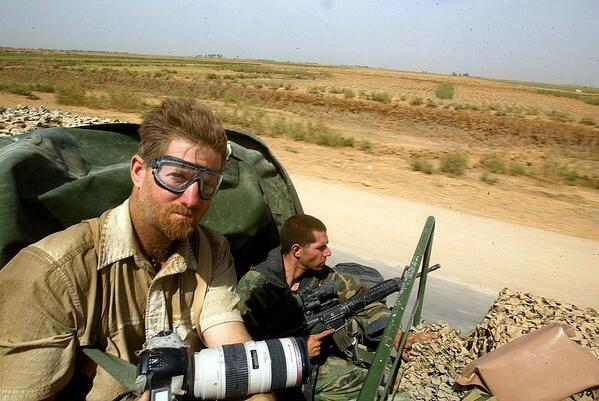
On the topics of Iraq and journalism, LA Times Photography Tweeted:
Staying with Tweets, this is the sort of incident that the western press repeatedly ignores:
And it's why the violence is so bad, incidents like that. This is the consensus the western media works to keep from you. They can yack forever about 'al Qaeda in Iraq' but they can't tell you about how Nouri al-Maliki, prime minister and chief thug of Iraq, brings on the violence.
It is the consensus. It's the consensus in the US Congress, it's the consensus among think tanks and NGOs. For example, Human Rights Watch's Kenneth Roth Tweeted the following today:
#Iraq PM Maliki's increasingly sectarian way of governing has helped to fuel the country's radical Sunni insurgency. http://trib.al/the0S4U
The western press whores themselves out repeatedly.
That's why Nouri is in power right now. He didn't get a second term from the voters, they didn't go for him which is why his State of Law came in second in the 2010 parliamentary elections. The White House gave him the second term in 2010. And Iraq has suffered ever since.
Here's the Brookings Institution's Kenneth M. Pollack:
The problems began after Iraq's 2010 national elections. The elections themselves were wonderful -- the best yet. Iraqis voted overwhelmingly for Ayad Allawi’s mostly-Sunni Iraqiya and Maliki's overwhelmingly Shi'a State of Law coalitions, the two groups seen as most secular, least sectarian and least tied to the militias. Of the two, Iraqiya garnered slightly more votes. But Maliki refused to believe that he had lost, insisting that the vote had been rigged (perhaps by the Americans, his aides claimed) and refusing to allow Allawi to take the first turn at forming a government. Then he pressured Iraq's high court to rule that he could get the first shot at forming a government, which deadlocked the entire political system. And the United States (and the UN) went along and said nothing. Rather than insist that Allawi be given the first chance, as is customary in most democracies and as was clearly what was best for Iraqi democracy. The U.S. did nothing. Ten months of political backstabbing followed, and in the end, the Iranians forced Moqtada al-Sadr to back Maliki, uniting the Shi'a behind him. At that point, the Kurds fell into place, believing that the prime minister had to be a Shi'a, and Iraqiya's chances were finished. It was also a defeat for Iraqi democracy. The message that it sent to Iraq's people and politicians alike was that the United States under the new Obama Administration was no longer going to enforce the rules of the democratic road. Washington was not going to insist that the will of the people win out. America was willing to step aside and allow Iraq's traditional political culture of pay-offs, log-rolling, threats and violence to re-emerge to determine who would rule the country. It undermined the reform of Iraqi politics and resurrected the specter of the failed state.
Pollack leaves a lot out in the above but you'll note that he does begin to put some blame on the White House. They can't escape it forever. And the best thing about the blame? It may mean the White House can't steal the 2014 election (supposed to take place April 30th) for Nouri this go round -- or at least not without getting called out.
We're playing catch up with Pollack. Last week's "Leahy: In any country, this legal interpretation is extraordinary" covered the Senate Judicial Committee hearing, the "Iraq snapshot" on the 12th covered the
Senate Veterans Affairs Committee hearing and the "Iraq snapshot" for the 13th covered US Secretary of State John Kerry appearing before the House Foreign Affairs Committee.
We've got one more hearing to report on from last week. Thursday, December 12th, there was a joint hearing held by the House Foreign Affairs Subcommittee on Terrorism, Nonproliferation and Trade and the Subcommittee on the Middle East and North Africa. For the first Subcommittee, the Chair is Ted Poe and the Ranking Member is Howard Berman. US House Rep Ileana Ros-Lehtinen is the Chair of the second Subcommittee and US House Rep Ted Deutch is the Ranking Member.
The topic was al Qaeda in Iraq. We may explore that identification in another snapshot. For now, we'll just note Pollack on the term:
Nevertheless, it is also important to recognize that AQI was actually only one of many Sunni insurgent/terrorist/militia groups operating in Iraq against the Shi'a, the Americans and to a lesser extent, the Kurds. At the height of Iraq’s civil war, dozens of groups like the 1920s Revolution Brigade, Ansar al-Sunnah, Jaysh al-Muhammad and Jaysh Rijal al-Tariqa Naqshbandia (JRTN). Many, but not all, of these groups embraced the same Salafist theology as AQI, but all of them espoused the same virulent Sunni chauvinism. To a considerable extent, we have come to use the term "AQI" as a shorthand term describing a wider range of violent Sunni extremist groups.
Appearing before the two Subcommittees were Pollack, Jessica D. Lewis (Institute for the Study of War), Michael Knights (Washington Institute for Near East Policy and Daniel Byman (professor in the Security Studies Program at Georgetown University).
We're going to note the hearing in at least two snapshots. Since the topic was Iraq, we may end up doing more coverage of it than just two snapshots.
Congress was highly resistant to Nouri al-Maliki when he met with them in the last week of October. (Friday, November 1st, he went to the White House and met with US President Barack Obama.) They're resistant because they know Nouri's a thug.
They don't have to whore like Jane Arraf and other reporters do.
We're very critical of John Kerry's failures with regards to Iraq. So much so that some e-mails complain about how Hillary got a pass. I think you need to look at the reporting in January on Hillary's testimony to Congress before you argue Hillary got a pass.
In terms of Iraq, Hillary wasn't over it. We noted that in real time. US Vice President Joe Biden was supposed to be in charge but he really couldn't go around War Hawk Samantha Power either (Power argued the White House had to give Nouri a second term -- Barack went along with her).
One good reason for Hillary not being over Iraq and for her making only one visit to the country? Nouri al-Maliki hates her. He hates most women, true. But Hillary talked what a thug and criminal he was in an April 2008 Senate hearing. Nouri never forgot. Now Biden made similar comments but spread out over time. He's also a man so Nouri's more likely to go meek.
It is not just Democrats or just Republicans that know Nouri's a thug, an abuser of human rights, a criminal. This is known in both parties of Congress. And when I note that here, someone wants to whine that that's just not true. Like Senator Barbara Boxer's public remarks indicting Nouri have vanished?
From Thursday's hearing, we're first going to note two statements on Nouri.
Subcommittee Chair Ted Poe is a Republican. We don't usually note party i.d. -- there are already enough harsh divisions in this country. But to make sure everyone gets that both parties know Nouri is a thug and a menace, we're going to do two party i.d.s.
Subcommittee Chair Ted Poe: Now he wants some help once again. He talks out of both sides of his mouth while trying to cozy up to the United States, he cozies up to the Iranians at the same time. Prime Minister Maliki came here dragging the sack in November wanting more tax payer money. He wanted attack helicopters and all sorts of advanced equipment. But is that what he needs to go after al Qaeda? Does he have other reasons for wanting that equipment? Maliki has centralized power. alienated the Sunnis, brought back the Shi'ite hit squads. This in part has allowed al Qaeda to return to be back in Iraq. What Maliki needs is a new strategy to fight al Qaeda. This includes doing a better job of reaching out to the Sunni population so that they feel that Maliki represents all Iraqis, not just one group.
Alright. Ranking Member Brad Sherman is a Democrat. What does he think of Nouri?
Ranking Member Brad Sherman: And he wants American weapons. And his biggest argument is that we should give him American weapons because his enemies hate us. The problem is, his friends hate us too. And his friends in Tehran are more dangerous to us than his enemies in Falluja. Now Maliki's argument goes something like this: He holds office today solely as a result of various actions taken by the United States -- some of which were mistakes. And so therefore he is our product and therefore we have to protect him and do whatever he wants. And so therefore he is one of the good guys no matter who he allies himself with today. The fact is, his allegiance to Tehran is only a little bit less than Assad's allegiance to Tehran. But Maliki's government goes something like this: Since he has been the beneficiary of a series of American mistakes in the past, we have a legal duty to continue to make mistakes on his behalf in the future. Uhm, if we're going to provide him with weapons, there ought to be at least four conditions. The first is that he start trying to reach a compromise with at least some elements of the Sunni community. He's taken provocative actions against Sunnis such as postponing elections in Sunni areas and forcing prominent Sunni politicians out of the government. He shouldn't be seeking the best deal he can for the Shi'ite community, he should be seeking a peace that would benefit not only him but the United States. And he needs to allow proper Sunni representation in his government. Second, if he wants our weapons, he ought to pay for them. People involved in foreign policy seem to be so focused on foreign policy that whether we get paid for the weapons is a footnote. The fact is Iraq has plenty of oil now, will have even more in the future. They've to enough cash to pay for the weapons now and they can certainly borrow on the international markets and, at very minimum, they can agree to pay us later in cash or oil. Third, he's got to stop Iranian flights over his air space into Syria. He'll say, 'Well then give me an airforce.' We don't have to. All he has to do is authorize the Saudi, the Turkish or the American airforce to ensure that his air space is not used by Iranian thugs transiting to so that they can destroy and kill as many innocent people and some non-innocent people in Syria. And finally he's got to focus on the hostages of Camp Ashraf and the human rights of those in Camp Hurriyah also known as Camp Liberty. These are international responsibilities that he has. So if there is no penetrating analysis, the argument will be: 'We created him, he seems like a good guy, he's in trouble, therefore we give him weapons for free.' That is the default position of our foreign policy
Get it? Criticism of Nouri is bi-partisan. It is not about who controls the White House. Though Democrats were the most vocal of the two groups back when Bully Boy Bush was in the White House, many Republicans in Congress, especially in the Senate, were publicly critical of Nouri and his thug ways.
And now we're going to note Kenneth Pollack's testimony:
Unfortunately, over the past two years, Iraq has taken a noticeable turn for the worse, although how bad things will get still remains uncertain. Our topic today, the reemergence of al-Qaeda in Iraq (AQI), is among the most visible and frightening manifestations of Iraq's downward turn. AQI has been one of the principal culprits in the worsening violence across Iraq. In 2012, Iraq experienced a 10 percent increase in violent civilian deaths. That was the first annual increase since 2006, prior to the so-called "surge." In 2013, Iraq may very well experience a 100 percent increase in violent civilian deaths over 2012. Thus, it is not an exaggeration to say that violence is multiplying in Iraq by orders of magnitude. However, we need to recognize that the increasing violence in Iraq, and the reemergence of groups like AQI do not constitute Iraq's problems per se. They are instead the symptoms of those problems. They are the outward manifestations of deep-seated structural conflicts and unresolved differences among Iraq’s various constituencies. Although it is not impossible to mitigate or even resolve those underlying problems, they will not be overcome easily, and few of Iraq's political leaders are making the kind of effort that would be needed to do so. Instead, most of Iraq's leaders concentrate on achieving short-term tactical gains against their rivals, often in ways that exacerbate those problems rather than ameliorating them. For this reason, it will be difficult even to meaningfully reduce the levels of violence in Iraq without addressing Iraq's fundamental political -- and, to a lesser extent, economic and social -- problems. Iraq will never be peaceful, prosperous and free of the scourge of AQI and groups like it until Iraq's leaders properly grapple with those underlying problems and forge reasonable compromises to allow the country to move forward. The converse is also true. The longer that Iraq's fundamental political problems are allowed to fester; the longer that Iraq's bad, old political culture is allowed to hold sway; and the longer that Iraq's leaders obsess over how to beat their adversaries rather than fixing what ails the nation, the worse the violence is likely to get and the stronger that groups like AQI are likely to grow. In the end, as they hope, these groups might succeed in pushing the country back into civil war. [. . .] Looking back, Iraq may have reached its political, military and economic apex in 2009 and early 2010. In 2009 Iraq held provincial elections, and in 2010 national elections, that had resulted in stunning victories for those parties considered the most secular, the most vested in improving governance and services, the least tied to the militias and the least sectarian. They also handed equally stunning defeats to the parties most closely tied to the militias and the civil war. Indeed, the militias -- Sunni and Shi'a -- were withering, as were the vast majority of terrorist groups. Violence and deaths were way down. Secular, peaceful, nationalistic Iraqi leaders -- including Sunnis like Osama al-Nujaifi and Rafe al-Issawi -- were emerging and becoming dominant figures in government. There was a widespread feeling that everyone had to play by the democratic rules and no one could get caught subverting the will of the Iraqi people or even being too corrupt. All of this progress was very real, but it was also very fragile. Like a bone that had been fractured but was now mending, it needed a cast to protect it, hold it, and allow the bones to knit together and become strong. That role was played by the United States, in particular by our military forces in Iraq. During that time frame, it became an increasingly symbolic role as the drawdown in troop strength meant that we did less and less of the actual provision of security for Iraqis, but it was an absolutely critical role. As long as American forces remained, Iraqis did not fear the re-emergence of the security vacuum or the widespread use of violence by any group -- including whichever group controlled the government, thereby giving it by far the greatest capacity to use violence against its rivals. It also meant that Iraq's political leaders had to abide by the democratic rules of the road laid down by the Americans. This enabled good Iraqis to act constructively, and prevented the bad ones from acting too destructively. Iraqis could assume that the future would be better, not worse, and make decisions based on their hopes, not their fears. The problems began after Iraq's 2010 national elections. The elections themselves were wonderful -- the best yet. Iraqis voted overwhelmingly for Ayad Allawi's mostly-Sunni Iraqiya and Maliki's overwhelmingly Shi'a State of Law coalitions, the two groups seen as most secular, least sectarian and least tied to the militias. Of the two, Iraqiya garnered slightly more votes. But Maliki refused to believe that he had lost, insisting that the vote had been rigged -- perhaps by the Americans, his aides claimed -- and refusing to allow Allawi to take the first turn at forming a government. Then he pressured Iraq's high court to rule that he could get the first shot at forming a government, which deadlocked the entire political system. And the United States -- and the UN -- went along and said nothing. Rather than insist that Allawi be given the first chance, as is customary in most democracies and as was clearly what was best for Iraqi democracy. The US did nothing. Ten months of political backstabbing followed, and in the end, the Iranians forced Muqtada as-Sadr to back Maliki, uniting the Shi'a behind him. At that point, the Kurds fell into place, believing that the prime minister had to be a Shi'a, and Iraqiya's chances were finished. It was also a defeat for Iraqi democracy. The message that it sent to Iraq's people and politicians alike was that the United States under the new Obama Administration was no longer going to enforce the rules of the democratic road. Washington was not going to insist that the will of the people win out. America was willing to step aside and allow Iraq's traditional political culture of pay-offs, log-rolling, threats and violence to re-emerge to determine who would rule the country. It undermined the reform of Iraqi politics and resurrected the specter of the failed state. Having backed Maliki for prime minister simply to end the embarrassing political stalemate, the Administration compounded its mistake by lashing itself uncritically to his government. No matter what Maliki did -- good, bad or indifferent -- Washington backed him. Whether it was out of fear of being criticized for allowing him to remain in office in the first place, or sheer lack of interest and a desire to simply do what was easiest and required the least effort on the part of the US, the Administration applauded and overlooked everything he did. Maliki certainly did some good. He was not all bad. But he also did some very bad things -- things that were highly subversive of Iraqi democracy. Among the worst was to thoroughly politicize the ISF, ousting huge numbers of the competent, apolitical officers that the United States had worked so hard to put in place and replacing them with people loyal to him, regardless of their credentials. Very quickly, the ISF went from an apolitical force that most Iraqis trusted, to a servant of the Maliki government deeply distrusted by those outside the prime minister's camp.
Again, we'll cover the hearing in at least one more snapshot this week. But the violence isn't happening in a vacuum. The foreign media in Iraq has been far too permissive when it comes to Nouri al-Maliki, allowing him to define what is violence, allowing him to define what started the violence.
The fact of the matter is, in 2010, he refused to nominate people to head the security ministries so that he could control them. Why is it only CNN can note that this is harmful to the security situation?
They've fawned over Nouri, they've covered for him. They've done everything but hold him accountable.
In a major update on the US government's illegal spying, Charlie Savage (New York Times) reports:
A Federal District Court judge ruled on Monday that the National Security Agency program that is systematically keeping records of all Americans’ phone calls most likely violates the Constitution, and he ordered the government to stop collecting data on two plaintiffs’ personal calls and destroy the records of their calling history.In a 68-page ruling, Judge Richard J. Leon of the District of Columbia called the program’s technology “almost Orwellian” and suggested that James Madison, the author of the Constitution, would be “aghast” to learn that the government was encroaching on liberty in such a way.
The Bill of Rights Defense Committee noted Charlie Savage's report. You can find information about BRDC at the following:
The ACLU issued the following today:
FOR IMMEDIATE RELEASE
CONTACT: media@aclu.org
WASHINGTON – A federal court ruled today that the NSA’s mass call-tracking program violates the Constitution. The lawsuit was filed in Washington by activist Larry Klayman. The American Civil Liberties Union is currently litigating a similar legal challenge in New York, ACLU v. Clapper.
ACLU Deputy Legal Director Jameel Jaffer, one of two attorneys who argued the ACLU case last month, had this reaction to today’s ruling:
“This is a strongly worded and carefully reasoned decision that ultimately concludes, absolutely correctly, that the NSA’s call-tracking program can’t be squared with the Constitution. As Judge Leon notes, the government’s defense of the program has relied almost entirely on a 30-year-old case that involved surveillance of a specific criminal suspect over a period of two days. The idea that this narrow precedent authorizes the government to place every American under permanent surveillance is preposterous. We hope that Judge Leon’s thoughtful ruling will inform the larger conversation about the proper scope of government surveillance powers, especially the debate in Congress about the reforms necessary to bring the NSA’s surveillance activities back in line with the Constitution. The bipartisan USA Freedom Act, which has 130 co-sponsors already, would address the constitutional problems that Judge Leon identifies.”
Resources on NSA reform legislation and other legal actions are at:
aclu.org/nsa-surveillance
Community note, Isaiah's The World Today Just Nuts "The Selfie" went up today, he has another comic that will go up tomorrow.
iraq
national iraqi news agency
alsumaria
all iraq news
afp
al-shorfa
deutsche welle
cnn
mohammed tawfeeq
reuters
"Jail breaks, massive suicide attacks and assassinations are the norm. Not since 2008 has it been this bad," declared US House Rep Ted Poe declared last week of Iraq (in a Congressional hearing we'll note later in this snapshot). And those two sentences are even more true today as a series of spectacular attacks slammed Iraq leaving many dead and injured. Russia Today reports 70 dead from the violence. Deutsche Welle observes, "This has been the worst year in terms of violence that Iraq has seen since 2007, when sectarian violence pushed the country to the brink of civil war. United Nations figures put the death toll from November alone at 659. More than 6,000 have been killed since the start of 2013." BBC News offers, "Correspondents say the attacks show how insurgents are now targeting symbols of government authority on a near daily basis." AP called today "the bloodiest day in violence in Iraq in nearly two months."
Malcolm Fraser, Prime Minister of Australia from 1975 to 1983, Tweeted:

Violence grips Iraq in day of deadly bombings.Gift from coalition of the willing. http://aje.me/1bKnJtE
All Iraq News notes suicide bombers took control of the Beiji police station -- 2 blew themselves up at the gates and 2 more entered the police station and took control of it. National Iraqi News Agency reports 7 police officers were killed and four more were injured in the initial attacks. In the process, All Iraq News notes, all prisoners being held at the police station were freed. However, Ghazwan Hassan (Reuters) quotes Major Salih al-Qaisi stating, "We believe the attack was aimed at freeing detainees who are being held in the building next door. All the militants were killed before they reached the police department building where the detainees are held." NINA adds that "security forces stormed the police station and killed the two suicide bombers who were inside." Alsumaria reports a curfew has been imposed upon the city.
Also NINA notes assailants in "military uniforms stormed the building of the Municipal Council in the center of Tikrit" using a car bombing as the initial assault. Alsumaria states the bombing was near the building and, following it, the municipal building was stormed. All Iraq News has two suicide bombers detonating in the building. NINA states security forces stormed the building killing all the assailants and freeing the hostages. EFE reports, "A city official, two police officers and three of the attackers died in the assault on Tikrit's city hall, a police spokesman told Efe." Al-Shorfa explains the city official was "local council member Hamid al-Ujaily" and that four of his bodyguards were injured while 1 was killed. AFP notes, "Security forces also ordered all government employees in the city, including teachers, to go home for the day."
In addition, National Iraqi News Agency reports 7 people were shot dead in Mosul, a Falluja armed attack left 1 police officer dead and another injured, a central Baghdad bombing (Nahda area) claimed 1 life and left five more people injured, a Falluja suicide car bomber took his own life and the lives of 2 police officers plus five more people were injured, an armed attack in Baghdad left one employee of the City of Baghdad injured, a Baghdad car bombign (Jisr, "south of the capital") left twenty-five people injured, and a Baghdad car bombing (Bayaa area) left eight people injured. Alsumaria reports the main checkpoint at the entrance to Anbar Province from Baghdad was attacked leaving 1 Iraqi military officer dead and four Iraqi soldiers injured. Russia Today reports, "Earlier on Monday, Gunmen opened fire on a bus in the northern city of Mosul, killing 11 and wounding eight. The bus was carrying a group of Shiite pilgrims to Karbala." Mohammed Tawfeeq (CNN) reports, "In Baghdad, at least 27 people were killed and more than 50 wounded when two car bombs exploded in quick succession near a procession of pilgrims making their way by foot to Karbala for the annual commemoration of the seventh century death of their Imam Hussein, a memorial called the Arbaeen."
Iraq Body Count notes 27 violent deaths on Sunday and, through Sunday, 475 people died from violence so far this month. Yesterday's violence included the murder of another journalist. Press TV notes, "According to local media reports, Nawras al-Nuaimi was shot on Sunday near her home in the Iraqi city of Mosul. She was the fifth journalist killed in the violence-hit city since October." Mu Xuequan (Xinhua) reports:
Nawras al-Nuaimi, 20, got several shots in the head when gunmen opened fire on her near her house in al-Jazaair neighborhood in eastern Mosul, some 400 km north of the Iraqi capital of Baghdad, the source told Xinhua.
Nuaimi has been working as a presenter of TV programs in the local Mosuliyah channel for five years, he said, adding that she was the fourth journalist killed in Mosul since October and the 51st in Nineveh province since the U.S.-led invasion in 2003.
She may actually have been 19 -- Al Rafidayn reports she was born in 1994. AFP adds that six journalists have been killed in Iraq since October (with five in Mosul) and notes, "On December 5, Kawa Germyani, the editor-in-chief of the news website Rayel and a correspondent for the Kurdish- language newspaper Awene , was killed outside his home in town of Kalar, south of the Kurdish Iraqi city of Sulaymaniyah, the Committee to Protect Journalists said."
Reporters Without Borders issued a statement today which included:
Reporters Without Borders is appalled by TV presenter Nawras al Nouaymi’s murder yesterday in Mosul, the capital of the northern province of Nineveh. Unidentified gunmen shot her near her home in the city’s eastern district of Al-Jazair.
Aged 19, she was a student at Mosul university’s media faculty and had worked as a presenter for satellite TV station Al-Mosuliya for the past five years.
“We are stunned by this latest murder and by the failure
of the local and national authorities to respond to the deadly campaign
against journalists in Iraq,” Reporters Without Borders said. “The
continuing violence and the impunity enjoyed by those responsible
constitute a major threat to freedom of information.
“We again urge the authorities to deploy all necessary
resources for independent investigations which do not rule out the
possibility of a link between these murders and the victims’ work as a
journalists, and which result in the perpetrators and instigators being
brought to justice.
“Although the security forces have been aware for weeks of the existence of a list of 44 journalists in Nineveh province who are targets for ‘physical liquidation,’
no measure has been taken to protect these journalists. We call on the
local and national authorities to address this omission at once.”
Last week, journalist Kawa Ahmed Germyani was shot dead in Mosul. As was her case then, so it is now, Jane Arraf (Christian Science Monitor and Al Jazeera) couldn't be bothered noting the deaths of Iraqi journalists in Iraq but let one be killed in Syria and Jane takes to Twitter to express her horror. It's a funny sort concern for journalists that never includes those within the borders of Iraq. AFP isn't being silent about the assassinations and reported on the latest assassination:
"I had to change my place of residence in Mosul and remain at my (new) home without leaving, after the killings that affected a number of my colleagues," said journalist Salim Fadhel, 30.
"My colleagues left Mosul for the Kurdistan region with their families, or for outside Iraq," Fadhel said, referring to the autonomous three-province region of northern Iraq where attacks are relatively rare compared to the rest of the country.
"There is a rumour in Mosul saying that armed groups issued a list of names of 40 journalists who will be eliminated by them," Fadhel added.
On the topics of Iraq and journalism, LA Times Photography Tweeted:
Witness to war: Photographers tell of their experiences covering Iraq conflict http://bit.ly/1eiFN2i pic.twitter.com/Qwy2aE6ZNI
Staying with Tweets, this is the sort of incident that the western press repeatedly ignores:

Iraq: armed men attack home of major Sunni leader opposing Maliki http://is.gd/iKpSeB #CNN #RAJAVI #NBC #CBS #AFP #CampAshraf #FOXNEWS
And it's why the violence is so bad, incidents like that. This is the consensus the western media works to keep from you. They can yack forever about 'al Qaeda in Iraq' but they can't tell you about how Nouri al-Maliki, prime minister and chief thug of Iraq, brings on the violence.
It is the consensus. It's the consensus in the US Congress, it's the consensus among think tanks and NGOs. For example, Human Rights Watch's Kenneth Roth Tweeted the following today:
 Kenneth Roth
The western press whores themselves out repeatedly.
That's why Nouri is in power right now. He didn't get a second term from the voters, they didn't go for him which is why his State of Law came in second in the 2010 parliamentary elections. The White House gave him the second term in 2010. And Iraq has suffered ever since.
Here's the Brookings Institution's Kenneth M. Pollack:
The problems began after Iraq's 2010 national elections. The elections themselves were wonderful -- the best yet. Iraqis voted overwhelmingly for Ayad Allawi’s mostly-Sunni Iraqiya and Maliki's overwhelmingly Shi'a State of Law coalitions, the two groups seen as most secular, least sectarian and least tied to the militias. Of the two, Iraqiya garnered slightly more votes. But Maliki refused to believe that he had lost, insisting that the vote had been rigged (perhaps by the Americans, his aides claimed) and refusing to allow Allawi to take the first turn at forming a government. Then he pressured Iraq's high court to rule that he could get the first shot at forming a government, which deadlocked the entire political system. And the United States (and the UN) went along and said nothing. Rather than insist that Allawi be given the first chance, as is customary in most democracies and as was clearly what was best for Iraqi democracy. The U.S. did nothing. Ten months of political backstabbing followed, and in the end, the Iranians forced Moqtada al-Sadr to back Maliki, uniting the Shi'a behind him. At that point, the Kurds fell into place, believing that the prime minister had to be a Shi'a, and Iraqiya's chances were finished. It was also a defeat for Iraqi democracy. The message that it sent to Iraq's people and politicians alike was that the United States under the new Obama Administration was no longer going to enforce the rules of the democratic road. Washington was not going to insist that the will of the people win out. America was willing to step aside and allow Iraq's traditional political culture of pay-offs, log-rolling, threats and violence to re-emerge to determine who would rule the country. It undermined the reform of Iraqi politics and resurrected the specter of the failed state.
Pollack leaves a lot out in the above but you'll note that he does begin to put some blame on the White House. They can't escape it forever. And the best thing about the blame? It may mean the White House can't steal the 2014 election (supposed to take place April 30th) for Nouri this go round -- or at least not without getting called out.
We're playing catch up with Pollack. Last week's "Leahy: In any country, this legal interpretation is extraordinary" covered the Senate Judicial Committee hearing, the "Iraq snapshot" on the 12th covered the
Senate Veterans Affairs Committee hearing and the "Iraq snapshot" for the 13th covered US Secretary of State John Kerry appearing before the House Foreign Affairs Committee.
We've got one more hearing to report on from last week. Thursday, December 12th, there was a joint hearing held by the House Foreign Affairs Subcommittee on Terrorism, Nonproliferation and Trade and the Subcommittee on the Middle East and North Africa. For the first Subcommittee, the Chair is Ted Poe and the Ranking Member is Howard Berman. US House Rep Ileana Ros-Lehtinen is the Chair of the second Subcommittee and US House Rep Ted Deutch is the Ranking Member.
The topic was al Qaeda in Iraq. We may explore that identification in another snapshot. For now, we'll just note Pollack on the term:
Nevertheless, it is also important to recognize that AQI was actually only one of many Sunni insurgent/terrorist/militia groups operating in Iraq against the Shi'a, the Americans and to a lesser extent, the Kurds. At the height of Iraq’s civil war, dozens of groups like the 1920s Revolution Brigade, Ansar al-Sunnah, Jaysh al-Muhammad and Jaysh Rijal al-Tariqa Naqshbandia (JRTN). Many, but not all, of these groups embraced the same Salafist theology as AQI, but all of them espoused the same virulent Sunni chauvinism. To a considerable extent, we have come to use the term "AQI" as a shorthand term describing a wider range of violent Sunni extremist groups.
Appearing before the two Subcommittees were Pollack, Jessica D. Lewis (Institute for the Study of War), Michael Knights (Washington Institute for Near East Policy and Daniel Byman (professor in the Security Studies Program at Georgetown University).
We're going to note the hearing in at least two snapshots. Since the topic was Iraq, we may end up doing more coverage of it than just two snapshots.
Congress was highly resistant to Nouri al-Maliki when he met with them in the last week of October. (Friday, November 1st, he went to the White House and met with US President Barack Obama.) They're resistant because they know Nouri's a thug.
They don't have to whore like Jane Arraf and other reporters do.
We're very critical of John Kerry's failures with regards to Iraq. So much so that some e-mails complain about how Hillary got a pass. I think you need to look at the reporting in January on Hillary's testimony to Congress before you argue Hillary got a pass.
In terms of Iraq, Hillary wasn't over it. We noted that in real time. US Vice President Joe Biden was supposed to be in charge but he really couldn't go around War Hawk Samantha Power either (Power argued the White House had to give Nouri a second term -- Barack went along with her).
One good reason for Hillary not being over Iraq and for her making only one visit to the country? Nouri al-Maliki hates her. He hates most women, true. But Hillary talked what a thug and criminal he was in an April 2008 Senate hearing. Nouri never forgot. Now Biden made similar comments but spread out over time. He's also a man so Nouri's more likely to go meek.
It is not just Democrats or just Republicans that know Nouri's a thug, an abuser of human rights, a criminal. This is known in both parties of Congress. And when I note that here, someone wants to whine that that's just not true. Like Senator Barbara Boxer's public remarks indicting Nouri have vanished?
From Thursday's hearing, we're first going to note two statements on Nouri.
Subcommittee Chair Ted Poe is a Republican. We don't usually note party i.d. -- there are already enough harsh divisions in this country. But to make sure everyone gets that both parties know Nouri is a thug and a menace, we're going to do two party i.d.s.
Subcommittee Chair Ted Poe: Now he wants some help once again. He talks out of both sides of his mouth while trying to cozy up to the United States, he cozies up to the Iranians at the same time. Prime Minister Maliki came here dragging the sack in November wanting more tax payer money. He wanted attack helicopters and all sorts of advanced equipment. But is that what he needs to go after al Qaeda? Does he have other reasons for wanting that equipment? Maliki has centralized power. alienated the Sunnis, brought back the Shi'ite hit squads. This in part has allowed al Qaeda to return to be back in Iraq. What Maliki needs is a new strategy to fight al Qaeda. This includes doing a better job of reaching out to the Sunni population so that they feel that Maliki represents all Iraqis, not just one group.
Alright. Ranking Member Brad Sherman is a Democrat. What does he think of Nouri?
Ranking Member Brad Sherman: And he wants American weapons. And his biggest argument is that we should give him American weapons because his enemies hate us. The problem is, his friends hate us too. And his friends in Tehran are more dangerous to us than his enemies in Falluja. Now Maliki's argument goes something like this: He holds office today solely as a result of various actions taken by the United States -- some of which were mistakes. And so therefore he is our product and therefore we have to protect him and do whatever he wants. And so therefore he is one of the good guys no matter who he allies himself with today. The fact is, his allegiance to Tehran is only a little bit less than Assad's allegiance to Tehran. But Maliki's government goes something like this: Since he has been the beneficiary of a series of American mistakes in the past, we have a legal duty to continue to make mistakes on his behalf in the future. Uhm, if we're going to provide him with weapons, there ought to be at least four conditions. The first is that he start trying to reach a compromise with at least some elements of the Sunni community. He's taken provocative actions against Sunnis such as postponing elections in Sunni areas and forcing prominent Sunni politicians out of the government. He shouldn't be seeking the best deal he can for the Shi'ite community, he should be seeking a peace that would benefit not only him but the United States. And he needs to allow proper Sunni representation in his government. Second, if he wants our weapons, he ought to pay for them. People involved in foreign policy seem to be so focused on foreign policy that whether we get paid for the weapons is a footnote. The fact is Iraq has plenty of oil now, will have even more in the future. They've to enough cash to pay for the weapons now and they can certainly borrow on the international markets and, at very minimum, they can agree to pay us later in cash or oil. Third, he's got to stop Iranian flights over his air space into Syria. He'll say, 'Well then give me an airforce.' We don't have to. All he has to do is authorize the Saudi, the Turkish or the American airforce to ensure that his air space is not used by Iranian thugs transiting to so that they can destroy and kill as many innocent people and some non-innocent people in Syria. And finally he's got to focus on the hostages of Camp Ashraf and the human rights of those in Camp Hurriyah also known as Camp Liberty. These are international responsibilities that he has. So if there is no penetrating analysis, the argument will be: 'We created him, he seems like a good guy, he's in trouble, therefore we give him weapons for free.' That is the default position of our foreign policy
Get it? Criticism of Nouri is bi-partisan. It is not about who controls the White House. Though Democrats were the most vocal of the two groups back when Bully Boy Bush was in the White House, many Republicans in Congress, especially in the Senate, were publicly critical of Nouri and his thug ways.
And now we're going to note Kenneth Pollack's testimony:
Unfortunately, over the past two years, Iraq has taken a noticeable turn for the worse, although how bad things will get still remains uncertain. Our topic today, the reemergence of al-Qaeda in Iraq (AQI), is among the most visible and frightening manifestations of Iraq's downward turn. AQI has been one of the principal culprits in the worsening violence across Iraq. In 2012, Iraq experienced a 10 percent increase in violent civilian deaths. That was the first annual increase since 2006, prior to the so-called "surge." In 2013, Iraq may very well experience a 100 percent increase in violent civilian deaths over 2012. Thus, it is not an exaggeration to say that violence is multiplying in Iraq by orders of magnitude. However, we need to recognize that the increasing violence in Iraq, and the reemergence of groups like AQI do not constitute Iraq's problems per se. They are instead the symptoms of those problems. They are the outward manifestations of deep-seated structural conflicts and unresolved differences among Iraq’s various constituencies. Although it is not impossible to mitigate or even resolve those underlying problems, they will not be overcome easily, and few of Iraq's political leaders are making the kind of effort that would be needed to do so. Instead, most of Iraq's leaders concentrate on achieving short-term tactical gains against their rivals, often in ways that exacerbate those problems rather than ameliorating them. For this reason, it will be difficult even to meaningfully reduce the levels of violence in Iraq without addressing Iraq's fundamental political -- and, to a lesser extent, economic and social -- problems. Iraq will never be peaceful, prosperous and free of the scourge of AQI and groups like it until Iraq's leaders properly grapple with those underlying problems and forge reasonable compromises to allow the country to move forward. The converse is also true. The longer that Iraq's fundamental political problems are allowed to fester; the longer that Iraq's bad, old political culture is allowed to hold sway; and the longer that Iraq's leaders obsess over how to beat their adversaries rather than fixing what ails the nation, the worse the violence is likely to get and the stronger that groups like AQI are likely to grow. In the end, as they hope, these groups might succeed in pushing the country back into civil war. [. . .] Looking back, Iraq may have reached its political, military and economic apex in 2009 and early 2010. In 2009 Iraq held provincial elections, and in 2010 national elections, that had resulted in stunning victories for those parties considered the most secular, the most vested in improving governance and services, the least tied to the militias and the least sectarian. They also handed equally stunning defeats to the parties most closely tied to the militias and the civil war. Indeed, the militias -- Sunni and Shi'a -- were withering, as were the vast majority of terrorist groups. Violence and deaths were way down. Secular, peaceful, nationalistic Iraqi leaders -- including Sunnis like Osama al-Nujaifi and Rafe al-Issawi -- were emerging and becoming dominant figures in government. There was a widespread feeling that everyone had to play by the democratic rules and no one could get caught subverting the will of the Iraqi people or even being too corrupt. All of this progress was very real, but it was also very fragile. Like a bone that had been fractured but was now mending, it needed a cast to protect it, hold it, and allow the bones to knit together and become strong. That role was played by the United States, in particular by our military forces in Iraq. During that time frame, it became an increasingly symbolic role as the drawdown in troop strength meant that we did less and less of the actual provision of security for Iraqis, but it was an absolutely critical role. As long as American forces remained, Iraqis did not fear the re-emergence of the security vacuum or the widespread use of violence by any group -- including whichever group controlled the government, thereby giving it by far the greatest capacity to use violence against its rivals. It also meant that Iraq's political leaders had to abide by the democratic rules of the road laid down by the Americans. This enabled good Iraqis to act constructively, and prevented the bad ones from acting too destructively. Iraqis could assume that the future would be better, not worse, and make decisions based on their hopes, not their fears. The problems began after Iraq's 2010 national elections. The elections themselves were wonderful -- the best yet. Iraqis voted overwhelmingly for Ayad Allawi's mostly-Sunni Iraqiya and Maliki's overwhelmingly Shi'a State of Law coalitions, the two groups seen as most secular, least sectarian and least tied to the militias. Of the two, Iraqiya garnered slightly more votes. But Maliki refused to believe that he had lost, insisting that the vote had been rigged -- perhaps by the Americans, his aides claimed -- and refusing to allow Allawi to take the first turn at forming a government. Then he pressured Iraq's high court to rule that he could get the first shot at forming a government, which deadlocked the entire political system. And the United States -- and the UN -- went along and said nothing. Rather than insist that Allawi be given the first chance, as is customary in most democracies and as was clearly what was best for Iraqi democracy. The US did nothing. Ten months of political backstabbing followed, and in the end, the Iranians forced Muqtada as-Sadr to back Maliki, uniting the Shi'a behind him. At that point, the Kurds fell into place, believing that the prime minister had to be a Shi'a, and Iraqiya's chances were finished. It was also a defeat for Iraqi democracy. The message that it sent to Iraq's people and politicians alike was that the United States under the new Obama Administration was no longer going to enforce the rules of the democratic road. Washington was not going to insist that the will of the people win out. America was willing to step aside and allow Iraq's traditional political culture of pay-offs, log-rolling, threats and violence to re-emerge to determine who would rule the country. It undermined the reform of Iraqi politics and resurrected the specter of the failed state. Having backed Maliki for prime minister simply to end the embarrassing political stalemate, the Administration compounded its mistake by lashing itself uncritically to his government. No matter what Maliki did -- good, bad or indifferent -- Washington backed him. Whether it was out of fear of being criticized for allowing him to remain in office in the first place, or sheer lack of interest and a desire to simply do what was easiest and required the least effort on the part of the US, the Administration applauded and overlooked everything he did. Maliki certainly did some good. He was not all bad. But he also did some very bad things -- things that were highly subversive of Iraqi democracy. Among the worst was to thoroughly politicize the ISF, ousting huge numbers of the competent, apolitical officers that the United States had worked so hard to put in place and replacing them with people loyal to him, regardless of their credentials. Very quickly, the ISF went from an apolitical force that most Iraqis trusted, to a servant of the Maliki government deeply distrusted by those outside the prime minister's camp.
Again, we'll cover the hearing in at least one more snapshot this week. But the violence isn't happening in a vacuum. The foreign media in Iraq has been far too permissive when it comes to Nouri al-Maliki, allowing him to define what is violence, allowing him to define what started the violence.
The fact of the matter is, in 2010, he refused to nominate people to head the security ministries so that he could control them. Why is it only CNN can note that this is harmful to the security situation?
They've fawned over Nouri, they've covered for him. They've done everything but hold him accountable.
In a major update on the US government's illegal spying, Charlie Savage (New York Times) reports:
A Federal District Court judge ruled on Monday that the National Security Agency program that is systematically keeping records of all Americans’ phone calls most likely violates the Constitution, and he ordered the government to stop collecting data on two plaintiffs’ personal calls and destroy the records of their calling history.In a 68-page ruling, Judge Richard J. Leon of the District of Columbia called the program’s technology “almost Orwellian” and suggested that James Madison, the author of the Constitution, would be “aghast” to learn that the government was encroaching on liberty in such a way.
The Bill of Rights Defense Committee noted Charlie Savage's report. You can find information about BRDC at the following:
- Get involved! Volunteer, organize, raise your voice—we have an opportunity that's right for everyone.
- Read our blog. We publish the latest civil liberties news, plus analysis beyond the headlines.
- Support our work! Donate online or mail a check or money order to:
- Follow BORDC on Facebook and Twitter. Connect with other supporters and help build the movement.
- Spread the word! Forward this email newsletter to your friends and family.
The ACLU issued the following today:
FOR IMMEDIATE RELEASE
CONTACT: media@aclu.org
WASHINGTON – A federal court ruled today that the NSA’s mass call-tracking program violates the Constitution. The lawsuit was filed in Washington by activist Larry Klayman. The American Civil Liberties Union is currently litigating a similar legal challenge in New York, ACLU v. Clapper.
ACLU Deputy Legal Director Jameel Jaffer, one of two attorneys who argued the ACLU case last month, had this reaction to today’s ruling:
“This is a strongly worded and carefully reasoned decision that ultimately concludes, absolutely correctly, that the NSA’s call-tracking program can’t be squared with the Constitution. As Judge Leon notes, the government’s defense of the program has relied almost entirely on a 30-year-old case that involved surveillance of a specific criminal suspect over a period of two days. The idea that this narrow precedent authorizes the government to place every American under permanent surveillance is preposterous. We hope that Judge Leon’s thoughtful ruling will inform the larger conversation about the proper scope of government surveillance powers, especially the debate in Congress about the reforms necessary to bring the NSA’s surveillance activities back in line with the Constitution. The bipartisan USA Freedom Act, which has 130 co-sponsors already, would address the constitutional problems that Judge Leon identifies.”
Resources on NSA reform legislation and other legal actions are at:
aclu.org/nsa-surveillance
Community note, Isaiah's The World Today Just Nuts "The Selfie" went up today, he has another comic that will go up tomorrow.
iraq
national iraqi news agency
alsumaria
all iraq news
afp
al-shorfa
deutsche welle
cnn
mohammed tawfeeq
reuters

