Monday, October 26, 2015

Cranky Clinton

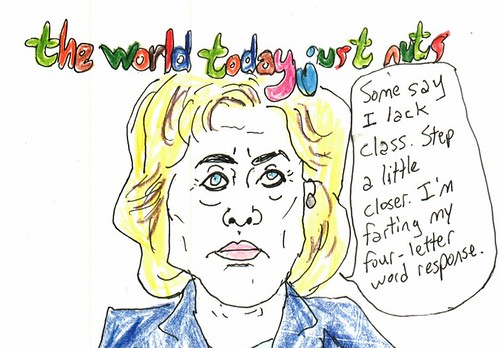
 Isaiah's The World Today Just Nuts "Classy Clinton"

classycranky

H.A. Goodman also notes Cranky Clinton.  At The Huffington Post, he explains:


Democrats must win swing states in 2016 to prevent Trump or another Republican from sitting in the Oval Office. Since voters in general elections normally won't vote for a candidate they don't like or at least find trustworthy, it's imperative that a Democratic nominee hold positive favorability ratings going into Election Day.
I explain in great detail in my latest YouTube segment why Hillary Clinton is unelectable due to negative favorability polls nationwide and within swing states.
Also, it used to be important not have an ongoing FBI investigation linked to emails, but any controversy related to the former Secretary of State is viewed as a badge of honor to certain voters. Nonetheless, electability is always tied to winning battleground states, and Hillary Clinton faces an uphill battle pertaining to electoral votes in these regions.


Not electable.

That is Cranky Clinton.

When will people realize that?

This is C.I.'s "Iraq snapshot" for today:


Monday, October 26, 2015.  Chaos and violence continue, Barack toys with more US troop involvement in Iraq, The Nation and The Progressive continue to ignore the Iraq War and last week's US combat fatality, protests continue, and much more.


Starting with news of even more war, Missy Ryan and Greg Jaffe (Washington Post) report,


The president’s most senior national security advisers have recommended measures that would move U.S. troops closer to the front lines in Iraq and Syria, officials said, a sign of mounting White House dissatisfaction with progress against the Islamic State and a renewed Pentagon push to expand military involvement in long-running conflicts overseas.


Kristina Wong (The Hill) adds:


U.S. military commanders have forwarded several options to the Defense Department in the last few weeks, the officials told The Hill, as part of a mounting push within the administration to more aggressively target the terrorist group.
One of the options presented was embedding U.S. troops with Iraqi security forces; they would have the ability to call in airstrikes, a step that would bring American forces to the front line.


RT speaks with Phyllis Bennis:


RT: Can the Pentagon still realistically maintain its 'no boots on the ground' stance given that an American soldier has been killed apparently in action?


Phyllis Bennis: I think the question of US boots on the ground has been true for over a year now. We’ve had at least 35,000 troops in Iraq that went back last year and I don’t think most people in this [US] country recognize the difference any more than they would in Russia if and when Russian troops or volunteers are sent to Syria; if somebody tries to claim they are not combat troops, nobody would believe that either. These are troops engaged in combat. They are advising, they are supporting, they are arming, they are training and they are fighting with forces on the ground. So, the notion that there are ‘no boots’ is simply not the case. We also know that besides 35,000 US troops on the ground in Iraq there are an unknown number of other Special Forces and CIA forces on the ground. Maybe they wear sneakers rather than boots. But there is no question that US forces have been fighting directly in Iraq for more than a year now.


I think Isaiah captured the absurdity better back on October 26, 2014 26th "Barack Prepares:"


In the comic above, a confused White House spokesperson Josh Earnest asks, "What's he doing?" Valerie Jarrett explains, "Ballet slippers on the ground are not boots on the ground."  
Why today's talk?
Possibly because . . . 


Thursday saw the combat death of 39-year-old Master Sgt Joshua L. Wheeler in Iraq.


And possibly because of the silence that greeted this death.

Silence?


 Press TV notes Noam Chomsky can talk about Iraq today:

Prominent American author and linguist Noam Chomsky has blasted the US foreign policy, calling Washington's 2003 invasion of Iraq “the worst crime of this century.”
“What right do we have to kill somebody in some other country who we don't like,” Chomsky told teleSUR on Monday.
Calling the US-led invasion of Iraq “the worst crime of this century,” the renowned scholar and intellectual said, “Suppose it had worked... it's still a major crime, why do we have the right to invade another country?”


But sadly not everyone can follow Noam's example.


Take two of our 'great' rags on the left: The Progressive and The Nation.


The Progressive ignored the death and its implication.

Remember, editor Ruth Conniff bragged on KPFA that she didn't know anyone who'd been touched by the war.

How very nice for her and the other racists in the gated community she lives in.

Then there's The Nation magazine.


Anyone remember their November 10, 2005 editorial?


It started on the cover and continued inside the rag.

They insisted they "wound only support candidates who made a speedy end to this [Iraq] war a major campaign issue."


Ignoring the combat death, ignoring the ongoing war, let's them pretend like they ever fulfilled that promise.

Just like they pretend the Iraq War ended.

And when outlets that are allegedly anti-war don't note the combat death -- or the broken promise from Barack of no US troops in combat -- there's no pressure, is there?

There's no outcry.

So there's no pressure on Barack not to increase the presence of US troops in Iraq.


Katrina vanden Heuvel bought her seat at the table, she never earned it and, goodness, does it show.


Her grandfather stole from Lena Horne, no surprise she steals peace from the world. (Only one of many African-Americans who enriched the family.)   She is the Peace Resister.


As Isaiah long ago noted


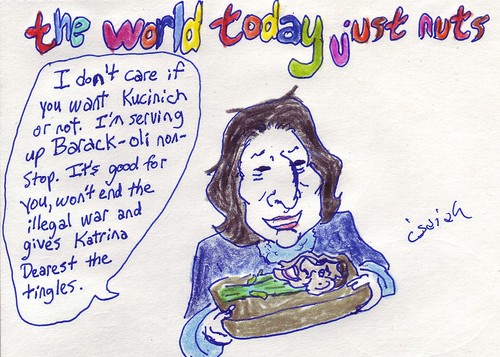
"From the kitchen of the Peace Resister"

peaceresisterliving

The Peace Resister Katrina vanden Heuvel

kvh


Katty van-van ignores reality to protect her baby in the White House.


While she stays silent, the US Defense Dept announces:


Airstrikes in Iraq

Attack, bomber, fighter, ground attack and remotely piloted aircraft conducted 15 airstrikes in Iraq, coordinated with and in support of the government of Iraq:

-- Near Beiji, one strike struck a large ISIL tactical unit and destroyed four ISIL fighting positions, three ISIL mortar positions, an ISIL heavy machine gun, and an ISIL cave entrance.

-- Near Habbaniyah, two strikes suppressed two ISIL mortar positions.

-- Near Kisik, one strike struck an ISIL tactical unit and destroyed an ISIL fighting position.

-- Near Mosul, one strike struck an ISIL tactical unit and destroyed an ISIL fighting position.

-- Near Ramadi, five strikes struck an ISIL tactical unit and destroyed two ISIL fighting positions, two ISIL weapon caches, an ISIL command and control node, an ISIL building, and denied ISIL access to terrain.

-- Near Sinjar, three strikes struck an ISIL tactical unit and destroyed 18 ISIL fighting positions and two ISIL vehicles.

-- Near Sultan Abdallah, one strike suppressed an ISIL sniper position.


-- Near Tal Afar, one strike destroyed an ISIL fighting position.


In addition, Alsumaria notes 2 corpses discovered in Baghdad (a mother and her son).  Xinhua adds a Baghdad suicide bomber took their own life and the lives of 2 other people (twelve more left injured), 1 woman and her husband were shot dead in Husseiniyah, and a Latifiyah roadside bombing claimed the life of 1 Iraqi soldier with two more left injured.


Meanwhile, protests took place throughout Iraq.

Alsumaria reports protests in Baghdad (outside the Ministry of Labor and Social Affairs and outside the Ministry of Finance) saw government workers objecting to their pay scale, and at the University of Basra the protesters were objecting to pay cuts for professors.


War Criminal Tony Blair is familiar with protests and objections and, today, he is back in the news.


Why?

Tina Nguyen (Vanity Fair) explains, "Ever since former British prime minister Tony Blair stepped down from office in 2007, he hasn’t received the love he may have hoped for, primarily due to that teensy matter of dragging Great Britain into the Iraq war and getting the nation stuck in that deadly quagmire along with the United States. In an attempt to make everything right, he apologized for his actions on Sunday during an interview with CNN’s Fareed Zakaria. Long story short, it didn’t work."


War Criminal Tony Blair plotted and planned the crime with others.

He still can't accept the fact that there is no comeback for him. Justin Wm. Moyer (Washington Post) notes that Blair's issuing a limited apology:


Former British prime minister Tony Blair made the comment in a interview with CNN’s Fareed Zakaria.
“When people look at the rise of ISIS, many people point to the invasion of Iraq as the principal cause,” Zakaria said. “What do you say to that?”

“I think there are elements of truth in that,” Blair said, “but I think we’ve got to be extremely careful. Otherwise, we’ll misunderstand what’s going on in Iraq and Syria today.”


Again, it's a limited apology.

He insists "mistakes" were made.

Not in lying, he won't admit to that.

"I apologize for the fact that the intelligence we received was wrong," he declared.

But he knew it was wrong and he manipulated the intel.

His 'apology' only continues his long string of lies.


He doesn't apologize for starting the illegal war.


But, after it started, "mistakes" were made.

He really seems to be testing the waters for whether or not he can break with Bully Boy Bush.

Breaking with Bush would allow him to, as the Iraq Inquiry did in public testimony, pin the blame on the US government for de-Ba'athification.

Blair's limited apology is an attempt to water down the outrage that still greets him.

What he's still refusing to grasp is that the illegal war will haunt him until his dying day.

There's no escaping it.

And his fake assery today only serves to anger people.

Peter Dominiczak (Telegraph of London) reports:

Families of soldiers killed in Iraq have told of their “revulsion” at Tony Blair’s failure to give a full apology for the war and warned that the Chilcot report will be “a cover-up”. 
[. . .]
 Reg Keys, whose son Lance Corporal Tom Keys was killed in Iraq in 2003, said that he felt “revulsion” when he heard Mr Blair’s comments.
“I feel revulsion,” Mr Keys said. “This man certainly got it wrong. 179 British service personnel dead, 3,500 wounded. Not to mention the hundreds of thousands of innocent Iraqi men, women and children that lost their lives. The guy has got to hold his hands up [and say] I got it wrong and I apologise.”
Mr Keys added: ““I feel that he’s obviously pre-empting the Iraq inquiry’s findings. It’s finger-pointing. He’s blaming intelligence chiefs for giving him the wrong intelligence. He’s not apologising for toppling Saddam.
“What about apologising for the unnecessary loss of life? The reason we went to war was weapons of mass destruction, not to topple Saddam.” 


At The Atlantic,  Kathy Gilsinan takes on Tony's claim that taking out Saddam Hussein was a good thing and we'll note the final example she offers:

In human terms, the accounting is stark. Hundreds of thousands of Iraqis are estimated to have been killed in the violence unleashed in 2003, though the true number of deaths remains unknown. The continuing bloodshed in Iraq has contributed to the biggest refugee crisis since World War II, and the ascent of ISIS has exacerbated the outflow of refugees from Syria as well. “They are the forgotten casualties of the Iraq war. Fully one in six Iraqis (4.7 million people) fled or were forced from their homes following the U.S. led invasion in 2003, and most have not returned,” the International Rescue Committee writes. “Close to half are living in neighboring countries such as Jordan and Syria, while the remainder are uprooted within Iraq’s borders.” How would they answer the question of whether things are better now that Saddam’s gone?


New content at Third:


missy ryan
the washington post
greg jaffe
kristina wong

press tv


Saturday, October 24, 2015

She is just an embarrassment

An e-mail asked if I would note this from the right-wing Brietbart News:

Democratic presidential candidate former Secretary of State Hillary Clinton stated that she and her team had a “great” time “eating Indian food, and drinking wine and beer” at her house after her testimony before the Benghazi Select Committee in an interview broadcast on Friday’s “Rachel Maddow Show” on MSNBC.


And I will do it one better, I will also note this:

On Saturday’s “Fox & Friends” on the Fox News Channel, Michael Ingmire the uncle of Benghazi attack victim Sean Smith said that he’s “glad” former Secretary of State Hillary Clinton had a “party” after her testimony before the Benghazi Select Committee, and it was “too bad” his nephew couldn’t make it. Ingmire further stated he was “embarrassed” at the Democrats on the committee.
Ingmire stated, “I’m glad that Mrs. Clinton had an Indian food, wine, and beer party. It’s too bad my nephew and Ambassador Stevens, you know, couldn’t show up.”


Hillary Clinton is either tone-deaf or unfeeling.

Bragging about partying following the hearing?

She has no sense of perspective.


This is C.I.'s "Iraq snapshot" for today:


Saturday, October 24, 2015.  Chaos and violence continue, Russia allegedly gets an invitation, sex addict Brett McGurk gets a promotion, Barack courts charges of playing the weasel (no, he's not Brett's latest conquest), Congress hears about veterans academic needs, and much more.


Ryan Kaufman:  I served in the U.S. Army from 2000-2003. I was deployed with the First Brigade Combat Team in October 2001 to Kuwait and Afghanistan as a Signal Support Systems Specialist. Upon my return, the proper procedures were not in place to catch what I was dealing with. At 19-years-old, I came home and was afraid of the dark; couldn’t sleep; and had a hard time eating. If the task was not mission critical, I could not find the motivation within myself to complete the task. Two months after I returned home, I caused an accident, almost killing myself and a friend. I was charged with driving under the influence. Everyone, including myself, thought I just had a problem with alcohol. But then I tested positive for marijuana. The Army left me no choice; I was discharged with a General under Honorable Conditions. During this same time period, my mother was diagnosed with stage four cancer of the throat and lungs. She was given six months to live and made it to December 2003. Six months after my discharge, I was homeless. A year prior I was part of the world’s greatest machine, the United States Army. But by December 2003, I found myself walking into a homeless shelter, unable to feed or house myself. I could not comprehend how this had happened. Shortly thereafter, I was granted a couch in a friend’s basement. I wish I had straightened my life out then, but this would not be my last experience with homelessness. In September 2004 I enrolled in college for the first time. My discharge left me without the GI Bill, so I took out Stafford Loans like the rest of the civilian population. I attempted college two more times following this 2004 attempt. I failed out in the first semester each time. Juggling work, relationships, family, and an addiction is not conducive to a learning experience. I would repeat the homeless cycle and enroll in college two more times, in 2008 and 2010. By 2011 I finally found permanent sobriety. After four years of documented VA therapy, and appeal after appeal, I was granted a service connected disability in October 2012. With school constantly on my mind, I immediately applied for the Vocational Rehabilitation/VetSuccess Program, was interviewed, approved, and enrolled in another college, after paying the back balances on my student loans.


August 1, 2009, the Post-9/11 GI Bill went into effect.  This legislation was Congress acknowledging the need for a new GI Bill -- due both to the increase in the veterans population that the wars in Iraq and Afghanistan were and would be creating and the changing needs since the GI Bill (Serviceman's Readjustment Act of 1944) was created in response to WWII.


We covered Congressional hearings that led to the legislation in the past.  Thursday, the House Veterans Affairs Subcommittee on Economic Opportunity explored one aspect, the VetSuccess On Campus program (VSOC).


Chair Brad Wenstrup:  The program is in place to provide veteran service members and their dependents with assistance and counseling as they are using their GI Bill or attending school through Voc Rehab.  VSOC is an additional resource for veterans and service members as they transition from active duty to student life and further assist them as they work towards meaningful employment following their military careers.  Each school with a VSOC program has a Voc Rehab counselor in place to assist students attending that school.


Appearing before the Subcommittee were: Iraq and Afghanistan Veterans of America's Ryan Kaufman (already quoted at the start), Student Veterans of America's William Hubbard, Dr. Lawrence Braue (retired Lt Col, Director of the Office of Veterans Services at the University of South Florida where the first test VSOC was launched in June 2009), the University of Cincinnati's Veterans Programs and Services Manager Terence Harrison and the VA's Jack Kammerer.

As noted, US House Rep Brad Wenstrup is the Subcommittee Chair. US House Rep Mark Takano is the Ranking Member.  He noted some of the issues VSOC can assist with.


Ranking Member Mark Takano:  Obstacles could include VA benefit issues, questions about where to go for mental health counseling, concerns about financial or legal issues or job market information.  We know from many studies that successful transition from active duty to civilian life requires significant planning and support from the military and the VA.  Transitioning from active duty to campus life can be even more daunting -- especially for first generation college students.  Add the burdens of injury or PTS [Post-Traumatic Stress], and it is not hard to imagine why graduation levels are not as high as we would like them to be  for veterans using their GI Bill benefits. Now this is where the VSOC counselor comes in, however, they are easily accessible on campus so problems are resolved as quickly and as easily as possible.


FYI, the original plan (on Wednesday) for Thursday's snapshot was to highlight this hearing and another VA hearing (this one was in the afternoon, the other started at nine) and note how few press attended and how the dog-and-dog show (Benghazi and Hillary) consumed all the press' attention.  That plan drifted away the minute it was reported Thursday that a US service member had been killed in Iraq.


From Thursday's hearing:


Chair Brad Wenstrup:  Mr. Kaufman, I want to specifically thank you for your service and having the courage to share your incredible story.  It's uplifting and gives us all a lot of hope.  It's clear from your testimony that the Voc Rehab program has really given you opportunities that you need to be successful.  So what do you believe could be done to improve the program and make sure that we have the opportunity to help hundreds, if not thousands, of veterans be successful and have stories like yours -- hopefully, not the first part but the later part?

Ryan Kaufman:  Yes, sir. I thank you for the compliments, Mr. Chairman.  In regards to policy, I would have to defer to any of the Iraq and Afghanistan Veterans of America's DC policy team.  But, in my experience, the relationship matters.  So the relationship that I with my VR&E [Vocational Rehabilitation and Employment] counselor matters.  And I live in rural America and geographical lines get redrawn on a regular basis and case loads get switched.  And as a -- as a gentleman who struggles with trust, putting me on a new caseload -- just like with my VHA doctors -- throws me for a loop and now I'm having to remember which person to get a hold of, what's their phone number?  Right when I memorize somebody's phone number, it may change to a new individual.  But opening in particular the VSOC counselors to many more campuses -- especially as Mr. Hubbard said from the SVA -- to campuses that don't have a lot of resources would be very beneficial -- especially in my area -- because we're making an investment in the veteran, we're not making an investment in the particular institution.  And our job is to make sure that the veteran is successful.  Does that answer your question, Mr. Chairman?

Chair Brad Wenstrup:  It does.  It's very helpful.  Because I think one of the things that you touched on is important.  You know, as a physician, I always find it important that once in a while I may be able to pinch hit for somebody in my practice but that's a relationship between you and the patient that really needs to be sustained.  Somebody can cover for you once in a while but to really be successful, you need that time and time again to build that bond.  So that input is very helpful to us and that may be something that we need to make sure that we monitor and that we are providing some consistency for people because you're at a point in your life where a lot of things are very inconsistent -- and, let's face it, when you're in uniform, things are pretty consistent so that's a big shift, when you go from that.  You know, I've said during my deployment, "I hate being away from home."  But it was a simple life except for the fact that people were shooting at me.  And from that stand point, I wore the same clothes every day.  So that's a transition and you need some consistency in your life.


The hearing was poorly attended.  The only press report I've found on it is Joseph Morton's report for the Omaha World-Herald.


We'll note this exchange from the hearing:


Ranking Member Mark Takano:  Are you a public university or a private university?

Dr. Lawrence Braue:  We are a public university.

Ranking Member Mark Takano:  And what's your total student enrollment?

Dr. Lawrence Braue:  Total student enrollment is 48,000 --

Ranking Member Mark Takano:  So 48,000 --

Dr. Lawrence Braue (Con't):  a little over 48,000.

Ranking Member Mark Takano:  How many counselors do you have available?  I mean, just generally, your counselors available to the general student population?

Dr. Lawrence Braue:  We have one VSOC counselor on campus.

Ranking Member Mark Takano:  One VSOC.  But let's just talk about counseling in general, not counseling that's available to veterans.  I want -- I want the Committee to understand the plight of community colleges and public universities in terms of the availability of counselors generally and the general challenge of retention to students who come to public universities.


Dr. Lawrence Braue:  Well we have VA counselor, just the one.  We have other counseling services on the campus that are open to all students.  They're not heavily utilized by our student veterans because they just are not experienced with the issues that our student veterans face.  And our veterans won't go to them.

Ranking Member Mark Takano:  I understand that.  But what I'm trying to get at is -- I come from the California community colleges and we have such a shortage of counselors generally.  So one of the requirements has been to have every student take a counseling class, they get a one unit for that class. So that the issues a counselor would deal with can be dealt with "more efficiently." And community colleges, for example, have a general issue with retention.  And so what I'm trying to get at is the general counselor shortage. I come from a public school setting where out of 4,000 persons in a freshman class you might have two counselors assigned.  So basically you have a five-hundred-to-one counseling burden. Right?  So I'm just trying to say I don't believe the counseling function in higher education, higher public education, is much better. Probably even more difficult.  The amount of time a counselor will spend with a regular student.  Now I'm just trying to go through this background in order to shine a little clearer light on what the challenges are when we deal with a veteran who has a much more complex set of issue.  So we already have a challenge in terms of retention in the general student population.  Now we're talking about how we address veterans who have been through -- who carry a lot of other issues with them. So my thought is -- So you're telling me this VSOC counselor also has a VR&E caseload of about 50, you say?

Dr. Lawrence Braue:  Yes, sir.

Ranking Member Mark Takano:  So is that generally the case, Mr. Kammerer, the VSOC counselors also carry -- the VSOC counselors also have a VR&E function?

Jack Kammerer:  That's a good question, sir.  Thank you for asking.  Of the 79 counselors, I work a regular spreadsheet of their  caseload.  We currently do not have a policy that says VSOC counselors cannot touch a traditional caseload.  As Dr. Brau pointed out, we run the gamut from zero up to what I might call a full caseload.  When I testified to the Committee in July, I said our average caseload was about 139 per counselor.  So for FY15, I think that was accurate.  So Dr. Brau's math was about right in my head when he said if his counselor -- if his VSOC counselor -- had 50 cases, that was about 1/3 of the average caseload. We are looking at a policy to limit the caseload of traditional cases, Mr. Takano, the challenge we have is many of the veterans on campus are Chapter 31 clients. Or some of them.  And we need to serve those veterans on campus with Chapter 31 services -- the traditional range of support that our counselors provide. I use the example, in Los Angeles, of the VSOC counselor that serves three -- We have a cluster of three institutions in Los Angeles.  The challenge is, in Los Angeles, the regional office is on the other side of town from those  institutions.  So if we didn't serve those veterans on campus with the VSOC counselor with their Chapter 31, we would either have to have counselors come from across town from the R.O. to the campus or we would have to ask the veteran to come to the RO which is not a good idea in Los Angeles traffic.  So, in many cases, I spoke to a counselor this week who is visiting for other purposes -- who's a VSOC counselor -- and she carried a caseload of 62 cases and she was comfortable with that in her current situation.  So it is a balancing equation, Mr. Takano, in terms of --

Ranking Member Mark Takano:  Well --

Jack Kammerer (Con't): -- serving the veterans.


Ranking Member Mark Takano (Con't):  -- here's -- [to the Chair] if I may? -- Mr. Kaufman, I also want to express how moved I was by your testimony.  And thank you for your courage.  And thank you for your service to our country.  Thank you for continuing to serve our country by being so open about your life and the struggles -- and for being such a success.  You'll be -- You already are a hero, you'll be a bigger hero to show -- No, seriously [in response to Kaufman shaking his head "no"], I have veterans in my community dealing with a number of issues and to see somebody get through that is going to be an enormous inspiration to them.  Now tell me about -- You talk about your relationship with your VR&E.  Because you're getting your education benefits through your VR&E, not through 9/11.  VR&E is a much more generous program if you can qualify for it.  You initially went through taking out loans, you didn't really know about your education benefits.  Was it the VSOC counselor that got you straightened out? Is that what happened?

Ryan Kaufman: So, first of all, Mr.  Takano, thank you for the compliments.  It was -- It was actually, it would have been a Mr. Harrison or a Dr. Braue that pulled me to the side and advised me of VR&E.

Ranking Member Mark Takano:  Uh-huh.

Ryan Kaufman:  And then a year later we got a vital counselor.

Ranking Member Mark Takano:  Uh-huh.

Ryan Kaufman: What the vital counselor can provide is VA benefit access sooner -- almost immediate  rather than me attempting to contact my VR&E counselor who may have -- especially in September and in January -- when she may have 150 veterans trying to reach her.  This vital counselor, if I'm having benefit issues, backpayment issues or over payment issues, he has the ability to contact the VBA on my behalf and then relay any news from the VBA.

Ranking Member Mark Takano:  Your story and your challenges are giving me a window into understanding what happens and how people become homeless and how they go through initial mis-steps. I'm concerned about the caseload of VR&E of 50 people to that one VSOC person.  I mean, you have a huge student veteran population. I can imagine that counselor just totally being consumed by those 50 VR&E.  I mean, it's a lot of work.  You hear Mr. Kaufman's story, you see how much time and energy it takes for that trusted person to do their job.  That's just a lot -- 50 cases, 50 people.  I'm not saying all of them will be as intense as Mr. Kaufman but I can imagine that a lot of them are.  So I can't imagine that we don't have a presence on campuses.  That's my thing. Mr., go ahead, Mr. Braue.

Dr. Lawrence Braue:  Thank you, sir.  I completely agree. The -- Having this VetsSuccess counselor on campus is essential.  It's absolutely essential. The caseload -- the Chapter 31 caseload that she has does take away from her ability to meet the needs of other people who might need her services.  And it is -- Chapter 31 cases, it can be intensive.  Especially having her on campus, it makes her more accessible than most VR&E counselors who only come to campus once in a while.  So her being on campus, her caseload, the members, the people that she is managing can walk in two or three times a week to see her which then exacerbates the problem of her not being able to reach other people so she's really spending more time on the Chapter 31s than she would if she were not a VR&E -- if she were a VR&E somewhere else.  So that becomes an issue too. 


From reality to the absurd . . .

CIA contractor Juan Cole has the nerve, the temerity to write a piece pondering what if the US had never invaded Iraq.

This would be the same Juan Cole who was a cheerleader for the illegal war during the lead up to it.

No link to Juan, he's paid by the CIA, he doesn't need the web traffic.


The war Juan Cole was so eager for has claimed millions of lives.


Thursday saw the death of yet another person in Iraq -- this time a US citizen.


  • On the tragic death, we'll note this Tweet:


  • NB: WH says POTUS did not sign off on Spec Ops raid that left US solider dead, says it was Def. Sec. Carter's call


  • That may stand as one of the all time cowardly moments for a commander-in-chief.

    The funeral hasn't even taken place and Barack's put out the spin that, "It's not me! It's Ash Carter!"  Shameful.

    True?

    Doesn't matter if it's true or not.  Reality Barack and The Cult of St. Barack has never been able to face: When you hold the position of president, you are responsible.  Even if Ash Cater authorizes the raid/rescue, he serves under you and you are responsible.


    Offering some realities, Gayle Tzemach Lemmon (Defense One) observes:

    Thursday’s events have thrust have into the public spotlight the rather plastic definitions of war and combat in which Americans have been operating now for a while. We may not by name or distinction be a nation at war, and we may not be a nation whose troops are part of full-scale, on-the-ground combat operations. But the men and women serving in those countries are indeed in a war zone and serving their nation in combat. They are at war whether or not we are as a nation.

    [. . .]


    American forces are in combat. Not saying it out loud allows us—and perhaps our leaders in Washington—to feel we are not a nation at war, even if some of us are serving in battle.


    In other news, the US government insisted Russia not be allowed to take part in air strikes over Iraq.  And the response?

    DEBKA File reports, "The Iraqi government is allowing the Russians to use the Al Taqaddum airbase that is also being used by US troops for operations against ISIS. However, Baghdad has yet to mention the Russian presence at the base, located 74 kilometers west of Baghdad." And Middle East Eye reports:

    The Iraqi government authorised Russia to target Islamic State group convoys coming from Syria, a senior Iraqi official said.
    The authorisation for Russia to target IS inside Iraq comes amid security coordination between Iraq, Russia, Iran and Syria.
    Hakem al-Zamli, chief of the Iraqi parliament’s security and defense committee, told Anadolu Agency on Friday that the measure contributed to weakening IS by cutting off its supply routes.

    Click here for the Andolu Ajansi report.


    Friday, the US Defense Dept announced:


    Airstrikes in Iraq
    Attack, fighter, and bomber aircraft conducted 15 airstrikes in Iraq, coordinated with and in support of the Iraqi government:
    -- Near Kisik, a strike destroyed an ISIL fighting position.
    -- Near Makhmur, a strike destroyed two ISIL weapons caches.
    -- Near Mosul, four strikes struck three separate ISIL tactical units, suppressed ISIL mortar fire, and destroyed five ISIL heavy machine guns, five ISIL fighting positions, and an ISIL tactical vehicle.
    -- Near Ramadi, three strikes struck two separate ISIL tactical units, denied ISIL access to terrain, and destroyed seven ISIL fighting positions, four ISIL heavy machine guns, three ISIL mobility obstacles, two ISIL roadside bomb clusters, two ISIL mortar positions, an ISIL building, an ISIL vehicle, an ISIL bomb and an ISIL anti-tank guided missile system.
    -- Near Sinjar, three strikes destroyed 15 ISIL fighting positions and two ISIL command and control nodes.
    -- Near Tal Afar, two strikes struck two separate ISIL bomb-making facilities.

    -- Near Sultan Abdallah, a strike struck an ISIL tactical unit.

    As The Four Tops once pointed out, "It's The Same Old Song."  Patrick Cockburn (Independent) explains:


    The main US-led action after Isis emerged as a powerful force last year has been an air campaign that has carried out 7,000 strikes in Syria and Iraq. But it is clear they have not worked, for inter-linked military and political reasons: guerrilla movements do not present enough targets to be defeated by airpower alone. 


    Finally, the retired general who was an idiot has retired/been forced out of his post as Special Envoy. Idiot?  He was an ambassador now and refused the title preferring to be called "general."  If you don't want the post, don't take it.  Now Brett McGurk will step in as Barack's Special Envoy for Iraq and Syria.  And Brett will get right on the job just as soon as he can pull his dirty dick out of wherever he plugged it last.  (Oh, Gina Chon, you didn't really think he was being faithful, did you?  He cheated on his wife to be with you.  It was fun and exciting, remember?  Now your his wife and it's other women that get to have the fun and excitement of extra-marital affairs with your husband.)


    Thursday, October 22, 2015

    Liar Cranky Clinton finally tells some truth

    For me, the key moment in today's Benghazi hearing was when Hillary Clinton insisted, "I would imagine I’ve thought more about what happened than all of you put together. I’ve lost more sleep than all of you put together."


    At first, I thought, "More lies from the liar supreme."

    But then I thought a little more and decided she was telling the truth.

    She probably has thought about it more than anyone else.

    Think about it, have you ever been in an accident?

    I once rear-ended a car outside a hospital.  I was not watching, I had turned around as I was talking to one of my sons (then a small child) and rear ended the car in front of me.

    It was my fault.

    I knew it then.

    I know it now.

    And in the days and weeks after, I replayed it over and over in my head.

    If only, I had been looking.

    If only I had pulled the car over to talk to my son.

    If only I had stopped at a gas station on the way and got a drink for the kids and me, I would not have been in the parking lot at that time.

    If . . .

    Hillary Clinton was responsible for Benghazi.

    And it has cost her many votes.

    And so, yes, I do believe she has thought about it repeatedly.

    The guilty often relive their crimes repeatedly in their minds.


    This is C.I.'s "Iraq snapshot:"

     
    Wednesday, October 21, 2015.  Chaos and violence continue, Russia and the US want to dance with Haider, the US continues bombing Iraq, the number of reported cholera cases continue to increase, and much more.


    In the fall of 2014, US puppet Haider al-Abadi, newly installed as prime minister of Iraq, thought he'd be a player on the world stage.  Full of hubris, he made one faux pas after another culminating with his public claim that he had intel the Islamic State was determined to strike NYC subways.


    After that he was bum rushed off the world stage and has been left to nurse his hurt pride ever since.


     I see a possibility 
    And try it out for size
    And it's so scary
    Confusing
    What I might be losing
    But I'm willing
    Open for surprise
    Feeling so alive 
    Between the promise and the prize
    -- "The Promise And The Prize," written by Carly Simon for the television show PHENOM


    Iraq, especially puppet Haider al-Abadi, is caught between something.   Patrick Cockburn (Independent) reports:

    Iraqi political and military leaders are demanding that the government follow Syria in requesting Russia to start air attacks on Isis fighters in Iraq. 
    Two members of parliament are quoted as saying that the Prime Minister, Haider al-Abadi, is under "tremendous pressure" from his ruling National Alliance group to call for Russian military help.


    But Pravda reports, "Iraq no longer intends to appeal to Russia for help in the fight against terrorists. Allegedly, such a decision was made after the head of the Joint Chiefs of Staff of the US Army Joseph Dunford paid a visit to the country. "  CBS and AP quote Dunford stating, "I said it would make it very difficult for us to be able to provide the kind of support you need if the Russians were here conducting operations as well.  We can't conduct operations if the Russians were operating in Iraq right now." Ahmed Rasheed and Saif Hameed (Reuters) observe, "Growing pressure on Abadi to seek Russian support puts him in the delicate position of trying to appease his ruling coalition, as well as militias seen as a bulwark against Islamic State, while keeping strategic ally Washington on his side."

    Exploring the topic further, Mustafa al-Kadhimi (Al Monitor) offers:

    So far, Abadi seems to have resisted the pressure placed by Shiite forces and parties, such as the Popular Mobilization Units that announced Sept. 20 that “the Baghdad-Damascus-Tehran-Moscow alliance is a natural and legal right for Iraq.” These forces stressed the need for full participation in the Russian alliance and to speed up the official request that Russia take part in attacks on IS in Iraq.
    Yet Abadi is taking his time and does not want to risk his relations with the West at this sensitive stage. He has contented himself with the intelligence cooperation and arms deals with Russia, and he has refrained from going beyond this point to avoid losing the United States as a strategic ally of Iraq.
    Abadi is reasonable in being cautious, because the Iraqi political situation is vulnerable and would not tolerate further internal divisions, which would take place in the event of a radical change in the Iraqi international alliances. In addition, Abadi does not perceive the new Russian alliance as a guaranteed alternative to the Western one, and he does not desire that Iraq be turned into a field for a new battle between the world powers, which would lead to dire consequences.
    At the same time, Abadi does not believe he can manage without an external party to help Iraq restore its territorial integrity and get rid of IS. This is particularly true in light of Russia's strong participation in fighting IS and US confirmation that the fight will be long.


    Haider al-Abadi is at a deciding point.


    What can I say this time
    Which card shall I play
    The dream is not over,
    The dream is just away
    And you will fly
    like some little wing
    straight back to the sun
    The dream was never over
    The dream has just begun
    The dream has just begun

    -- "Straight Back," written by Stevie Nicks, first appears on Fleetwood Mac's MIRAGE


    He seems to be taking cues from his predecessor.

    Former prime minister and forever thug Nouri al-Maliki loved to play kick the can.


    His special brand of it was to make promises for a future date and then stall and stall and, when the date finally arrived, act like no promises were ever made.

    Haider seems to think he can wait out this power struggle between the governments of Russia and the United States.

    But most likely, his stalling only continues to weaken him internally within Iraq.


    Meanwhile, the United Nations calls attention to worsening conditions in Iraq:

    The humanitarian situation in Iraq is deteriorating and growing more complex, as conflict protracts, coping capacities diminish, and funding falls short, according to a report issued today by the United Nations Office for the Coordination of Humanitarian Affairs (OCHA).
    The number of Iraqis requiring humanitarian assistance has grown to over 8.6 million people, including over 3.2 million people who have fled their homes since January 2014, according to OCHA. The International Organization for Migration’s most recent tracking of displacement shows that there are now 3,206,736 internally displaced people in Iraq, while military operations and insecurity have triggered new displacement in Salah al-Din and Anbar governorates.
    Cholera has spread across the country, with over 1,600 confirmed cases and two deaths one month after the outbreak was first declared, according to the Ministry of Health and the World Health Organization (WHO). The main causes for the current outbreak are broken water supply systems and the lack of sufficient chlorine in the country to provide clean water.
    Insecurity and military operations continue, as Iraqi security forces and its allies continue military operations to retake areas from the Islamic State of Iraq and the Levant (ISIL). Amidst unverified reports of an escalation of military operations there have been reports of civilians seeking to leave Ramadi and Falluja, but access to safety for civilians in conflict areas remains a concern, according to the OCHA report.
    The UN Assistance Mission for Iraq reported that at least 537 Iraqi civilians were killed and 925 civilians injured nationwide in September 2015. This includes civilian police and casualty figures from Anbar.
    International assistance has alleviated the suffering of over two million Iraqis during the past year, but funding is still short of growing needs, said OCHA. Overall global funding to Iraq in 2015 is $618 million, of which $237 million has been received outside the UN and its partners' joint appeals. On 4 June, the Government of Iraq and the UN launched a revised and prioritized Iraq Humanitarian Response Plan seeking $498 million, 41 per cent of which has currently been received. 


    The Associated Press notes the 1,600-plus cases of cholera today are in contrast to the 54 cases that had been confirmed previously as of September 22nd.  Saif Hameed, Isabel Coles and Jon Boyle (Reuters) add that the Iraqi Ministry of Health has confirmed over 1800 cases and, "The illness, which can lead to death by dehydration and kidney failure within hours if left untreated, was detected last month west of Baghdad." And AFP reports, "Ministry spokesman Rifaq al-Araji told AFP that the governorates of Baghdad and Babil, south of the capital, were the worst affected with more than 500 cases each."

    Monday night, Betty weighed in:

    Cholera.
    The failure Barack pretends the bombings are 'humanitarian' but when Iraq needs real humanitarian help, where's the money?
    No where to be found.


    And still the bombs drop as Operation Inherent Failure continues with the DoD announcing today:

    Airstrikes in Iraq

    Attack, bomber and fighter aircraft conducted 14 airstrikes in Iraq, coordinated with and in support of the government of Iraq:

    -- Near Kisik, six strikes struck an ISIL vehicle bomb facility and destroyed five separate ISIL staging areas.

    -- Near Ramadi, two strikes struck an ISIL tactical unit and destroyed an ISIL command and control node, an ISIL bomb, and denied ISIL access to terrain.

    -- Near Sinjar, four strikes struck two separate ISIL tactical units and destroyed 14 ISIL fighting positions, an ISIL light machine gun, and an ISIL heavy machine gun.

    -- Near Sultan Abdallah, one strike suppressed ISIL mortar fire.


    -- Near Tal Afar, one strike destroyed 16 ISIL fighting positions.


    Jacky Sutton's death was news earlier this week.


    Tuna
    Rubber
    A little blubber in my igloo
    And I knew you pigtails and all 
    Girls, when they fall
    And they said Marianne killed herself
    And I said not a chance
    -- "Marianne," written by Tori Amos, first appears on her BOYS FOR PELE


    The family has decided to go along with a 'finding' many who knew Sutton feel is off the wall.  They would like their privacy.  So they'll have it here.  But in closing on this issue, we'll just note that it is deeply, deeply stupid to issue the statement they did while also wanting to add sotto voice that if other details emerge . . .


    No, there are no other details when you tell the world, "Disperse, nothing to see here."  Should other details emerge, they will do so when the press' attention has moved on to other topics and when there is no 'fresh' value to Sutton's death to motivate coverage.

    The family has ensured that there will be no serious investigation as a result of their idiotic statement.

    It is one thing to say, "We want our privacy and await the results of the investigation."

    It is quite another to say, "We want our privacy and believe the findings reported by the Turkish press."

    We have serious issues to cover here.  The family's statement has ensured that Jacky Sutton's death will no longer be treated like a serious issue.


    reuters
    ahmed rasheed


    Wednesday, October 21, 2015

    Likeable?

    The Boston Herald notes:


    To use a 2008 quote from Barack Obama, Hillary Clinton is still trying her best to be “likable enough.” And it’s not clear that she’s succeeding.
    While yesterday’s Franklin Pierce University/Boston Herald poll showed Vermont Sen. Bernie Sanders holding a steady 10-point lead over Clinton among New Hampshire Democratic primary-goers, that’s not the more troubling number for her. Her favorability rating is sinking like a piece of granite, from 84 percent in March, to 80 percent in August, to 72 percent now.


    Please grasp that, in 2008, Hillary Clinton beat Barack Obama in the New Hampshire primary.

    Now?

    She is trailing Bernie Sanders.


    And that is New Hampshire.

    She is said to be doing even worse in Iowa.


    This is a winner?
    This is C.I.'s "Iraq snapshot:"


    Tuesday, October 20, 2015.  Chaos and violence continue,  turmoil increases in the KRG, the US Chair of the Joint Chiefs of Staff visits Iraq, War Hawk down in Canada, and much more.


    Let's start with politics.


    , "We made a mistake going into Iraq" and weighs in on the war in Afghanistan:                                                                                                                                                                                                                                                          


    I know Donald Trump.  I don't like Donald Trump.  I'm not voting for Donald Trump.


    But I find it hilarious how so many on the centrist-left side -- not real leftists, just whores for the Democratic Party -- are obsessed over when Trump was against the Iraq War.  Was it before the illegal war started (March 2003) or, as the public record seems to indicate, some time in 2004?


    While the whores rush to attack him, does anyone bother to register Hillary Clinton?


    She 'regrets' her vote authorizing the Iraq War (mainly because it's the one mess she hasn't been able to lie herself out of).  It was a "mistake."

    Where's her statement on Iraq?

    Where's her statement on anything other than her own narcissistic self?

    The worthless might consider that but then if the likes of Kevin Drum were honest or ethical, instead of challenging Trump or anyone else, they'd be taking a vow of public silence because it's trash like (and including) Kevin Drum that pimped the Iraq War to begin with.


    It's a sign of how craven the Kevin Drums are -- and how craven their candidate Hillary is -- that they need to attack someone for decrying the Iraq War.


    While the US election is a year away, Canada's held their election.


    The loser?

    Stephen Harper.  The War Hawk who persecutes war resisters has been prime minister of Canada since February 2006.

    Thanks to the election, he's out and Justin Trudeau is in.  Trudeau will not only become Canada's next prime minister, he'll become the second in his family.  He's the son of the late Pierre Trudeau whose name has been raised repeatedly over the last years as people noted that, during Vietnam, Canada was a refuge for war resisters while, under Harper, it became known for kicking them out of the country.


    Australia's ABC reports:


    Canada's prime minister-elect Justin Trudeau has told US president Barack Obama that Canadian fighter jets will withdraw from fighting the Islamic State (IS) group in Iraq and Syria.
    Mr Trudeau told a press conference that, while Canada remains "a strong member of the coalition against ISIL", he had commitments to end the combat mission.


    June 19, 2014, Barack declared the only answer to Iraq's various crises was a political solution. But in the months that followed, he didn't work on a political solution, he worked on building a group of countries that would agree to bomb the already war-torn Iraq.

    The bombings have not been successful.

    Civilians have been killed and wounded.

    Any 'militants' killed?

    The bombings have been a great recruiting tool for the Islamic State.

    Barack's 'plan' is a failure, Operation Inherent Failure.


    And now Canada plans to walk away from the bombings.


    The Guardian notes the White House's attempt to put a happy face on the news via the following statement:


    The two leaders agreed on the importance of deepening the already strong United States-Canada relationship and committed to strengthening the countries’ joint efforts to promote trade, combat terrorism, and mitigate climate change. In particular, they noted the successful conclusion of Trans-Pacific Partnership negotiations and the need to move forward with implementing the high standards of the agreement, which promises to boost economic growth and support good-paying jobs on both sides of the border. They committed to work together to achieve an ambitious and durable global climate agreement in Paris in December. 


    Staying with the US government, Iraq came up in today's State Dept briefing.  Spokesperson John Kirby was asked specifically about the Kurdistan Regional Government in northern Iraq.


    QUESTION: Just a couple of questions on Iraq. The prime minister of the Kurdish region has been in Iran for the past few days. He has been seeking Iran’s assistance to help resolve the political turmoil in the region. Some commentators in the region have called this possible because of the lack of an effective U.S. role there. There’s a void the Iranians are filling. Do you agree with that?


    MR KIRBY: A role – a lack of effective role in Iraq?


    QUESTION: In the region. In the – specifically in the Kurdish region. The United States has not been playing an effective role to solve this domestic problem, and the Kurds are now feeling that they  have to reach the Iranians to solve that problem.


    MR KIRBY: Well, I won’t – certainly, they have the right to speak to who they want to speak to. But I absolutely would completely disagree with any assumption, perception, or assertion that the United States is not playing an important, indeed leading, role in the coalition efforts against ISIL. And look at the ledger. Just look at what we’ve done.


    QUESTION: I was talking about the political crisis that is in the region over the position of President Barzani.


    MR KIRBY: I think we’ve talked about this many, many times. These are internal political decisions that need to be worked out. You – when we talked about this before, we were certainly invited to some of the early discussions, and we’re grateful for the invitations and we went. But ultimately, these are decisions that local politicians have to make, and we respect that. And the support that we are giving to Iraq is through the government in Baghdad, and we’ll continue to do that.


    QUESTION: Okay, it’s domestic, but one last question. You seem to be taking sides when it comes to practical steps in the region. For example, yesterday General Joe Dunford was in Kurdistan and he openly called Barzani “Mr. President,” while domestically a lot of people believe that his mandate is over. Why would a high-ranking --


    MR KIRBY: We’ve talked about this --


    QUESTION: -- U.S. official call him president? I mean, do you see him as the legitimate leader of the region?


    MR KIRBY: We have talked about this before, that while these --


    QUESTION: Can you answer that again now? Do you see him as the legitimate --


    MR KIRBY: Well, if you’d let me answer I’d be happy to. But you’ve got to stop interrupting. Okay?


    QUESTION: Sure.


    MR KIRBY: While these discussions are ongoing, he is still fulfilling that role and so we – he is considered to be the president while this is ongoing. But ultimately, these are decisions that Kurdish politicians have to work through, and I’ve said that before. Okay?


    On the turmoil, Mahmut Borzarslan (Al Monitor) sketches out the recent incidents:


    Developments that brought the Kurdish region to this crisis situation began when Barzani's term officially ended Aug. 20, but the Ministry of Justice extended his tenure until 2017. That solved a political issue, but it did not end political squabbling. Leaders tried to resolve the issue by holding meetings of all parties represented in the parliament.
    But before a solution was found, strikes and demonstrations began.
    Earlier this month, as Sulaimaniyah province was hosting one of those meetings -- the ninth -- schoolteachers who had not been paid for three months walked off their jobs.
    A group protested in front of the hotel where the meeting was being held, and police used force to prevent the demonstrators from entering the building. The group then resorted to a sit-in. As this was going on, health workers in the Iraqi Kurdistan capital, Erbil, walked off their jobs.

    In addition, a more recent development appears to be an orchestrated attack on the press in the region.  Reporters Without Borders announced Saturday:

    Reporters Without Borders is alarmed to learn that many Kurdish media have been attacked in connection with a political crisis in the past few days in the autonomous region of Iraqi Kurdistan, where the security forces have closed media outlets in an attempt to suppress criticism of the government.
    The crisis over President Masoud Barzani’s succession since his term ended in August has sparked many demonstrations since the start of October, especially in Sulaymaniyah, an opposition stronghold. Some have turned into riots, with protesters demanding the payment of salaries to government employees and calling on Barzani to stand down.
    To limit news coverage of the demonstrations, the premises of several media outlets have been attacked by the security forces or in some cases by demonstrators. Access to Facebook was even blocked for a day, 10 October, in Erbil.
    We condemn the attacks on the media and we call on the Kurdish authorities to respect the media’s work and to end the harassment to which they are being subjected with complete impunity,” said Alexandra El Khazen, the head of the Reporters Without Borders Middle East and Maghreb desk.
    “And amid the continuing political crisis, we urge journalists to act in an independent and professional manner and to refrain from fuelling political tension and disputes.
    As noted in the State Dept press briefing, US Gen Joe Dunford, Chair of the Joint Chiefs of Staff, visited Iraq today. Jim Michaels (USA Today) reports, "America's top military officer arrived in the Kurdistan region of Iraq on Tuesday, saying that Iraq's government has not sought Russian airstrikes to help in its fight against Islamic State militants."  Phil Stewart (Reuters) reminds that Iraq's Prime Minister Haider al-Abadi was publicly open to Russia taking part in air strikes on October 1st but that Dunford declared today, "Subsequent to that, U.S. officials engaged Abadi and he did not request Russian air strikes."


     AP states, "Dunford said he wants to talk with his commanders to get updates on battles in Beiji and Ramadi."   He need not travel to Iraq for updates.

    It's rather simple.

    Ramadi was seized last April, the battle to retake it began in May and now, in October, it's still ongoing with no visible progress since Iraqi forces have failed to even enter the city in the last five months.

    In fact, Mosul is the best example of the 'success.'

    The Islamic State took control in June of 2014.

    A year and a half later, they remain in control of Mosul.

    There is no success.


    And there is no progress.
    The Beiji oil refinery is a crucial piece of infrastructure for Iraq, which made it a target for the Islamic State of Iraq and the Levant.
    Iraqi security forces – with coalition air support -- have wrested the refinery from ISIL, and this has given Iraqi government forces confidence that they can take on the terror group, Marine Gen. Joseph F. Dunford Jr., the chairman of the Joint Chiefs of Staff, said today.
    Dunford told reporters traveling with him that the capture of the massive refinery by Iraqi forces could be an inflection point for the campaign against ISIL. The chairman visited Irbil and Baghdad today and met with Iraqi, U.S. and coalition leaders. They briefed him on the campaign against the terror group.
    Kurdistan Regional President Massoud Barzani said the myth that ISIL is some unbeatable opponent has been broken, Dunford told reporters.
    Beiji was a tough battle, said Army Maj. Mike Filanowski, an operations officer with Combined Joint Task Force Operation Inherent Resolve here.  
    Did they get control of the refinery?
    Finally?
    Did they finally get control of the refinery?
    The one that was seized in April.
    What a pretend proud moment.
    But then, you have to pretend to ignore the slaughter of Sunnis taking place in Iraq.
    Oh, you can also pretend that they're all being killed by the Islamic State.
    But if you're even a little bit honest, you have to face the fact that Shi'ite militias and the Iraqi military itself continues to target Sunnis.


  • Lastly, David Bacon's latest book is The Right to Stay Home: How US Policy Drives Mexican Migration.  This is from Bacon's photo essay entitled "RECYCLING WORKERS FIGHT FIRINGS AND WIN A UNION:"


    SAN LEANDRO, CA - ACI workers walked out on strike to protest the company's decision to fire workers accused of not having legal immigration status. They were protesting low wages of $8.30 an hour, and the company's refusal to honor San Leandro's Living Wage of $14.17/hour.  The workers filed a suit after learning their wage was illegal, and the company then began firing people.


    SAN LEANDRO, CA  - ACI workers cheer in the company break room to celebrate the victory of the union in an election at the company.  Workers voted for Local 6 of the International Longshore and Warehouse Union.


    David Bacon holds the copyright to the photos above and the other ones in the essay  "RECYCLING WORKERS FIGHT FIRINGS AND WIN A UNION.".