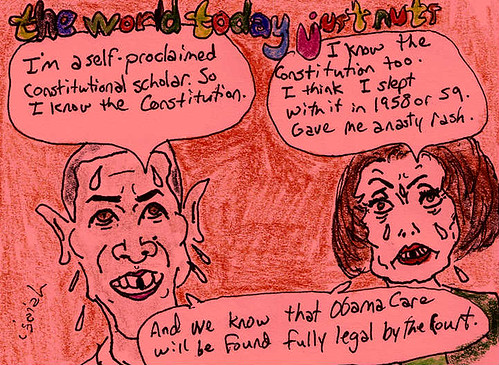
Wednesday, June 27, 2012

Image problems

If you missed the news, President Barack Obama is going to take a bus tour.  Julie Pace (AP) reports that he is desperate to connect with voters.  The glitzy million dollar fundraisers for celebrities have not allowed Mr. Obama to look of the people.  Imagine that.  Pace reports:


While Obama has been running for re-election for months, his efforts thus far have focused largely on hauling in cash from supporters in dozens of fundraising events across the country as his campaign seeks to compete with energized Republican donors. He spent the early part of this week on a two-day, four-state fundraising blitz that brought in more than $5 million.
It probably does not help that he has been hanging with disliked celebrities like Sarah Jessica Parker.  Talk about divisive. Men do not like her.  Women argue over whether her TV show was empowerment or consumerism run wild. 

I have bad news for the White House.  It is going to take a lot more than a bus tour to fix the president's image at this point.  A lot more.

This is C.I.'s "Iraq snapshot" for today:

Wednesday, June 27, 2012.  Chaos and violence continue, Nouri threatens early elections, we play out the worst case scenario which pits Nouri up against Vice President Tareq al-Hashemi (it could happen and it would be Nouri's fault if it did), a veterans wife tells the US Senate the VA shouldn't be able to destroy someone's dream of having a family, and more.
 
Today the editorial board of the Spokesman-Review observed the vast number of suicides among service members and veterans and noted the work of Senator Patty Murray including the bill she introduced Monday: "The bill spins off the discovery that as many as 285 soldiers -- or 40 percent of those diagnosed with post-traumatic stress disorder -- had thos findings reversed at the Madigan Army Medical Center in Tacoma since 2007.  A PTSD diagnosis can come with lifetime benefits, so a lot rides on those decisions.  Murray became concerned that costs were becoming a factor in overriding legitimate diagnoses when she learned that a Madigan forensic psyhciatrist urged team members to be cognizant of the bottom line.  It was at Madigan that many veterans were accused of faking symptoms to gain benefits.  Many of those PTSD diagnoses were restored after news of the high reversal rate."  Today she spoke of the bill, S. 3340.


Chair Patty Murray: The Mental Health ACCESS Act of 2012 is sweeping legislation that improves how VA provides mental health care. I think it is fitting that we are here considering this legislation on National PTSD Awareness Day.  Over the past year, this Committee had repeatedly examined the alarming rate of suicide and the mental health crisis in our military and veterans populations.  We know our service members and veterans have faced unprecedented challenges multiple deployments, difficulty finding a job whenhome, and isolation in their communities.  Some have faced tough times reintegrating into family life, with loved ones trying to relate but not knowing how.  These are the challenges our service membes and veterans know too well. But even as they turn to us for help, we're losing the battle. Time and time again, we've lost service members and veterans to suicide. We are losing more service members to suicide than we are to combat.  Every 80 minutes a veteran takes his or her own life. On average this year, we have lost a service member to suicide once every day.  But while the Departments of Defense and Veterans Affairs have taken important steps towards addressing this crisis, we know there's a lot more that needs to be done.  We know that any solution depends upon reducing wait times and improving access to mental health care, ensuring proper diagnosis, and achieving true coordination of care and information between the Departments.  The Mental Health ACCESS Act would expand eligibility for VA mental health services to family members of veterans.  It would require VA to offer peer support services at all medical centers and create opportunities to train more veterans to provide peer services.  This bill will require VA to establish accurate and reliable measures for mental health services.  This Committee has held multiple hearings on VA mental health care, and we heard repeatedly about the incredibly long wait times to get into care.  It's often only on the brink of crisis that a veteran seeks care.  If they are told "sorry, we are too busy to help you," we have lost the opportunity to help and that is not acceptable.  Without accurate measures, VA does not know the unmet needs.  Without a credible staffing model, VA cannot deploy its personnel and resources effectively.
 
That was this morning where she presided over the Senate Veterans Affairs Committee.  There is a ton of stuff to cover in that hearing.  Tonight at her site, Kat's grabbing Ranking Member Richard Burr as usual, Ava's going to fill in at Trina's site and cover Scott Brown, Wally will fill in at Rebecca's site to cover an aspect of the hearing which may be a cost issue but he's also considering a Bill of Rights and doesn't know yet what he'll go with.  Again, it was a jam packed hearing.  The purpose was to review and/or advocate for proposed legislation so you saw many US Senators not on the Committee appear before the Committee today.  We'll probably note the hearing in tomorrow's snapshot as well because so much did take place but we'll focus on Chair Patty Murray today.  If Murray's actions since becoming chair of the Committee were boiled down to one thing, I would argue she's been very firm that veterans have an equal playing field.  If they're promised something, it needs to be delivered.  If they're not promised something but civilians are, Murray's advocating for equality.  She has two bills she covered in the hearing.  We noted the mental health aspect.  Her other bill is S. 3313, The Women Veterans and Other Health Care Improvement Act of 2012. This pulls the VA into 2012 by recognizing reproductive injuries among other things.  Tracy Keil appeared before the Committee and noted, "I'd like to emphasize this statement: War time changes a family, it shouldn't take away the ability to have one."  But without the bill, many veterans families won't have the opportunity because certain procedures are not covered currenty.  She explained what happened to her and her husband, Iraq War veteran Matt Keil.  This is from her written statement.
 
My husband Matt was shot in the neck while on patrol in Ramadi, Iraq on February 24, 2007 just 6 weeks after we were married.  The bullet went through the right side of his neck, hit his vertebral artery, went through his spinal cord and exited through his left shoulder blade.  Matt instantly because a quadriplegic.  When I first saw him 3 days after he was injured I was in shock, they explained to me that he had a "Christopher Reeve type injury."  He would be on a ventilator for the rest of his life and would never move his arms or legs.
Matt and I looked at each other in his hospital room at Walter Reed and he asked me if I still loved him? I said "baby you're stuck with me!" at that moment we knew that we would be okay if we stayed in this together.  I knew that we just needed to work really hard to get Matt off his ventilator to increase his life expectancy.  Ultimately we moved to Craigh Hospital in Denver to be closer to family support.
Four weeks to the day of arriving at Craig Hospital in Denver, Matt was officially off of his ventilator and we could truly concentrate on him doing physical rehabilitation.  Matt has regained about 10% function of his left arm but not his hand.  He was feeling good and getting used to his new normal of being in a wheelchair and asking for help for everything.
It was while we were at Craigh hospital that we started talking about having a family.  Craig doctors talked to us about invitro fertilzation and recommended some doctors for us to speak to when we were ready tos tart a family.  We started to get really excited that even though so much had been taken away from Matt physically that we could still have the future we always dreamed of. 
My husband is the msot amazing man I have ever met, he is strong, honest and loyal and he wanted us to both have everything we always wanted before his injury and we agreed that this injury wasn't the end, it was the beginning of a new life, and we were in this together.
We had our whole lives ahead of us.  Matt was just 24 when he was injured and I was 28.  We are very fortunate that he survived his injuries that day and we made a promise to each other on our wedding day "For better or worse, in sickness and in health" I meant every word and still do today.  It is a challenge for my husband and I everyday but we knew we still wanted to start a family.  I remember back when he was in rehabilitation at Craigh Hospital it's all we could talk about was when we were going to be adjusted to our new normal and when we would we be ready to have children. We always knew we had wanted children.
In 2008 we moved into a fully handicap accessible home built for us by Homes For Our Troops.  We were strating to feel like things were falling into place in our lives.  We felt like we were starting to get back on track to where we were before Matt was injured.
His injury unfortunately prvents him from having children naturally.  In mid 2008 I started asking the VA what services they could offer my husband and I to assist us with fertility.  I can remember hitting road blocks at every turn.  I decided to take things into my own hands and write letters and make phone calls to try and get anyone to listen to us that we needed help.  Fertility treatments are very expensive and since I had left my full time job we were still adjusting to living on one income.
I felt helpless and hopeless and thought that our dreams of having a family may never come true.  The VA finally said that they would cover the sperm withdrawal from my husband . . . that costs $1,000 and that they would store the sperm for us at no charge.
It was very difficult when I found out there was no help available for us from the VA or Tricare. I felt very defeated, sad, disappointed and in some ways I felt helpless.  I researched everything I could about how to get Tricare to cover some of the costs but they couldn't because it was a direct result of my husband's injury and that fell under the VA.  The VA said that they had no programs in place for this sort of thing.  I even started asking non profits to assist with the cost and they couldn't help due to the other immediate needs of injured service members.
 
They had to jump through hurdles they never should have had to but , on November 9, 2010,
Tracy Keil gave birth to their twins Faith and Matthew.
 
Chair Patty Murray:  The Dept of Defense, as I mentioned earlier, provides access to advanced reproductive treatments.  And recently issued some guidance on offering these services at no cost to severely injured service members and their spouses.  The VA on the other hand can't provide these services and it's pretty clear that they don't meet the reproductive health care needs of veterans who have experienced severe trauma as you outlined to us in your testimony a few moments ago.  When you and your husband Matt were trying to conceive, you faced some very substantial road blocks from both the Dept of Defense and VA.  And since that time, DoD has changed their policy.  They now do offer fertility services for severely injured veterans.  I believe that veterans like Matt have earned DoD and VA coverage and there should be no difference.  I assume you agree with that?
 
Tracy Keil: I absolutely agree.  My understanding is that you would need to travel to a military treatment facility in order to receive those services that the DoD is offering -- whether that be Fort Bragg or Walter Reed. That's not an option for families of the most severely injured such as my husband. There's no way that I could travel to one of those treatment facilities  and care for my husband.  And I want him there every step of the way.  So that, for us, would not be an option.  I feel that he, with his service and sacrifice, I feel that he now falls under the VA guidelines  of care.  He is a retired -- medically retired -- service member. And he ultimately is the VA's responsibility.  So I feel that we fall under their responsibility.
 
A lot's going on in Iraq -- as usual -- so that's going to have to be it on the hearing for today.


In Iraq today a new development in the ongoing political crisis.  Khalid Al Ansary and Nayla Razzouk (Bloomberg News) report, "Iraqi Prime Minister Nouri al-Maliki will call for early elections if dialogue fails to resolve a political crisis, his media adviser Ali al-Moussawi said." Ahmed Rasheed (Reuters) notes that Nouri is threatening to "call for early elections if other political parties refuse to negotiate to end crisis over power-sharing that threatens to revive sectarian tensions."  To throw some reality at the topic, the crisis could end at any time -- as Moqtada al-Sadr has repeatedly noted -- by Nouri returning to the Erbil Agreement.  I realize that journalists are cowardly and stupid (friends excepted of course) but do they realize how bad they look as they report on the political crisis without addressing what's going on?  Since last summer, the Kurds, Iraqiya and Moqtada have been calling for a return to the Erbil Agreement.  For months now, as they have explored getting Nouri out of office, it has been noted that Nouri can stop that effort at any point by returning to the Erbil Agreement.
 
Now Nouri's saying that he'll call for early elections if others -- If others.  So the news?  If Nouri's making that threat it is reasonable to conclude that he (still) will not return to the Erbil Agreement.
 
What's the Erbil Agreement?
 
In March 2010, parliamentary elections were held.  Despite Nouri's 'polls' insisting his State of Lead would win by an overwhelming margin, they didn't.  They didn't even win.  Ayad Allaw's Iraqiya won.  Nouri refused to allow the Constitution to be followed, he refused to step aside and allow someone else to be named prime minister-designate.  He refused for over eight months.  It was Political Stalemate I.  The White House backed Nouri.  Otherwise he would have been forced out of office.  In November 2010, the US government negotiated an agreement, the contract known as the Erbil Agreement.  Nouri and the other leaders signed off on it.  In exchange for various concessions from Nouri, the blocs would allow him a second term as prime minister.
 
The tantrum throwing brat was appeased.  Nouri grabbed the Erbil Agreement and ran with it to have a second term as prime minister.  But he refused to honor the written promises he made in the contract.  And the US government was more than happy to play dumb. 
 
As noted earlier, this is what the political crisis is about.
 
As the calls to return to the Erbil Agreement increased and as Nouri refused to do anything.  People began to explore other possible actions and outcomes.  April 28th, Iraqiya, the Kurdisan Alliance and Iraqiya met in Erbil to discuss withdrawing confidence from Nouri. 
 
A press conference followed that meeting as these participants attempted to present a unified front.  And certain questions remained not only unanswered but also unasked.  Mustafa Habib (Niqash) asked the questions when he interviewed MP Diaa N. al-Asadi of the Sadr bloc last week.  For example:
 
NIQASH: Who came up with the idea of withdrawing confidence? 
 
Al-Asadi: In a meeting in Erbil attended by the leaders of various political blocs and also by al-Sadr, the President [of Iraq] Jalal Talabani suggested it because he felt there was a lot of support for the idea. Talabani himself felt that his role was being marginalized and his powers diminished.  Those who met in Erbil concluded that al-Maliki really had no intention to reform and that the best way change this situation was to initiate a motion of no confidence. Al-Sadr said that he was with them if they collected 124 votes [from MPs] supporting this motion. In which case, he would join them and then there would be enough votes [the Ahrar bloc have 40 votes, 163 were needed].
 
Iraqi President Jalal Talabani came up with the idea of a vote of no-confidence?
 
Very interesting. 
 
For those who've forgotten, Jalal was a big talker.  He also told those present that he could do a vote of no-confidence all by himself, without any need for a petition or a for a call from the floor of Parliament.  But it was decided to go the petition for no confidence vote.  And 176 signatures -- more than needed -- were collected.
 
It seemed a done deal.
 
Then Jalal came up with a new 'power.'  He could go through and authenticate the signatures -- that's not in the Constitution.  Per the Constitution, he's merely to pass any such petition onto the Parliament.  But authenticity turned out not to be enough for Jalal.
 
He eliminated signatures.  How come?  Because people said they signed it but they'd changed their minds.  That's not how a petition works.  Once you sign it, you've signed it.  You can vote in Parliament anyway you want but an MP who says, "Yes, I signed it but I've changed my mind"?  That's someone who needs to be told, "You can register that change when the Parliament takes a vote."  Under Jalal's 'rules' any petition you signed for a stop sign?  Call your local government.  Explain to them that you did sign the petition but now you've changed your mind and you want your name off.  See how long they laugh at you and grasp that Iraqi -- especially in the KRG -- are laughing even longer and harder at Jalal Talabani.
 
That's why he fled to Germany for an 'emergency procedure' that required him ignoring the request not to leave Iraq during this political crisis.  (The 'emergeny procedure'? Knee surgery.)
 
Nouri's threat to call early elections is only the most recent tactic.  Already, he's been  rejecting calls to appear before the Parliament.  Kitabat reports today that the Speaker of Parliament's office released a statement noting that the Constitution outlines this process and that Parliament is an equal partner in government.  In addition, the statement notes that the Parliament is the legitimate representatives of the people and that must be recognized.  Unlike the post of prime minister or the Cabinet of Ministers, the people vote in Parliament elections.  (It's a bit more complicated than that in practice but we don't have time this morning.  Suffice is to say, most of the MPs were not voted on as individuals.)  Alsumaria notes that the statement goes onto point out that the Parliament's successfully passed "hundreds" of bills in the legislative session and that they are doing the work of the people.  The statement notes that the Constitution must be respected.

Nouri's political slate State of Law came in second in the 2010 elections.  That may explain the perpetual chip they have on their shoulder.  Alsumaria notes they are saying Speaker of Parliament Osama al-Nujaifi made a "fatal error" by signing onto an agreement in Erbil.  They're not clear on which agreement.  It's a 2012 one and may mean the April 28th deal or something later.  It's so very hard to tell what the half-wits of State of Law mean to say.  They're also attacking Moqtada al-Sadr and stating now that his decision not to take part in questioning of Nouri (should Nouri appear before Parliament) indicates he's on their side.  No, it indicates that Moqtada's acting consistent with what's he's stated for months now: This isn't about dumping Nouri, this is about returning to the Erbil Agreement.


Al Rafidayn reports Ibrahim al-Jaafari has declared the Nationl Alliance will create a reform body.  Talk about meaningless gesutres. A toothless body of Nouri supporters will 'oversee' Nouri?  Already Alsumaria reports Iraqiya (who came in first in the 2010 elections) is calling the measure a non-starter that will not resolve the crisis.  It's in that environment that Nouri threatened to call early elections.  Hevidar Ahmed (Rudaw) quotes Kurdish MP Arif Tayfur (Kurdistan Democratic Party) offering of the chances of Nouri keeping political promises, "He has not done it for six years and he has constantly attempted to add to this crisis."
 
W.G. Dunlop (AFP) quotes Nouri's website where a statement reads, "When the other side refuses to sit at the table of dialogue and insists on the policy of provoking successive crises in a way that causes serious damage to the supreme interests of the Iraqi people, the prime minister found himself forced to call for early elections."  (Whether it was intended as an inside joke or not, Dunlop's "President Jalal Talabani's position on the issue was not immediately clear." made me laugh. And, intended joke or not, Dunlop's report is the strongest factually of any on the topic.  The weakest?  AP because, yet again, they treat an ongoing crisis as something that only started December 21st.)
 
Though it's in the news cycle today, early elections have long been floated by others.  As we pointed out yesterday:
 
Some might see that as a good way to go and possibly it is.  But there is a potential negative side.  Parliament gets dissolved and Nouri rules through the next elections.  The next elections would not be in  a matter of weeks.  The KRG is currently working on their laws ahead of the 2013 provincial election.  This could take months and the KRG runs smoother than any other part of Iraq.  Meaning parlimentary elections are scheduled for 2014.  The Nouri al-Maliki who let over 8 months of gridlock pass following the March 2010 elections isn't necessarily someone who feels pressure to move in a speedy manner.  He could easily stall and delay it so that there are no elections until 2014 when they ae scheduled to take place.
 
Also, you might remember that the 2010 parliamentary elections were supposed to take place in 2009.  But kept getting pushed back and pushed back.  Remember all of Chris Hill's assurance on them that ended up being wrong?  Chris hopes you don't, he's still pretending an expert on Iraq. Bare minimum for early elections: all voting laws must be in compliance and be fair (the KRG is addressing a law that reads so that Christians can only vote for other Christians, that's the law they're trying to amend currently), a law for the election must be passed -- which requires agreement (one big sticking point in 2009 was the issue of how many external refugees Iraq had and whether or not they were properly represented -- remember that, we'll come back to it) and you need to print up the ballots and have the election centers in place.  The ballots is with the help of the United Nations.  As November progressed in 2009, the UN announced there would be no 2009 elections because there was no longer enough time to print the ballots.  For the March 7, 2010 election ballots, the UN began printing those on January 21, 2010 and they were pressed but managed to do it in 45 days.
 
Here's the Iraqi Constitution's Article 61:
 
Article 61:
First: The Council of Representatives may dissolve itself with the consent of the absolute majority of its members, upon the request of one-third of its members or upon the request of the Prime Minister and the consent of the President of the Republic. The Council may not be dissolved during the period in which the Prime Minister is being questioned.
Second: Upon the dissolution of the Council of Representatives, the President of the Republic shall call for general elections in the country within a period not to exceed sixty days from the date of its dissolution. The Cabinet in this case is considered resigned and continues to run everyday business.


Remember the refugee issue and how we were talking about how it was part of the delay in 2009 on parliamentary elections?  Sunnis make up a larger number of external refugees than do Shi'ites (and refugees are allowed to vote in Iraqi elections, they do not have to be living in Iraq).  And this was among the reasons that Vice President Tareq al-Hashemi wanted them to be represented properly (a quota is set aside).  When he didn't get what he wanted, he vetoed the proposed law as was his right.
 
What our 'constitutional' experts who've never studied a Constitution don't understand is that a Constitution has stated powers and implied powers.  In addition, there are powers that become powers via custom.  In the US, for example, the failure to hold Barack Obama accountable for the same crimes that Bush committed?  A legal argument can now be made that those powers exist for the presidency now via custom.  You have had a Republican do it and now a Democrat do it and the Congress never bothered to outlaw it or challenge it.  So, it can be argued, it's now a power of the office via custom.
 
All the Nir Rosens and his circle jerk buddies cheering on Nouri's authoritarian stance never seemed to grasp that in a country with a new Constitution, it was not only important that the Constitution be followed, it was vital that it be followed.
 
But here's where Nouri's power grabs could potentially bite him in the butt.  Nouri's refused to name the security ministries.  He's refused to nominate anyone and send them to the Parliament for a vote.  He's instead created 'acting' ministers -- a term that doesn't exist in the Constitution.  But he's done that for some time now.  Jalal Talabani, as we noted last week, in what was probably a pathetic bid for sympathy, floated the notion that when he returned to Iraq after his 'delicate' surgery, he would step down as president.
 
If that happens, who's president of Iraq?  Until one's electing, it can be argued that a vice president becomes 'acting.'  Article 69 makes no mention of this and outlines how the Parliament would begin to elect a president if one resigned.  But there's no mention of 'acting' ministers in the Cabinet either and the Parliament might have other things to do or might be on a break.
 
Were that to happen -- and this will shock some -- the 'acting' president of Iraq would be Tareq al-Hashemi.  Some will gasp, "He's on trial!"  Check the Constitution.  He's not been removed from his office.  And to be removed the Speaker of Parliament would have to go along with it.  That's Osama al-Nujaifi.  Like al-Hashemi, al-Nujaifi is both Sunni and a member of Iraqiya. 
 
During Nouri's first term as prime minister (beginning in 2006), Vice President Adil Abdul-Mahdi and Vice President Tareq al-Hashemi were Iraq's two vice presidents.  In early 2011, there was a move towards upping it to three vice presidents and it would have gone through at that time but, among other reasons, sexism prevented it.  The three would have been Adil Abdul-Mahdi, Tareq al-Hashemi and female Turkman. Sexism doomed that.  But the idea of three wasn't dropped and the male Khudair Khuzaie was quickly named to the spot along with Abdul-Mahdi and al-Hashemi.  This caused the leader of the Iraqi Turkmen Front issued the following statement February 14, 2011:
 
We, as the Iraqi Turkmen Front, as a political organization defending the legal national rights of the Turkmen nation, thank the President of Iraq for his request for a fourth vice presidency and for the candidate to be a Turkmen.  However, we would have wished that the third vice presidency position be offered to the Turkmen and we would like to take the opportunity to ask the distinguished Presidenty why the third vice presidency was not offered to a Turkmen candidate. 
The distinguished President could have requested the fourth vice presidency position and refrained from disclosing the names of the three other vice presidents and sending them to the Iraqi parliament before this position was approved.
The names of the three vice presidents presented to the Iraqi Parliament in a single list and a request to the same parliament for a fourth vice presidency position is just a ruse thrown in front of those who obstruct the Turkmen and their legal rights.  Those segments have resisted the deputizing of a Turkmen vice president from the beginning.
For this reason, we request that after the fourth vice presidency is approved, the names of all four vice presidents are presented to the Iraqi Parliament together.  Otherwise, we must accept that the proposal was not serious and just an incident targeting the rights and jurisprudence of the Turkmen.
Dr. Sadettin Ergec
Leader of Iraqi Turkmen Front
 
 
In May of 2011, when the 100 days Nouri asked the protesters for (give him 100 days and he would address the lack of public utilities, the issue of unemployment, the issue of the missing in Iraq, etc. and all the corruption) expired and Nouri hadn't done anything, Adil Abdul-Mahdi announced government was not serving the Iraqi people and he was resigning.  That makes Tareq al-Hashemi the senior vice president.  He remains in office.  By the rules Nouri's created over the years for acting ministers -- including in 2010 when he forced the Minister of Oil off as also being the Minister of Energy when the latter minister quit -- Tareq al-Hashemi can assume the presidency if Jalal steps down.  He can be 'acting' president until the time comes that Parliament votes in a new president.
 
There is nothing in the Constitution -- read it -- that says the president must be in Baghdad.  In fact, as written, al-Hashemi could be president of Iraq -- 'acting' president -- from Saudi Arabia if he wanted.  So if Jalal does make good on his threat and Nouri tries to make good on his, there is a chance that Tareq al-Hashemi could announce himself 'acting president.'  And you can be sure Osama al-Nujaifi, in his role of Speaker of Parliament, would recognize al-Hashemi as that.
 
That would mean no consent for early elections and that would also mean al-Hashemi would immediately call for a withdrawal of confidence vote.
 
The Constitution needs to be followed.  Nouri's lived outside it for two terms now.  In doing so, he's created powers that don't exist but have remained unchallenged.
Mohammed Tawfeeq (CNN) notes that Iraq experiences bombings again today.  Lu Hui (Xinhua) counts two bombings which left 11 dead and twelve injured with one of the bombings targeting the home of a Sahwa and, when people arrived on the scene, another bomb went off.  Alsumaria notes that another house was also bombed killing 3 women in one family.  While some outlets are counting three bombings, AFP and  BBC count two.  In addition, Alsumaria reports a Babel sticky bombing which claimed 1 life and left another person injured.


Lastly, despite reports yesterday ("The body of an American contractor who was found dead in Baghdad was flown back to the U.S. on Tuesday after a two-week bureaucratic debate over whether the Iraqi government would perform an autopsy on his remains."),  Michael David Copeland's body was not flown to the US. The body of the Iraq War veteran who died June 9th, shortly after retutning to Iraq as a worker for DynaCorp, was in Kuwait as of Tuesday night according to his family.  His father Mike Copeland tells Jamie Oberg (News9 -- link is text and video) that, "We are very pleased to know that the long struggle as far as that goes is over, he's not home yet of course he's got a long ways to go and we still don't know what the cause of his death was."  Victoria Maranan (KXII -- link is text and video) adds, "He died 17 days ago while working for a contractor in Iraq. His family has been fighting to have his body brought home to Oklahoma ever since. Mike Copeland said they were notified yesterday by DynCorp that arrangements had been made to send Michael David's body back to the U.S. He said the Iraqi government did not perform the autopsy, but instead it will be performed by the Armed Forces Medical Examiner when Michael's body arrives in Delaware.Bryan Dean (News OK) quotes Michael David Copeland's cousing Brent Barry stating, "He will be flown to Dover, Del., arriving on Thursday."
 
 
cnn

Tuesday, June 26, 2012

How to tell a pig

Do you ever wonder how to tell if someone is a sexist pig?

Film maker Nora Ephron passed away today.  Steven Zeitchik (Los Angeles Times) wants to offer some quotes from her films.

There are six quotes from scripts she wrote or co-wrote.  Four of them are men.

Pig.

And none are from Meg Ryan's characters.

Double Pig.

Meg Ryan played the lead in When Harry Met Sally . . . (written by Ms. Ephron), in Sleepless in Seattle (directed and co-written by Ms. Ephron), in the Diane Keaton directed Hanging Up (co-written by Nora Ephron), and in You've Got Mail (directed and co-written by Ms. Ephron).  That is four roles and out of four roles Steven Zeitchik cannot find one funny line from Ms. Ryan?

Pig.

I can think of many fun lines.  For example, from When Harry Met Sally . . . , every line is funny and it leads into the most famous scene.  Harry tries to defend himself as a lover.


Harry: I think they have an OK time.
Sally: How do you know?
Harry: What do you mean how do I know? I know.
Sally: Because they...
Harry: Yes, because they...
Sally: And how do you know that they really...
Harry: What are you saying, that they fake orgasm?
Sally: It's possible.
Harry: Get outta here!
Sally: Why? Most women at one time or another have faked it.
Harry: Well they haven't faked it with me.
Sally: How do you know?
Harry: Because I know.
Sally: Oh, right, that's right, I forgot, you're a man.
Harry: What is that supposed to mean?
Sally: Nothing. It's just that all men are sure it never happened to them and that most women at one time or another have done it so you do the math.

 After this, Sally (Meg Ryan) will fake an orgasm in the deli for Harry (Billy Crystal) and Rob Reiner's mother will say, "I'll have what she's having."

And some lines were funny and deep.  In You've Got Mail, Ms. Ryan's character is asked by her boyfriend, as they break up, if there is someone else and she replies, "No, but there's the dream of someone else."

This is C.I.'s "Iraq snapshot" for today:


Tuesday, June 26, 2012.  Chaos and violence continue, the Iraqi political crisis continues, 5 members of the Kurdish Alliance prepare to question Nouri al-Maliki, Mad Maddie Albright repeats herself, Tony Blair remains in hot water, the ICRC continues their work in Iraq, and more.
 
Starting in the US where conservative Robert Maginnis weighs in on Iraq at Human Events.  First up, good for him, he notes the ridiculous 'survey' by the National Democratic Institute which was nothing but lies and he notes, rightly, that some outlets stupid enough to run with it (the New York Times -- always a whore -- and it's this piece by Tim Arango and Duraid Adnan).  We noted the poll May 22nd, either as it was being released or right after (a day) or right before (ibid):
 
Perhaps the saddest thing for the White House was realizing that it you want bi-partisanship, don't piss off Republicans.  Specifically, don't piss off [a] Republican on the issue of Iraq.  (Think about it, you'll quickly guess which US Senator I mean.)  Not only did he rally opposition to keep the International Republican Institute from being used to rubber stamp numbers that were going to be called results for a poll, he's gone away making sure many know that an upcoming National Democratic Institute for International Affairs  'poll' was nothing but propaganda on behalf of the White House.  The poll will insist -- abusrdly -- that Nouri al-Maliki's popularity is on the rise.
It would have been unbelievable coming from a reputable polling organization.  It would have been laughable coming from the NDI (a notorious tool to oppress and suppress freedom around the world -- as is its Republican counterpart) but with the senator telling anyone who will listen how the White House shopped it first as a joint-poll and the had no interest in it, the White House looks like its in the business of non-stop lying.  But maybe that's every administration's business?  Regardless, it's not a good time for the administration.
 
Maginnis and I will never agree on the illegal war but good for him for calling out the 'poll' ("Obama loyalists hosted and conducted the survey.").    It's a surprisingly strong article:
 
On the day the U.S. withdrew from Baghdad Maliki's security forces surrounded the residences of prominent Sunni politicians including Vice President al-Hashemi, to arrest him on charges of running death squads. But Hashemi escaped to northern Iraq and sectarian violence has since skyrocketed.
"It is very troubling the Maliki-led government is operating on cultivating sectarian tensions and executing policies to suppress democracy at the expense of the Iraqi people," said Vice President al-Hashimi from his exiled refuge.  He continued, "Iraqi politicians must put the past and our differences behind us to improve the lives of our people."
But Maliki isn't putting past differences behind him.  Rather he is resurrecting memories Iraqis associate with their former dictator, Saddam Hussein.
Second, the DNI/GQRR survey found most non-Shia Iraqis believe Maliki has too much power and 64 percent say he acts like a dictator.  Iraqis have good reason to associate Maliki's actions with their former dictator.
The prime minister is consolidating personal power as did Saddam Hussein says British scholar Toby Dodge who outlined Maliki's power grab at a forum hosted by the National Defense University and reported in Foreign Affairs.
Maliki completely transformed Iraq's security and intelligence forces to be at his beck and call, explained Dodge.  The prime minister retained the title and role of defense and interior ministers, controls all high-ranking appointments, and created special counter-terrorism brigades that report directly to him.  These special forces, which some Iraqis label fedayeen [Arabic for "those who sacrifice"] al-Maliki, remind them of Hussein's fedayeen Saddam which performed the dictator's dirty work.
 
And "surprisingly strong" is not due to, 'From the left, I can't believe anyone on the right can get anything about Iraq correct!'  "Surprisingly strong" means that at a time when the US media clearly doesn't give a damn about Iraq, it's surprising to find a strong article in any US media.  Good for Robert Maginnis.  And for any who are surprised that Republicans might want to make an issue out of Iraq, weren't you paying attention?  We told you that was the plan back in 2009.  That's why the questions and issues about Chris Hill were raised at his confirmation hearing.  We went all into that and how he would get confirmed but Republicans were getting it on the record. 
 
Many Democrats supported the war and many went along.  If they didn't, they could have stopped it at any time.  Former US Senator Mike Gravel discussed how you do that repeatedly in 2007 and 2008 but no one wanted to end it, not even 'brave' Dennis Kucinich.  And along with supporters and tag-alongs, you also had the evil that actively worked to get the illegal war up and going.  Indo-Asian News Service reports on the human garbage dump that is Mad Maddie Albright who declared in New Dehli today that "the war on Iraq was the biggest mistake we could make and are still hurt because of it." Lest anyone think the woman known as "Iraq's Grim Reaper" has come to her senses, she rushed to insist "that the international community has a responsibility to act if a country's leaders deny the people their rights, despite such actions being an encroachment of that country's sovereignty."  But Mad Maddie, as you damn well know, the costly and illegal Iraq War wasn't sold to the American people as, "Let's go kill millions and send our own off to die in a foreign land because we think the people are being denied rights!"  That never would have sold the illegal war.  Just last week a Dartmouth YouGov poll (with a +/- 3.18% margin of error) found only 32.1% of Americans surveyed would support using US military force "To stop small-scale or moderate human rights abuses by the government, such as the killing of tens or hundreds of civilians." 
 
The sentiment is similar around the world and not surprising.  It's why the United Kingdom required Tony Blair's endless lies -- including silencing objection from his government's legal expert about the legality of the Iraq War -- to sell the war there.  And in England, the war refuses to fade as an issue and the publication of Alistair Campbell's liary has only led to more attention.  More news from the book broke over the weekend.   Jane Merrick and Matt Chorley (Independent) reported:

MPs demanded an emergency recall of the Chilcot inquiry last night after new revelations that Tony Blair blocked the Government's most senior lawyer from explaining to Cabinet the legality of the war in Iraq. According to the newly published full version of Alastair Campbell's diaries, the Attorney General Lord Goldsmith wanted to "put the reality" to cabinet ministers that there was a case against, as well as for, military action in March 2003. But, according to his former spin doctor, the then Prime Minister feared that the legal opinion was too "nuanced" and would allow the war's ministerial critics Robin Cook and Clare Short to say that the case had not been made.


"Why does Alastair Campbell's account of cabinet decision-making about Iraq nine years ago still matter?" asked the editorial board of the Independent before answering:

Because, more than any that a government can make, the decision to join military action is the most serious. Millions of British people believed at the time that they were being taken to war on a false premise. They, and The Independent on Sunday, feared that Tony Blair had committed himself to the US. George Bush's motives were an unhealthy mixture of wanting to impress US voters with a vigorous response to the humiliation of 9/11, completing his father's unfinished business from the first Gulf War and a strategic concern about security of oil supplies.
 
By Monday,  Daniel Martin (Daily Mail) was reporting that Campbell had already rushed to deny that what he wrote meant what it said: "Mr Campbell said on his blog yesterday that the entry had been misinterpreted, and that Lord Goldsmith had addressed Cabinet after the meeting referred to in the diary. He had argued in Cabinet that there was a legal case for war and was cross-questioned by ministers."  
 
 
On my previous post on the issue of the Independent on Sunday article claiming that "Tony Blair blocked the Government's most senior lawyer [the attorney general] from explaining to Cabinet the legality of the war in Iraq", it was noted that Alastair Campbell had responded to the story on his blog. Campbell's (attempted) rebuttal largely misses the point but does make a very good point about what the views of the attorney general (Lord Peter Goldsmith] were at the time.
Campbell is so hooked on his self justifying claim that "The Real Spin Doctors Are The Journalists" that he does exactly what he accuses one of the IoS story's authors of doing.
I also drew attention to various passages of former Attorney General Peter Goldsmith's evidence to Chilcot, and asked if the IoS had bothered to study it before rushing to print a story which conformed to their view of the Iraq war.
e.g. when Sir Roderic Lyne asks: 'so no one at any stage asked you to restrict what you said to cabinet to the fairly limited terms in which you presented this to cabinet?' And Goldsmith replies 'No.'
If Campbell had bothered to read the IoS story properly, he would have seen -- as I pointed out yesterday -- that it did quote exactly that piece of evidence to the Inquiry. He later claims that what he recorded in his diary – that Blair "made it clear he did not particularly want Goldsmith to launch a detailed discussion at Cabinet" – is "consistent" with this.
 
Poodle Tony and Mad Maddie, two War Hawks. The Albright article notes that Mad Maddie's supporting Barack in the 2012 elections -- of course she is.  War Hawks of a feather bind and teather.  Just last month, Barack gave her the Presidential Medal of Freedom (she also chairs the laughable National Democratic Institute we were just mentioning).
 
From the killing machines to care, the International Committee of the Red Cross released a statement on their latest update on Iraq today, noting at the top:
 
With the impact of Iraq's long years of war and insecurity still marring the future, older problems, such as water scarcity and weak infrastructure, are also harming prospects for development and stability.  The ICRC is striving to improve the situation in the areas hardest hit. 
The ICRC has been working in Iraq for the past 30 years, attending to the mounting humanitarian needs. During this period, the challenges relating to water and basic public infrastructure have taken various shapes.  The fall in the water levels of the Tigris and Euphrates river, which provide the bulk of Iraq's water supply, is not new.  The ICRC has long been warning of the serious consequences of a dwindling water supply.  But present-day Iraq faces challenges that are even more daunting. 
 
 
How very sad that the ICRC has to depend upon donations for their work in Iraq when so much of it could be done by the Iraqi government which is too cheap to spend the billions on making life better for the Iraqi people.  Iraq's not a poor country.  Kadhim Ajrash and Nayla Razzouk (Bloomberg News) report today,  "Iraq's crude output rose to the highest in 20 years as the Halfaya field increased production."
 
The Red Cross update, covering March 2012 through May 2012, is entitled [PDF format warning] "Iraq: The Challenge of Providing Clean Water and Rebuilding Infrastructure"  which quotes the ICRC's Alexandre Farine stating, "Access to clean water is not the only problem faced by Iraqis today, though it is one of the major ones.  There are areas in Iraq where entire systems are in need of repair.  We are focusing on the areas that have been hardest hit, where such problems have posed the greatest challenge for the population.  People's daily lives are affected by the scarcity of clean water, which in turn causes health and hygiene problems."   The update notes the ICRC's work on behalf of the disabled:
 
* treated 8,398 patients, 4, 266 of whom were amputees;
* manufactured 4,840 devices and fitted patients with them so they could walk again;
* distributed 227 crutches and 40 wheelchairs to needy patients;
* provided training in wheelchair adaptation and assembling and in management of ankle-foot orthosis services in three centres;
* provided on-site support for nine primary health-care centres in areas including Ninawa, Kirkuk, Diyala, Babil, Baghdad and Diwaniya, serving approximately 260,000 people
 
There are many other findings in the report but here's what the ICRC is emphasizing from the update:
 
  • supported the upgrade of more than 100 kilometres of irrigation schemes in Rabea and Qaratapa, in Dohuk and Diyala governorates respectively, which will help increase agricultural production and income for more than 1,500 families;
  • enrolled 437 needy community members in cash-for-work activities in connection with the irrigation works, enabling those taking part to temporarily increase their household income;
  • awarded 183 grants to disabled people and to women heading households in Kirkuk, Diyala, Ninewa, Suleymaniyah, Basra and Missan and Erbil, enabling them to start small businesses and regain economic self-sufficiency;
  • distributed essential hygiene and household items to over 17,300 displaced people in Salah Al-Din, Anbar, Sulaimaniyah, Kirkuk, Dohuq and Mosul; 527 of the beneficiaries also received basic food items for one month for their families;
  • provided aid for 1,092 women heading households in Baghdad and Anbar governorates, and helped them register with the State welfare allowance system.
 
 
The update notes other topics including their work on identifying the dead -- such as from Iraq's war with Kuwait -- allowing the remains to be returned home.  Iraq released the remains of a US citizens.  Dropping back to the June 20th snapshot:
 
 An Iraq War veteran returned to Iraq as a DynaCorp [worker] and was dead a week later.  Now his family fights to have his body returned to the US.  Steve Shaw of Oklahoma's News 9 (link is text and video) reports:


Angela Copeland: They came in and they told me that they had found Michael deceased in his living quarters.


 Steve Shaw:  Michael Copeland's widow Angela is distraught -- not only because of Michael's sudden death but because our State Dept told Copeland's family Iraqi leaders say Copeland died of Severe Acute Respiratory Syndrome -- or SARS -- an extemely rare disease, and our State Dept bought it.  Iraq says it can't release the body.  Michael Copeland's fathe says he talked to his son by phone just 12 hours before his death,  nobody's died from SARS since 2003, and he says that his son showed no signs of the disease.


Mike Copeland:  Everyone that I've spoke with is always sorry for our loss but they say there's nothing they can do. I find that very difficult to believe.  That my government?  There's nothing they can do to bring my son home fom Iraq?
The Center for Disease Control and Prevention's SARS page notes:


Severe acute respiratory syndrome (SARS) is a viral respiratory illness caused by a coronavirus, called SARS-associated coronavirus (SARS-CoV). SARS was first reported in Asia in February 2003. The illness spread to more than two dozen countries in North America, South America, Europe, and Asia before the SARS global outbreak of 2003 was contained. Since 2004, there have not been any known cases of SARS reported anywhere in the world. The content in this Web site was developed for the 2003 SARS epidemic. But, some guidelines are still being used. Any new SARS updates will be posted on this Web site.


No new updates have been posted to the CDC's page.

"Not only are we having to deal with the loss,"
Angela Copeland tells NewsOn6, "but we're having to deal with the battle to get him back home."  Michael Copeland died June 9th.  She tells Victoria Maranan (KXII -- link is video),  "There is absolutely no excuse in this world that you could give me that could convince me why he should not be home."  Jerry Wofford (Tulsa World) reports on the case and quotes Oklahoma State Rep. Dustin Roberts stating, "Michael David Copeland was a man who served our nation as a Marine and our state as a National Guardsman, and his family deserves better than this."  Zach Maxwell (Durant Democrat) reports this evening, "The family of Michael Copeland is still waiting for answers more than 10 days after the former Marine and National Guardsman passed away in Iraq."
 
 
Lara Jakes (AP) reports Michael David Copelad's body is back in the US and that the long delay resulted from disputes "over whether the Iraqi government would perform the autopsy on his remains."
 
In Iraq, the political crisis continues as efforts are pursued to question thug and prime minister Nouri al-Maliki before Parliament and, if answers do not reassure, move towards a vote to withdraw confidence in Nouri.  Because there is so much confusion in the press about what's required and what's allowed, we'll note the following from Article 58 of the Iraqi Constitution:


Seventh:
A. The Council of Representatives member may direct questions to the Prime Minister and the Ministers on any subject within their specialty and they may answer the members' questions. The Member who has asked the question solely has the right to comment on the answer.
B. At least twenty-five members of the Council of representatives may table a general issue for discussion to obtain clarity on the policy and the performance of the Cabinet or one of the Ministries. It must be submitted to the President of the Council of Representatives, and the Prime Minister or the Ministers shall specify a date to come before the Council of Representatives to discuss it.
C. A Council of Representatives member with the agreement of twenty-five members may direct a question to the Prime Minister or the Ministers to call them to account on the issues within their authority. The discussion on the question shall begin at least seven days after submitting the question.
Eighth:
A. The Council of Representatives may withdraw confidence from one of the Ministers by an absolute majority and he is considered resigned from the date of the decision of confidence withdrawal. The issue of no confidence in the Minister may be tabled only on that Minister's wish or on a signed request of fifty members after an inquiry discussion directed at him. The Council of Representatives shall not issue its decision regarding the request except after at least seven days of its submission.
B.
1- The President of the Republic may submit a request to the Council of Representatives to withdraw confidence from the Prime Minister.
2- The Council of Representatives may withdraw confidence from the Prime Minister based on the request of one-fifth (1/5) of its members. This request may be submitted only after a question has been put to the Prime Minister and after at least seven days from submitting the request.
3- The Council of Representatives shall decide to withdraw confidence from the Prime Minister by an absolute majority of its members.
C. The Government is considered resigned in case of withdrawal of confidence from the Prime Minister.
D. In case of a vote of withdrawal of confidence in the Cabinet as a whole, the Prime Minister and the Ministers continue in their positions to run everyday business for a period not to exceed thirty days until a new cabinet is formed in accordance with the provisions of article 73 of this constitution.


As you can see from the above, there really wasn't a requirement for Jalal Talabani to 'vet' the petition he was given nor for X-number of signatures to be on it.  It had 176 but that wasn't good enough for President Jalal who stabbed his partners (Moqtada al-Sadr, KRG President Massoud Barzani, Iraqiya's Ayad Allawi, etc.) in the back.  Last week, Mustafa Habib (Niqash) interviewed MP Diaa N. al-Asadi who heads Moqtada's bloc in Parliament.  Excerpt:
 
NIQASH: So how did this initiative – to withdraw confidence from al-Maliki's regime – get started?
 
Al-Asadi: A series of events. There were a lot of negative indicators regarding the performance of the government; the Iraqi people went to protest on the streets to demand reform and improved levels of services; those demands were not politically driven. 
Additionally the government has not respected the Erbil agreement [formulated to end a nine month dispute over who should run the government following 2010 elections] and they have caused political crises over [deputy PM] Saleh al-Mutlaq and Vice President Tareq al-Hashimi. All of these factors have combined to create a lot of pressure. There was an urgent need to find a definitive solution. 
 
NIQASH: Can you give us more details about this initiative to withdraw confidence?
 
Al-Asadi: Other political parties – the Iraqiya bloc and the Kurdish bloc - came to us, complaining about the way al-Maliki was governing. They felt that al-Maliki was creating these crises and then resolving them in ways that served only his interests. 
We, the Sadrists, were already unhappy with him. And they asked us to take a patriotic stand.
That's why Muqtada al-Sadr met with al-Maliki in Tehran, when al-Maliki was there. We discussed with him what his version of the crises was and his ideas on how to solve them.
But al-Sadr also wanted to hear what other parties had to say. That's why he went to Erbil to meet with Masoud al-Barzani, the president of [the semi-autonomous region] Iraqi Kurdistan.
It was at this stage that al-Sadr said he was for the use of constitution and legislation [to get out of the political impasse]. The results of that meeting in Erbil and of another in Najaf ended in a letter that was sent to al-Maliki's office.
This letter contained nine points, suggestions for the resolution of the political crisis in Iraq. Seven of the nine points focused on reform and the other two suggested a motion of no confidence was possible if the other seven points were not dealt with, and if limits were not put on how long the Iraqi prime minister could be in power. This letter was ignored by al-Maliki's office. 


Alsumaria reports that Moqtada does not plan to question Nouri himself.  That's not surprising.  Throughout this process, Moqtada has stated that if Nouri would agree to return to the Erbil Agreement (contract between the political blocs that the US government drew up with gave Nouri a second term as prime minister -- despite his State of Law coming in second in the 2010 elections -- in exchange for concessions from Nouri), they would drop the move to vote him out of office.  Moqtada has stated that over and over.  He's also stated that he plans to listen to the answers Nouri provides to the Parliament (Nouri's refusing to appear so he may not provide any answers) and then make up his mind on the vote.

Who would question Nouri?  Alsumaria reports that the Kurdistan Alliance has five deputies prepared to question Nouri before Parliament and the Kurds state they will not be silent even in Nouri (appears before Parliament, faces questions) and manages to stay in power.  This is becoming a very big issue in the KRG and may become a position of honor.  Nouri became prime minister in 2006.  The Constitution -- Article 140 -- called for him to hold a referendum and census for Kirkuk by the end of 2007.  He refused.  He still refuses.  The Kurds feel Kirkuk is their province and this is only one of the many disputes between them and Nouri's Baghdad government.  You've also got the shrinking Jalal Talabani (his influence is on the wane at present) and his disregarding the Kurdish hope of an independent Kurdish homeland.    So there are a lot of details at play as a confrontation looms and a lot of tangled emotions can become vested in this move towards no-confidence.

Dar Addustour reports the National Alliances Ibrahim al-Jaafari declared Nouri is not planning to face Parliament and that he is questioning the process.  (He should refer to the Constitution.)  Meanwhile Nouri's trying another stalling technique.  Al Rafidayn reports that he's calling for a national dialogue.  He only wants that when he's in trouble, then when it's 'about to happen' or even scheduled, he manages to subvert it as well.  Kitabat reports Nouri's threatening to dissolve the Parliament and call for early elections. 
 
Some might see that as a good way to go and possibly it is.  But there is a potential negative side.  Parliament gets dissolved and Nouri rules through the next elections.  The next elections would not be in  a matter of weeks.  The KRG is currently working on their laws ahead of the 2013 provincial election.  This could take months and the KRG runs smoother than any other part of Iraq.  Meaning parlimentary elections are scheduled for 2014.  The Nouri al-Maliki who let over 8 months of gridlock pass following the March 2010 elections isn't necessarily someone who feels pressure to move in a speedy manner.  He could easily stall and delay it so that there are no elections until 2014 when they ae scheduled to take place.
 
And?
 
If Nouri dissoled the Parliament, who would act as a check on his power?  New elections might not come until 2014.  During the time between that and right now, Nouri would have no check on his power. 
 
That's something for Iraqis to consider as they weigh what's going on. 
 
It could get very hard to determine what's going on if Nouri is successful in attacking the media.
Qassim Abdul-Zahra (AP) quotes Moqtada al-Sadr stating, "In our beloved Iraq, the government is always interfering in the affairs of media outlets and tring to politicize them."  Saturday the Journalism Freedoms Observatory published an alert about a government list of 44 news outlets Nouri's government was planning to close.  Ruchi Shroff (Digital Production) observes, "Organizations targeted for shutdown reportedly include BBC, Voice of America, U.S.-financed Radio Sawa, as well as privately-owned TV channels Sharqiya and Baghdadia." AFP notes, "Iraq regularly ranks near the bottom of global press freedom rankings. It placed 152nd out of 179 countries in media rights watchdog Reporters Without Borders' 2011-2012 World Press Freedom Index, down 22 from the year before."  Kitabat notes the Ministry of the Interior has rushed to distance itself from the issue, declaring it had no issued the orders and that its role in implementing them would be minimal.  Today Alsumaria reports the commission says it is putting the list (temporarily) on hold.  On hold.  It's not been dropped.


Turning to the US where Senator Patty Murray is the Chair of the Senate Veterans Affairs Committee. Her office notes that proposed legislation will be discussed in a hearing of the Committee tomorrow and that Murray will discuss her bills to ensure equality for veterans the Mental Health ACCESS bill and the Women Veterans Health Care Improvement Act -- the latter will also be championed with testimony from Iraq War veteran Matt Keil's wife Tracy Keil:
 
FOR IMMEDIATE RELEASE
Tuesday, June 26, 2012
Contact: Murray Press Office
(202) 224-2834
 
TOMORROW: Spouse of Severely Wounded Veteran to Testify on VA's Fertility Services
At a hearing on pending health and benefits legislation, Senator Murray will discuss her Mental Health ACCESS bill and Women Veterans Health Care Improvement Act
 
(Washington, D.C.) – Tomorrow, Wednesday, June 27, 2012, U.S. Senator Patty Murray, Chairman of the Senate Veterans' Affairs Committee, will chair a hearing to examine health and benefits legislation pending before the Committee. At the hearing, Tracy Keil, the spouse of a severely wounded OIF veteran will discuss her family's experience with VA's fertility services. Veterans who have severe reproductive and urinary tract injuries and spinal cord injuries (SCI) often need highly specialized treatments and procedures like IVF to conceive. However, under current law, IVF is expressly excluded from fertility services that are provided by the VA to veterans or their spouses. This is a significant barrier for veterans with SCI and genital and urinary tract injuries and as a result they have to seek care outside of the VA. Senator Murray's Women Veterans and Other Health Care Improvements Act of 2012 , which she introduced last week, would expand fertility treatment and care for seriously wounded veterans, their spouses, and surrogates.
In addition, Senator Murray will discuss her new servicemembers and veterans mental health legislation, the Mental Health ACCESS Act of 2012, S. 3340.  Vets First will testify on the Mental Health ACCESS Act of 2012, which Senator Murray introduced yesterday. Six other Senators are expected to appear in support of their legislation, including Senators Ayotte, Boxer, Franken, Heller, Wyden, and Portman.  VA and stakeholder groups will provide their views on the legislation as well. View the full agenda for tomorrow's hearing below.  


We'll close with this from the Feminist Majority Foundation on the issue of enforced gender segregation in the education system:
 
 
FOR IMMEDIATE RELEASE
June 26, 2012
Contact: Hannah Gordon, 703-522-2214, media@feminist.org
Feminist Majority Foundation Releases Report on State of Public School Sex Segregation


The Feminist Majority Foundation (FMF) announces the release of a multi-year study (2007-10) of single-sex education in U.S. K-12 public schools. This study reveals that after the Bush Department of Education weakened previous Title IX restrictions on sex segregated education in K-12 public schools in 2006, over 1,000 public schools sex segregated at least some of their classes.

FMF found that during 2007-10, over 1,000 public K-12 schools instituted deliberate single-sex education in all but four states (HI, NH, ND, WY). Most were single-sex classes in coed public middle and elementary schools. This total of over 1,000 schools with sex segregation is even higher than the 500 plus schools listed by the National Association of Single Sex Public Education, an organization formed to advocate for and support this sex segregation.

FMF Education Director Sue Klein said, "While this increased deliberate sex segregation in some 1,000 schools is numerically insignificant considering there are about 98,000 K-12 U.S. public schools, it represents backsliding on Title IX protections against sex discrimination. As Title IX celebrates its 40th anniversary this year, efforts should be focused on creating more gender equitable coeducation which counteracts, rather than reinforces, sex stereotypes."

This FMF report and a chapter on "Single-Sex Education: Fertile Ground for Discrimination" in Title IX at 40: Working to Ensure Gender Equity in Education also just released by the National Coalition for Women and Girls in Education (NCWGE) document why sex segregation generally increases sex discrimination and sex stereotyping -- violating numerous federal and state laws. These reports recommend that the Department of Education rescind the 2006 Title IX regulation and provide guidance on what is and is not permissible to help end this increased sex discrimination. The three part FMF report also provides insights and recommendations on what gender equity advocates and states can do to identify and end unlawful sex segregation in U.S. public schools.

This FMF research and legal actions by the American Civil Liberties Union (ACLU) confirm non-compliance with Title IX and the U.S. Constitution, including many requirements specified in the 2006 Title IX regulation. FMF and ACLU have not found evidence of full legal compliance with non-discrimination provisions in any of the sex-segregated schools studied.

FMF found:
1.Justifications and specific plans for single-sex education were not based on scientific evidence that sex separation was needed to achieve desired educational outcomes for girls and/or boys.
2.Single sex classes were not equal. Often there were different student/teacher ratios and purposeful use of sex stereotypes to teach girls and boys differently based on false assumptions that they as a group learn differently.
3.Participation in the single-sex classes was not voluntary despite this requirement in the 2006 Title IX regulation. Schools often assigned students to these single-sex classes and some neighborhoods lost their access to coed schools when segregated schools or dual academies were created.
4.Schools with sex segregation did not have rigorous evaluations to determine whether or not single-sex treatment was more effective in increasing achievement than comparable coed classes, even though periodic evaluations are required by the ED 2006 Title IX regulation. (Occasional anecdotal information or reporting of achievement scores was provided, but not comprehensive quality evaluations to document effectiveness of sex segregation).

Similarly, FMF found no credible evidence that sex segregation (or the exclusion of girls or boys from any class) resulted in improved achievement or a decrease in sex discriminatory outcomes that is any better than comparable coeducation. Distinguished academic researchers from the American Council for Coeducational Schooling (ACCES) are not only documenting the false claims of advocates of single-gender education, but are also finding that sex segregated education is likely to be harmful.

In examining the role of the states in stopping unjustified and unlawful sex segregation, FMF emphasizes these important findings and recommendations:
-Many state Title IX coordinators were not aware of the sex segregation in their public schools and had no procedures in place to learn about it or to educate others about necessary safeguards against sex discrimination.
-State Title IX coordinators should be supported as gender equity experts and leaders of networks of school district Title IX coordinators and others interested in advancing gender equality. In addition to keeping track of any single-sex public education, the Title IX coordinators should actively prevent and end unlawful public school sex segregation.

The following three parts of the "The State of Public School Sex Segregation in the United States" are available from www.feminist.org/education/sexsegregation.asp
Part I: Patterns of K-12 Single-sex Public Education in the U.S. (2007-10)
Part II: Role of the States in Addressing Single-sex Public Education (2007-10)
Part III: Summary and Recommendations

###

Methodology
FMF obtained nationwide information on schools with single-sex classes by using web searches, media reports, assistance from state Title IX coordinators, verification telephone calls, and information from the U.S. Department of Education's 2006 and 2010 mandatory large scale Civil Rights Data Collection (CRDC) surveys which asked public schools if they had single-sex academic classes. Part II of the FMF study looked in detail at the role of the states in implementing Title IX and their own civil rights laws that prohibited sex discrimination. Additionally, Part II was designed to encourage the state Title IX coordinators to be proactive in stopping this sex discrimination.
The Feminist Majority Foundation (FMF), which was founded in 1987, is a cutting edge organization dedicated to women's equality, reproductive health, and non-violence. FMF utilizes research and action to empower women. The Feminist Majority Foundation's Education Equity Department seeks to eliminate sex discrimination in public education for the betterment of both girls and boys and to strengthen Title IX.
###


Monday, June 25, 2012

Bored with Baldwin

Isaiah's The World Today Just Nuts "Yes, Us Worry" went up last night.


yes us worry

Still no verdict on ObamaCare from the Supreme Court yet.

Fresh Air today had Alec Baldwin.  I listened because the promo ticked me off and because I like Alec Baldwin or used to.

The promo?  We were told that 30 Rock was a "hit" show.  Last time I checked, ratings determined whether a show as a hit and 30 Rock has never been a ratings success.  I have no idea why NPR would pimp like that but if you call something a "hit" then it needs to be one.

The interview?

If Alec Baldwin had all these scripts with makeout scenes offered to him, where are the movies?  He tells us it was before Brokeback Mountain and that writers were trying to push the envelope.  So why is there no such film in his history.

(Yes, he kisses a man -- a very old man -- in Prelude To A Kiss.  It is played for a joke and the man is supposed to have the sould of his bride Meg Ryan in him.)

So where are those movies?

I also do not like pompous asses and his whole I-stopped-listening-to-popular-music-in-1985 was both pompous and over-reaching.

Over-reaching?

Peter Frampton is and was a joke.  He was a weak artist in 1975 when he became famous.  So when Mr. Baldwin then yammers away about Mr. Frampton, drop the act.

Mainly, I was ticked because he talked about his move from movies to TV.  Which might have been interesting, right? 

Somehow he managed to forget Will & Grace.  And the six episodes he did on the show.  So did Fresh Air but they could play one clip after another from 30 Rock.  Unlike 30 Rock, Will & Grace was must-see TV.

This is C.I.'s "Iraq snapshot" for today:

Monday, June 25, 2012.  Chaos and violence continues, Senator Patty Murray proposes new veterans legislation, Nouri al-Maliki gets ready to shut down dozens of press outlets in Iraq, Tony Blair just can't seem to rehabilitate his bad image, and more.
 
 
Starting with legal and with proposed legislation in the US.  Senator Patty Murray is the Chair of the Senate Veterans Affairs Committee.  This evening, she took the Senate floor to introduce and advocate for a new mental health bill.
 
 
Senator Patty Murray:  Mardam President, last February in my office in Seattle I sat down with an Iraq and Afghanistan war veteran named Stephen Davis and his wife Kim.
Stephen and Kim were there to talk to me about their experience since he returned home and about the invisible wounds of war that they were struggling with together -- every single day. 
At the meeting, Kim did most of the talking.  She told me about the nightmares.  She told me about the lack of sleep. She talked about confusion and the anxiety that was now a constant in their lives.
But it was the way that she summed up her experience since Stephen returned home that struck me hardest.
She said that her husband still hadn't returned home.
She said that the husband she had been married to for nearly two decades -- although sitting directly next to her -- was still not back from war.
And you know what, despite the fact that we often refer to these wounds as invisible -- you could see it.
When it came time for Stephen to describe his experiences he shook as he explained how difficult the transition home has been for him, for his wife, and for their family. 
Now Madam President, the Davis family's story is no different than what thousands of other families have faced.
But their story does have a tragic and frustrating twist.
You see, Sergeant Davis knew when he returned home that he had a problem with post traumatic stress -- and he was courageous enough to reach out for help.
He sought care and was diagnosed with PTSD.
But just a few months later -- after a visit to Madigan Army Medical Base in my home state of Washington -- he was told something that shocked and appalled him and his wife.
After a 10 minute meeting and a written questionnaire -- Sergeant Davis was told that he was exaggerating his symptoms and that he didn't have PTSD.
He was told -- in effect -- that despite serving in two war zones, despite being involved in three separate IED incidents, and despite his repeated deployments, he was making it all up. 
He was then sent home with a diagnosis for adjustment disorder and told that his disability rating would be lowered and that the benefits that he and his family would receive would ultimately be diminished.
Now, Madam President, if this sounds like an isolated, shocking incident -- here is something that you'll find more shocking. 
And that's that Sergeant Davis was one of literally hundreds of patients at this Army hospital that was told the exact same thing.
Soldiers who had been diagnosed with PTSD -- not just once -- but several times -- had their diagnoses taken away.
In many instances these soldiers were told that they were embellishing or even outright lying about their symptoms.
In fact, so many soldiers were being accused of making up their symptoms by doctors at this hospital that I began to get letters and phone calls into my office.
Soon after documents came to light showing that the doctors diagnosing these soldiers were being encouraged to consider not just the best diagnosis for these patients but also the cost of care.
These revelations have led to a series of internal investigations that are still under way today.
But even more importantly, they have led to these soldiers being reevaluated and to date hundreds of soldiers -- including Sergeant Davis -- have had their proper PTSD diagnoses restored. 
Now, Madam President, this too, could be viewed as an isolated incident.
And in fact, when I first raised concerns that the problems we saw at Madigan could be happening at other bases across the country -- that's exactly what I was told.
But I knew better.
I remembered back to this Slaon.com article that ran a few years back.
In that article a doctor from Fort Carson in Colorado talked about how he was "under a lot of pressure to not diagnose PTSD."
It also went on to quote a former Army psychologist named David Rudd who said, "Each diagnosis is an acknowledgment that psychiatric casualties are a huge price tag of war. It is easiest to dismiss these casualties because you can't see the wounds.  If they change the diagnosis they can dismiss you at a substantially decreased rate."
I also had my own staff launch an investigation into how the military and the VA were diagnosing mental health conditions at other bases around the country.
And I was troubled by what they found.
It became clear there were other cases where doctors accused soldiers of exaggerating symptoms without any documentation of appropriate interview techniques.
They encountered inadequate VA medical examinations -- especially in relation to Traumatic Brain Injury.
And they found that many VA rating decisions contained errors, which in some cases impacted the level of benefits the veteran should have received.
Now, Madam President, to their credit the Army didn't run and hide as the questions about other bases continued to mount.
In fact they took two important steps.
First, in April they issued a new policy for diagnosing PTSD that criticized the methods being used at Madigan and pointed out to health officials throughout their system that it was unlikely that soldiers were faking symptoms.
Then, in May the Army went further and announced that they would review all mental health diagnoses across the country dating back to 2001.
This in turn led to Secretary Panetta to announce just last week that all branches of the military would undergo a similar review.
Now, Madam President, without question, these are historic steps in our efforts to right a decade of inconsistencies in how the invisible wounds of war have been evaluated.
Servicemembers, veterans, and their families should never have had to wade through an unending bureaucratic process.
And because of the outcry from veterans and servicemembers alike the Pentagon now has an extraordinary opportunity to go back and correct the mistakes of the past.
But Madam President . . . we still need to make sure these mistakes are not repeated.
We still need to fundamentally change a system that Secretary Panetta admitted to me has "huge gaps" in it.
And that is why I am here today.
Madam President, today I have introduced the Mental Health ACCESS Act of 2012.
It is a bill that seeks to make improvements to ensure that those who have served have access to consistent, quality behavioral health care.
It is a bill that strengthens oversight of military mental health care.
And improves the Integrated Disability Evaluation System we rely on.
Now Madam President, as anyone who understands these issues knows well this isn't any easy task.
The mental health care, suicide prevention, and counseling programs we provide our service members are spread out through the Department of Defense and VA.
Too often they are tangled in a web of bureaucracy.
And frankly too often this makes them difficult to address in legislation.
So what I did in crafting this bill is I identified critical changes that need to be made at both DoD and VA and set up a checklist of legislative changes needed to do just that.
Some provisions in this bill will likely be addressed in my Veterans Committee others will need to be addressed through Defense bills and work with the Chairs of other committees.
But all of these provisions are critical and today I wanted to share some of the most important ones. 
Madam President, high atop the list of changes this bill makes it addressing military suicides -- which was we all know is an epidemic that now outpaces combat deaths.
My bill would require the Pentagon to create comprehensive, standardized suicide prevention programs. 
It would also require the Department to better oversee mental health care for servicemembers.
Second, my bill would expand eligibility for a variety of VA mental health services to family members.
This will help families -- and spouses like Kim -- who I spoke about earlier -- cope with the stresses of deployments and help strengthen the support network that is critical to servicemembers returing from deployment.
Third, my bill will improve training and education for our health care providers.
Often times our servicemembers seek out help from chaplains, medics, and others who may be unprepared to offer counseling.  This bill would help prepare them through continuing education programs.
Fourth, my bill would create more peer to peer counseling opportunities.
It would do this by requiring VA to offer peer support services at all medical centers and by supporting opportunities to train vets to provide peer services.
And finally, this bill will require VA to establish accurate and reliable measures for mental health services.
This will help ensure the VA understands the problem they face so that veterans can get into the care we know they can provide.
Madam President, all of these are critical steps at a pivotal time.
Because the truth is -- right now -- the Department of Defense and the VA are losing the battle against the mental and behavioral wounds of these wars.
To see that you don't need to look any further than the tragic fact that already this year over 150 active duty servicemembers have taken their own lives.
Or the fact that one veteran commits suicide every 80 minutes.
And while there are a number of factors that contribute to these suicides including repeated deployments, a lack of employment security, isolation in their communities, and difficulty transitioning back to their families.
Not having access to quality and timely mental health care is vital.
When our veterans can't get the care they need they often self medicate.
When they wait endlessly for a proper diagnoses they often lose hope.
Last year at this time, I held a hearing on the mental health disability system that this bill seeks to strengthen and heard two stories that illustrate this despair.
Andrea Sawyer, the wife of Army Sergeant Lloyd Sawyer testified about how her husband -- an Iraq veteran -- spent years searching for care.
Together they hit barriers and red tape so often that at one point he held a knife to his throat in front of both her and an Army psychiatrist before being talked out of it.
Later in the same hearing, Daniel Williams an Iraq combat veteran testified about how his struggle to find care led him to stick a gun in his mouth while his wife begged him to stop -- only to see his gun misfire.
Madam President these are the stories that define this problem.
These are the men and women who we must be there for.
They are those who have served and sacrificed and done everything we have asked of them.
They have left their families and homes, several multiple times, and protected our nation's interests at home and abroad.
Madam President, this bill will help make a difference.
But we need to make changes now.
Today, I am asking members of the Senate from both sides of the aisle to join me in this effort.
We owe our veterans a medical evaluation system that treats them fairly, that gives them the proper diagnosis, and that provides access to the mental health care they have earned and deserved.
Thank you.
 
Her office noted the speech in a press release which also noted:
 
 
(Washington, D.C.) – As it becomes increasingly clear that the Pentagon and VA are losing the battle on mental and behavioral health conditions that are confronting so many of our servicemembers and veterans, Senator Murray gave a speech on the Senate floor to introduce her new servicemembers and veterans mental health legislation, the Mental Health ACCESS Act of 2012. Her speech also comes as the Pentagon begins a comprehensive military-wide review, which Senator Murray urged Secretary Panetta to conduct on diagnoses for the invisible wounds of war dating back to 2001.  The misdiagnosis of behavioral health conditions has been a constant problem for soldiers at Madigan Army Medical Center in Tacoma, Washington, where to date over 100 soldiers and counting have had their correct PTSD diagnosis restored following reevaluation.
The Mental Health ACCESS Act of 2012 would require the Department of Defense to create a comprehensive, standardized suicide prevention program; expand eligibility for a variety of Department of Veterans Affairs mental health services to family members; strengthen oversight of DoD Mental Health Care and the Integrated Disability Evaluation System; improve training and education for our health care providers; create more peer-to-peer counseling opportunities; and require VA to establish accurate and reliable measures for mental health services. More about Senator Murray's bill HERE.


Still on the legal, in England today, a major case.  ITV News reports, "Three Court of Appeal Judges -- The Master of the Rolls, Lord Neuberger, Lord Justice Moses and Lord Justice Rimer -- are scheduled to hear arguments" as to whether the family members of British soldiers can sue the UK government for damages.  Richard Norton-Taylor (Guardian) explains, "Lawyers representing families of soldiers killed by 'friendly fire' in Iraq, and others killed while travelling in Snatch Land Rovers, argue they have the right to sue the Ministry of Defence for negligence.  The MoD argues it cannot be held legally liable and should be released from a duty of care arising from cases involving combat and how to deploy resources -- decisions, it says, that are essentially political or a matter for executive discretion." BBC News adds:
 
Robert Weir QC, who is acting for some relatives, said: "The state is under a positive obligation to take all reasonable measures to protect the lives of its soldiers."
He said that - even in the context of dangerous activities - this positive obligation required the state to "adopt and implement regulations and systems to mitigate the relevant risk to life - including adequate equipment and training".
 
Brian Farmer (Independent) notes that the safety issue revolves around the Snatch Land Rovers, "In this case the (MoD) took a decision not to provide medium armoured vehicles in Iraq but instead to deploy soldiers using Snatch Land Rovers.  It did this in circumstances where it was aware of the inadequacy of those vehicles and the increased risk to life that they involved."  Will Inglis (British Forces News -- link is text and video) adds, "Lawyers say the judges' decision could also affect potential claims by injured servicemen and women."  Some in the US will be watching the case closely.  US service members saw their own government play cheap with their lives as well.  From The NewsHour December 9, 2004 broadcast (link is text, audio and video):
 
RAY SUAREZ: The war in Iraq has followed the defense secretary to India.
As Donald Rumsfeld met his Indian counterpart in New Delhi today, he was dogged by the fallout from the town hall meeting he held yesterday with U.S. soldiers in Kuwait.
Rumsfeld sought to downplay his blunt exchange with a national guardsman over the lack of properly armored vehicles.
 
DONALD RUMSFELD: The military makes judgments about what types of vehicles with what types of armor should be used. They have priority list in terms of the pace at which they are adding armor.
For the person who asked the question, someone has to sit with him -- find out what... I have heard three different things about that comment on his part.
I don't know what the facts are, but somebody is certainly going to sit down with him and find out what he knows that they may not know and make sure he knows what they know that he may not know, and that's a good thing.
So I think it's a very constructive exchange.
 
RAY SUAREZ: The soldier who sparked the controversy yesterday was Specialist Thomas Wilson of the Tennessee National Guard.
 
SPC. THOMAS WILSON: We're digging pieces of rusted scrap metal and compromised ballistic glass that has already been shot up, dropped, busted-- picking the best out of this scrap to put on our vehicles go into combat.
We do not have proper armament vehicles to carry with us North.
 
DONALD RUMSFELD: As you know, you go to war with the army you have, not the army you might want or wish to have at a later time.
 
 
In June 2003, the U.S. Army realized that it didn't have enough armored Humvees in Iraq to protect soldiers from a growing number of attacks by insurgents. By Friday, officials expect to correct that problem by having almost 22,000 armored Humvees in Iraq -- up from 235 when the war began.
Why did it take the government almost two years to remedy a deficiency that the Army acknowledges was costing soldiers' lives?
 
 
A verdict for the families in the UK case might lead some US families to file comparative law suits in the US.  War Hawk Tony Blair just can't escape his bloody past.  Ian Dunt (Politics.co.uk) reports:


  Tony Blair failed to hide his frustration today after his comeback to the British political scene was again met by questions over the Iraq war.
The former prime minster cut an irritated figure on the Andrew Marr programme when he was stopped from discussing the eurocrisis and asked whether he had preventing Cabinet from hearing the attorney general's legal evidence against the Iraq war.

Though it's being largely ignored in the US press, the story has dominated the British press since Saturday night.  James Cusick (Independent) notes:


In the latest volume of his diaries, Alastair Campbell claims Lord Goldsmith, then Attorney General, was prevented in 2002 from telling the Cabinet about his "doubts" on the legal basis for war.
But in an interview with the BBC's Andrew Marr, Mr Blair denied he had intervened to stop Lord Goldsmith giving the Cabinet the "reality" of the legal position Britain faced if it went to war against Saddam Hussein's regime without the backing of the United Nations.


As we've noted before, don't trust Campbell.  He's a known liar.   Daniel Martin (Daily Mail) reports that Campbell's already rushed to deny that what he wrote means what it says: "Mr Campbell said on his blog yesterday that the entry had been misinterpreted, and that Lord Goldsmith had addressed Cabinet after the meeting referred to in the diary. He had argued in Cabinet that there was a legal case for war and was cross-questioned by ministers."  You have to wonder how much Hutchinson regrets publishing an author who repeatedly insists that what he wrote isn't what he meant?  And at what point do the few people who've bought copies of Campbell's bad book start demanding a refund as a result of Campbell's repeated denials that what's on the page of his 'diary' isn't actually true?


Rory MacKinnon (Morning Star) notes the estimated death toll of 1.5 million Iraqis killed in the illegal war and that antiwar activists are saying Blair and Campbell must be recalled for new questioning before the Iraq Inquiry.  Stop the War coalition's Lindsey German is quoted stating, "I think there is yet another piece of evidence that Blair set out to mislead not just the British public but his own Cabinet."  Journalist Chris Ames (Iraq Inquiry Digest) notes differences in accounts and concludes, "If the Inquiry does not address this, it will have no credibility at all."
 
Still with the legal, Iraq has a new legal guideline, one effecting the media.  Saturday, Iraq's Journalist Freedoms Observatory has issued the following alert:

An official document has been obtained by the JFO, revealing that security forces in Iraq have received orders from the authorities to shut down the offices of 44 media agencies. Included are prominent local TV channels and radio stations such as Sharqiya and Baghdadia satellite television stations and foreign-owned media such
as BBC, Radio Sawa and Voice of America.  
This matter comes at the time of escalated public debate between the administration
of Prime Minister Nouri al-Maliki and political opponents about the threats and the pressures that journalists have been exposed to during the current ongoing
political crisis. On June 20, followers of cleric Muqtada al Sadr held a
demonstration in Baghdad's Firdos Square, in which they protested restrictions
on Iraqi media, as well as calling for a vote of no confidence in Mr. Maliki to be
held at the Iraqi parliament.
The document obtained by the JFO was issued by the CMC (Communications and Media Commission), signed by acting director Safa al-Din Rabiah, and was
addressed to the Ministry of Interior. It recommends banning 44 Iraqi and foreign
media agencies from working in various areas in Iraq, including Kurdistan. The document states it has already been approved by the Deputy Interior Minister
Adnan al-Assadi, described in the letter as having instructed the ministry's
Department of Relations and Media "to stop media cooperation with these
agencies and to notify the police to ban these channels along with the necessity
of informing the channels to contact the CMC."
In past decisions, the CMC has caused controversy for its heavy-handed
regulations and tactics, seen by critics as conducting a program to undermine freedom of expression in Iraq by ordering arrests, fines and the closing of media organizations, which many media workers argue demonstrates a bias in favor of
the current political administration.  
The document was circulated among police forces in Baghdad on May 8, 2012,
five days after the International Press Freedom Day. In it, the CMC informs the
interior ministry that it has suspended the operating licenses, or has banned cameramen and other media workers from working, from television stations such
as Sharqiya, Baghdadia, al-Diyar, Babliya and BBC, and radio stations such as al-Marbad, Nawa, Radio Sawa, Nawa, and Voice of America. In the document, the
CMC also states that additional TV channels and media agencies are currently not licensed and requested by the interior ministry to have legal action taken against
them.


Dar Addustour reports on it here. RT adds, "The followers of prominent Islamist cleric
Muqtada al Sadr flocked to Baghdad's central square on Wednesday to protest against
what they see as a government crackdown on press freedom. They also called for a vote
of no confidence against PM Nouri al-Maliki to be held in the country's parliament.
Al-Maliki is currently acting head of the CMC."  From Thursday's snapshot:


A large number of Iraqis took to Baghdad's Firdous Square this week to protest
Nouri.  Dar Addustour (check out the photo of the turnout, this was a huge turnout) reports Moqtada al-Sadr supporters showed up demanding that the media be free,
that people speak freely and that no one muzzle the voice of democracy. 
Kitabat notes that Nouri's effort to shut down satellite chanel Baghdadi resulted in the large turnout and that the crowd chanted Moqtada's name.  Dar Addustour reports that Nouri attempted to limit -- if not halt -- the protests by butting off raods to the square, stationing security guards throughout and more.  Nouri dismissed the protest and their objections to him while insisting that his critics can say anything about him but he's gagged/prevented from speaking about them.
 
 
Sunday, Qassim Abdul-Zahra (AP) reports that the head of the Communications and Media Commission, Safaa Rabie, has confirmed the memo is genuine and that the plan is to go forward.  Rabie insists that it's "not a crackdown" and offers a 'reason' for the planned closures: They don't have operating licenses.  But Abdul-Zahra checks with two and quickly establishes that they do have them.  Margaret Griffis (Antiwar.com) notes the history:


For years, the Iraqi government has harassed journalists and organizations it has seen as a threat. One of the stations on the list, Baghdadiya TV, has been shut down before and even seen the occupation of its station in the past for its coverage of a massacre at a Christian church. Other stations are less politically inclined, but their religious affiliations may be the focus of the government's attention.
Today in DC, Victoria Nuland handled the US State Dept press briefing.  US journalists and foreign journalists gathered to act like little fools and to laugh at bad puns from those paid to spin for the government.  Never once did Iraq come up, never once did anyone express concern for the outlets or for freedom of the press in Iraq.  They thought they were clever talking about t-shirts, they weren't clever.  Forget clever, it's a stretch for just aware in that room.  But they and the US State Dept made clear that what happens to the press in Iraq might as well stay in Iraq because they only give damn about their own tiny little worlds.  Ammar Karim (AFP) reminds, "Iraq regularly ranks near the bottom of global press freedom rankings. It placed 152nd out of 179 countries in media rights watchdog Reporters Without Borders' 2011-2012 World Press Freedom Index, down 22 from the year before."   But, hey, as far as the press covering the State Dept is concerned, that's someone else's problem.


Violence continued in Iraq today.  Mohammed Tawfeeq (CNN) reports that a Baquba raodside bombing claimed 4 lives and left eight people injured while a Hilla bombing claimed 6 lives and left 25 injured.


cnn