This is from Allie Bohm's "Join Us in D.C. to Protect Abortion Coverage in Health Care Reform" (ACLU's Blog Of Rights):
On November 17, I asked if you were angry about the Stupak amendment to the House health care reform bill. Well it's clear that you are. So far, over 27,000 of you have signed our petition to President Obama and congressional leadership urging them to stand up for reproductive health care and ensure that the anti-choice Stupak amendment is not included in any final health care reform bill.
Well, now there's more that you can do. On Wednesday, December 2, reproductive rights advocates from across the country will come together in Washington, D.C., for a Capitol Hill Lobby Day. Make your voice heard in opposition to health care reform that limits access to abortion. Come join us!
We will kick off the day at 9 a.m. in the Dirksen Senate Office Auditorium (Dirksen G50). Throughout the day, you'll hear from members of Congress, receive lobby training, and meet other activists who want to protect a woman's ability to make private health care decisions without government interference. This is your opportunity to meet with your members of Congress to tell them that health care reform should improve women's lives, not interfere in their ability to get the health care they need.
Sign-up to attend the December 2 Lobby Day. We'll send you more specific information about the day as it is released.
And that is it for serious until we get to the snapshot. Tonight we have a theme. I believe Mike and Marcia came up with it: What show has you grabbing for the remote?
There are many, many shows I do not care for (and many, many shows I enjoy); however, there is one show that I loathe. It is not on TV these days, or I have not seen it.
Perfect Strangers. This awful show used to air on ABC. My youngest son was in love with that show and, if he had been five to eight-years-old at the time, I would not have had a problem. But the fact that he was mature enough to know better made me loathe the show even more.
It was like a Fey Three Stooges.
I like the Three Stooges. When my sons were young, the Three Stooges' shorts were on each morning and they would be watching before they left for school. I had watched the shorts growing up myself. I always thought they were funny and that Moe really needed some therapy. (Curly was my favorite.) But loving the Three Stooges did not make me like see a watered down and fey version of them.
I could not stand Balki and Cousin Larry. And the actor playing Balki being so convinced he was cute only made me loathe him more.
I found the show to be insulting to immigrants to native born, to the whole wide world and the stories were so awful. They were not even stories, they were barely situations. And the two women they 'dated' -- Rhonda and Mary Ann.
Oh, just thinking about it now gives me a headache. I would sit there and think, "There is no way two women would waste their time with these two."
Again, I love the Three Stooges but Balki and Cousin Larry were not the Three Stooges. They were a bad, watered down and 'sparkling' version of it. And so eager to laugh at how cute they thought they were that they never noticed how few people were actually laughing.
I am sure the actor playing Balki thought he was going to be another Robin Williams but Mr. Williams was actually funny on TV (in Mork & Mindy).
This is C.I.'s "Iraq snapshot" for today:
Tuesday, November 24, 2009. Chaos and violence continue, the Iraq Inquiry in London begins hearing public testimony, a former British ambassador calls the inquiry out as a sham, the January elections in Iraq may take place in February, and more.
This morning Al Jazeera reported that, "The storm clouds are already gathering over this Inquiry being held among high security in London." That is the Iraq Inquiry chaired by John Chilcot. Ruth Barnett (Sky News -- link has text and video) reports that Chilcot used his opening remarks this morning to insist that the inquiry would be "fair and frank." Since the announcement that it would start this year (and continue next year with former prime minister Tony Blair expected to testify after England holds elections), there has been much speculation that the inquiry would be a farce. We'll note the following from Chilcot's opening statement:
Welcome to the Iraq Inquiry's first day of public hearings. For those of you who do not know me, I am Sir John Chilcot chairman of the Iraq Inquiry. I am joined by my colleagues Professor Sir Lawrence Freedman, Professor Sir Martin Gilbert, Sir Roderic Lyne and Baroness Usha Prashar. Together we form the Iraq Inquiry Committee. Next to me is Margaret Aldred who is the Secretary to the Inquiry.
The Iraq Inquiry was set up to identify the lessons that should be learned from the UK's involvement in Iraq to help future governments who may face similar situations.
To do this, we need to establish what happened. We are piecing this together from the evidence we are collecting from documents or from those who have first hand experience. We will then need to evaluate what went well and what didn't -- and, crucially, why.
My colleagues and I come to this task with open minds. We are apolitical and independent of any political party. We want to examine the evidence. We will approach our task in a way that is thorough, rigorous, fair and frank.
The Committee and I are also committed to openness and are determined to conduct as much of our proceedings in public as possible. I welcome those members of the public who join us here today -- thank you for taking the time and effort to travel here this morning. I also welcome the media present here at the QEII. For those not physically present, I am pleased that the Inquiry proceedings are available for broadcast and are being streamed on the internet.
These public hearings are the activity which will attract the most publicity but they form only one part of our work.
Ben Quinn (Christian Science Monitor -- text and audio) offers that no one may be pleased with the outcome, "Critics of the war probably won't get what they most want from the government-appointed panel – a public drubbing of unpopular former Prime Minister Tony Blair for leading the nation to war in the mistaken belief that Saddam Hussein had weapons of mass destruction. And supporters of the war are unlikely to get a clear declaration that Britain's participation in the invasion was the right thing to do." Quinn goes on to note that many critics of the inquiry point out that the "six member panel [. . .] includes not a single lawyer or judge" leading people to doubt the inquiry's ability to determine the legality of the war. From the audio.
Pat Murphy: Ben, first off, can you tell us a little bit about these people that are making up this British board of inquiry?
Ben Quinn: Yes, Pat. Well there are six members on the panel. They were appointed by the prime minister, by Prime Minister Gordon Brown. The chair is Sir John Chilcot, a British civil servant. He's a Whitehall mandarin -- Whitehall being the headquarters of the British civil service. He has the unenviable task of chairing this panel. He has come into criticism in the past from, uh, various commentators who feel that he has taken a soft-touch to questioning in previous probes. So he'll be eagerly watched in terms of his handling of this inquiry. There are five others on the panel. Perhaps one of the more interesting figures is Sir Lawrence Friedman who is a distinguished academic. Now he's, he's been a professor of war at King's College in London since 1982 but notably he's credited with writing a large part of Tony Blair's famous -- infamous, perhaps -- some would say -- 1992 Chicago speech where he basically made the case for liberal military intervention.
Gideon Rachman (Financial Times of London) refrains from making any predictions while reminding that there were expectations on past British inquiries into Iraq: the Hutton inquiry which people thought "would destroy Tony Blair" instead whitewashed everything and falsely attacked the press (that's my call on the Hutton inquiry, not Rachman's) and the Bulter inquiry which Rachman feels wasn't a whitewash. John F. Burns and Alan Cowell (New York Times) feel reflective and observe, "The unpopularity of the war — and its impact on Mr. Blair's once glittery image among British voters -- contributed to his ouster by Prime Minister Gordon Brown two years ago." Of course, Gordon Brown was Tony's lap dog, his hand picked successor and the one who has carried out every one of Tony's policies (including refusing to release the files on John Lennon and citing 'national security' as a reason). As Gordon's stock continued to plummet, he finally yieled to public pressure this summer and announced he'd do what he had promised several years ago: Launch an inquiry into the Iraq War. Rose Gentle's song Gordon Gentle died serving in Iraq June 28, 2004. He is one of the 179 British forces who were killed in the Iraq War (ongoing Iraq War -- and ongoing for the British which expects to keep 200 service members in Iraq for the foreseeable future.) ITV News speaks with her (link is video) and she tells them, "I just hope the committee stuck to their word because they promised us that they'd look inside and outside and if there were mistakes made, the fingers would get pointed at the person making mistakes." Rose Gentle is a member of Military Families Against the War. Yesterday Julia Reid (Sky News -- link has text and video) spoke with Geoff Dunsmore, father of Chris Dunsmore who died serving in Iraq (July 19, 2007). He speaks of the Iraq Inquiry due to start this week in London, "The nation needs to know why we went to Iraq, clearly and concisely. We need to know why it cost money, but the biggest thing is why it cost a lot of lives -- my son's as one of them. I hope the inquiry will help the families that are struggling and trying to get some sense out of all this." Back in June Independent Labour MP Clare Short explained why she felt a real inquiry was necessary:
We need an inquiry that forces all parties and the public to face up to the fact that we got involved in Iraq because George Bush and the neo-conservatives wanted to overthrow the unpopular regime of Saddam Hussein -- regime change -- and establish a friendly power in Iraq, so that they could relocate American bases in the middle east, dominate the Gulf and have close relations with a country that contained a large proportion of the world's remaining oil. As has been said, all of that is laid out for all to read in the documents published by the Project for the New American Century, which many of those who became senior figures in the Bush Administration had signed up to.
Of course, the US expected the invasion of Iraq to be popular with Iraqis and therefore thought that it would help to stabilise the middle east. The only problem was that international law, laid down after the second world war under the leadership of President Roosevelt and with the support of Prime Minister Churchill, did not permit that, and thus the lying became necessary in order to do what the neo-conservatives thought to be right.
I did not know that Tony Blair had the published documents of the Project for the New American Century drawn to his attention -- they were certainly not drawn to the attention of the Cabinet -- but I think that he was desperate to be close to George Bush and worried that he would not be because of the closeness of his relationship with President Clinton, and that he therefore gave his word early on that Britain would be with him in the planned invasion of Iraq. From that, it all flows: the exaggeration of the threat from weapons of mass destruction to give an excuse for war, because regime change is not legal.
The Butler report and the various leaks from our intelligence agencies have shown that the intelligence was being fixed around the policy. Hans Blix started out believing that there were WMD in Iraq, but when he found and reported that there were not -- he reported to the Security Council what he had found, and also achieved the dismantling of large numbers of ballistic missiles -- he was briefed against and smeared because his truthful findings were obstructing the excuse for war.
Clare Short resigned from Tony Blair's cabinet May 12, 2003 declaring, "I am afraid that the assurances you [Tony Blair] gave me about the need for a UN mandate to establish a legitimate Iraqi government have been breached. The security council resolution that you and Jack have so secretly negotiated contradicts the assurances I have given in the House of Commons and elsewhere about the legal authority of the occupying powers, and the need for a UN-led process to establish a legitimate Iraqi government. This makes my position impossible."
Andrew Gilligan live blogged the first day of the inquiry for the Guardian. He calls attention to several moments in the hearing including, on the issue of the panel itself, this on the day's three witnesses (Peter Ricketts, Simon Webb and William Patey):
This is interesting. Webb also says that, during the time in question, he received a promotion in the MoD after going through a selection process that involved two members of the inquiry assessing candidates - Lady Prashar, who, as First Civil Service Commissioner, was involved in senior appointments of this kind and Sir Lawrence Freedman, who I presume was on the panel as a member of the "great and the good". This disclosure does rather reinforce the impression that the inquiry represents the establishment interrogating itself.
Nicholas Witchell (BBC News) offers a video report of today's hearing. Nico Hines (Times of London) offers up "best of the evidence. The Telegraph of London reports a witness has stated that Bush and Blair were planning the Iraq War two years before it began:Sir Peter Ricketts, who was chairman of the Joint Intelligence Committee in 2001, said there was concern in both London and Washington that the strategy of ''containment'' of Saddam Hussain was ''failing''.Giving evidence at the first public hearings of the inquiry, he said a review of the Iraq policy was already under way in Whitehall in anticipation of the arrival of the new Bush administration. He said that, in discussions with Secretary of State Colin Powell, it appeared the Americans were ''thinking very much on the same lines''.He added, however, that others in Washington were already thinking further ahead. A second report from the Telegraph offers a second witness testifying that the US was planning the Iraq War back in 2001:Sir William Patey, then head of Middle East policy at Foreign Office said that in February 2001, the UK knew that some in the new US administration wanted to topple SaddamHe said: "We were aware of the drum beats from Washington."However, he said that Britain was not then willing to engage in regime change in Baghdad. "Our policy was to stay away from that." David Brown and Nico Hines (Times of London) add of Ricketts, "He said a review of the Iraq policy was already under way in Whitehall in anticipation of the arrival of the new Bush Administration." On Monday, Chris Ames (Guardian) explained that Andrew Gilligan was unearthing a great deal and his scoops "are perhaps as significant for what they tell us about Sir John Chilcot's Iraq inquiry. They are a humiliation for the inquiry, which -- as I write -- has not put a single piece of new evidence into the public domain. [. . .] The Telegraph, on the other hand, is putting a lot of new information into the public domain. It has published extracts from two of the papers on which it has based its stories. It does have to be said that the first of these, 'Stability Operations in Iraq', was published last year on Wikileaks, but the whole effect of what Gilligan has done is to add to the sum of public knowledge." Sunday Gilligan summarized "hundreds of pages of secret Government reports" regarding the Iraq War:Tony Blair, the former prime minister, misled MPs and the public throughout 2002 when he claimed that Britain's objective was "disarmament, not regime change" and that there had been no planning for military action. In fact, British military planning for a full invasion and regime change began in February 2002.The need to conceal this from Parliament and all but "very small numbers" of officials "constrained" the planning process. The result was a "rushed"operation "lacking in coherence and resources" which caused "significant risk" to troops and "critical failure" in the post-war period. Operations were so under-resourced that some troops went into action with only five bullets each. Others had to deploy to war on civilian airlines, taking their equipment as hand luggage. Some troops had weapons confiscated by airport security. Commanders reported that the Army's main radio system "tended to drop out at around noon each day because of the heat". One described the supply chain as "absolutely appalling", saying: "I know for a fact that there was one container full of skis in the desert." The Foreign Office unit to plan for postwar Iraq was set up only in late February, 2003, three weeks before the war started.The plans "contained no detail once Baghdad had fallen", causing a "notable loss of momentum" which was exploited by insurgents. Field commanders raged at Whitehall's "appalling" and "horrifying" lack of support for reconstruction, with one top officer saying that the Government "missed a golden opportunity" to win Iraqi support. Another commander said: "It was not unlike 1750s colonialism where the military had to do everything ourselves." In another report, Gilligan explains, "In the papers, the British chief of staff in Iraq, Colonel J.K.Tanner, described his US military counterparts as 'a group of Martians' for whom 'dialogue is alien,' saying: 'Despite our so-called "special relationship," I reckon we were treated no differently to the Portuguese'." Richard Norton-Taylor (Guardian) adds:Fresh evidence has emerged about how Blair misled MPs by claiming in 2002 that the goal was "disarmament, not regime change". Documents show the government wanted to hide its true intentions by informing only "very small numbers" of officials.The documents, leaked to the Sunday Telegraph, are "post-operational reports" and "lessons learned" papers compiled by the army and its field commanders. They refer to a "rushed" operation that caused "significant risk" to troops and "critical failure" in the postwar period.Norton-Taylor has come up with a list of five questions that the inquiry must answer to be seen as genuine. We'll note his first one:
1 What assurances did Tony Blair give George Bush about Britain's involvement in the war with Iraq? The overriding factor that took Britain into war is a crucial secret the Chilcot inquiry could unlock. Key could be what assurances Tony Blair gave George Bush in a series of bilateral meetings, notably at the president's ranch in Crawford, Texas, in April 2002. One leaked classified document reveals that two months later, Whitehall officials noted: "When the prime minister discussed Iraq with President Bush at Crawford in April, he said that the UK would support military action to bring about regime change." But asked in July 2002 about whether the government was preparing for military action, Blair told MPs: "No. There are no decisions which have been taken about military action."
England's Channel 4 News also live blogged the inquiry:
Lyne: in terms of a military threat was Saddam and his regime in a cage? Patey: Yes. about 6 hours ago from web
Lyne: And we could continue like that until such time as he departed? Patey: Possibly. #Iraq about 6 hours ago from web
" Among the issues explored today were [PDF format warning] the No Fly Zone. Evidence submitted to the committee on this was largely historical (beginning with Iraq's 1990 invasion of Kuwait -- for any wondering, nothing in the evidence acknowledges that the administration of George H.W. Bush gave the go ahead for that assault). The No Fly Zone began April 1991 and it ended "formally on 1 May 2003."
The hearing continues to hear testimony this week: tomorrow with Tim Dowse and William Ehrman scheduled to speak on Weapons of Mass Destruction, on Thursday with Christopher Meyer scheduled to testify on the Transatlantic Relationship and on Friday with Jeremy Greenstock to offer testimony on the Developments in the United Nations.
Former British Ambassador Craig Murray evaluates the day's hearing and comes to a conclusion that the investigation is a farce:
Sir John Chilcot was just ten minutes in to the first public session of the Iraq Inquiry when he told the first big lie -- and a lie which, when examined, exposes the entire charade.
"My colleagues and I come to this inquiry with an open mind."
That is demonstrably untrue. Three of the five members -- Rod Lyne, Martin Gilbert and Lawrence Freedman -- are prominent proponents of the Iraq war. By contrast, nobody on the committee was in public against the invasion of Iraq. How can it be fine to pack the committee with supporters of the invasion, when anyone against the invasion was excluded?
Mehdi Hasan (New Statesman) is also unimpressed with the inquiry and offers "Five reasons to be cynical." Thomas Penny and Kitty Donaldson (Bloomberg News) note that this is the fifth inquiry into the Iraq War. Yesterday, Stan weighed in on the inquiry and pointed out that "you'll notice that in the US we still don't have an Iraq inquiry. In England, Gordon Brown is Labour and he replaced Tony Blair as Prime Minister. They are both Labour and Brown was Blair's chosen successor. And yet they get an inquiry." The BBC tries to call US Senate papers and a daft committee (Iraq Study Group -- Baker and Hamilton, not Mike's group that he started) inquiries. As the world's eyes turn to London, Sami Ramadani (Guardian) looks to Iraq:The attitude of those in Baghdad who are invited to comment on the inquiry swiftly changes from expressions of pain and sadness to that of anger and strong denunciation of the war and its architects, George Bush and Tony Blair. It is striking that the one common thought that comes to the fore is that Bush and Blair have escaped justice and "got away with murder".They certainly don't have any confidence that the outcome of the inquiry will lead to Blair appearing before a legal tribunal to account for his role in engineering and launching the illegal war.The terms of the debate in Iraq are very different from those here in Britain. For while here people are seeking to establish beyond much doubt who did what, when and why, people in Iraq regard it as an open and shut case: US policymakers, followed meekly by most of the British political and establishment notables, planned the invasion and "destruction" of Iraq many years before 2003. They cite the 13 years of murderous sanctions from 1991 to 2003 as a prelude for the occupation of the country. They stress that Saddam Hussein's 35-year dictatorship and non-existent WMD were "used as a pretext" for the war.
Yesterday in Iraq, the Parliament passed election law amendments. Liz Sly and Caesar Ahmed (Los Angeles Times) explain "The amendments did not offer any extra seats to Iraqi refugees, who include many Sunnis, and therefore did not adress the complaint that prompted Vice President Tariq Hashimi to veto the original law last week."
Steven Lee Myers (New York Times) explains, "The three-member Presidency Council, which includes Mr. Hashimi, President Jalal Talabani, and a second vice president, Adel Abdul Mahdi, now has 10 days to approve or veto the law." CNN walks through on the Constitutional powers, "According to Iraq's constitution, the presidency council -- made up of Kurdish President Jalal Talabani, Shiite Vice President Adel Abdul Mehdi and al-Hashimi -- must unanimously approve a bill for it to become law." That was so confusing to so many last week -- or they pretended it was. The Constitution is very clear that the council has the power to veto and everything passed by the Parliament has gone to the council -- though most outlets only paid attention to this aspect when the SOFA went to the council last year. CNN adds that if the council offers a veto, it would require a 2/3 vote from the majority of the MPs to push the legislation forward. Aamer Madhaniand Ahmed Fadaam (USA Today) quotes Iraqi Accordance Front spokesperson Salim Abdullah stating, "What has happened today represents a setback" and states Iraq's Independent High Electoral Commission believes the election will be pushed back to February. Nada Bakri (Washington Post) also notes the latter point, "Faraj al-Haidari, the head of the electoral commission, suggested that the elections would be held in February, although he said he was waiting for Hashimi's decision." Waleed Ibrahim (Reuters) reports the commission head Faraj al-Haidari declared today, "In all cases the possibility of holding the vote in January is over." Warren P. Strobel and Sahar Issa (McClatchy Newspapers) explore the election climate, "Prime Minister Nouri al Maliki, a Shiite, has launched a campaign warning that forces loyal to Saddam are trying to regain power. On Sunday, his government put on television three suspects it said were behind Oct. 25 bombings, which killed more than 150 people in Baghdad; they said remnants of Saddam's Baath party were behind the attacks."
Also in Iraq, Ahmed Rasheed, Alex Lawler, Michael Christie and William Hardy (Reuters) report that Iraq's pipeling to Turkey is not functioning following it being bombed over the weekend and that it is expected to take at least "four more days to fix". Staying with violence . . .
Bombings?
Sahar Issa (McClatchy Newspapers) reports a Baghdad sticky bombing which wounded three people, a second one which wounded two people, a Baghdad roadside bombing which left three people injured, and, dropping back to Monday, a Nasriyah roadside bombing which left four Iraqi police officers injured, a Falluja sticky bombing which claimed the life of 1 Imam and left three of his relatives wounded and a Baghdad sticky bombing which claimed the life of 1 Imam, 1 person traveling with him and injured a third person.
Yesterday's snapshot included this: " Sahar Issa (McClatchy Newspapers) reports an assassination attempt on Ayad Allawi that injured two of his body guards (Allawi is the former Iraqi Prime Minister and also a rival of Nouri al-Maliki's) and an assassination attempt on journalist Emad al-Abadi in which he was shot 'in the head, neck and shoulder' and is now in critical condition." Raheem Salman and Usama Redha (Los Angeles Times) report, "Baghdad is buzzing about the shooting Monday night of a prominent TV commentator who regularly criticized the government on his show 'Without Fences' on the privately owned Al-Diyar TV station." They offer an alternative spelling of Imad Abadi and quote the Journalistic Freedoms Observatory's Ziad Ajili stating, "For sure it is the politicians who are responsible. He was very brave in exposing corruption and he is one of the most prominent journalists who are criticizing the political parties."
Turning to the US, the Senate Democratic Policy Committee is chaired by Senator Byron Dorgan and has done some strong work gathering testimony on the burn pits in Iraq and Afghanistan. This month, Chair Dorgan has released a video where he discusses progress regarding the US government's approach to al Qaeda. In addition, they've released the following report.
PROGRESS AGAINST AL QAEDA By U.S. Senator Byron Dorgan (D-ND) Chairman, Senate Democratic Policy Committee A new policy paper released by the Senate Democratic Policy Committee outlines progress the Obama Administration's new strategy is making in the fight against al Qaeda. The Obama administration has opted for a different strategy -- an aggressive, comprehensive, and integrated approach to combating the terrorist network. The result is a significantly disrupted and weakened al Qaeda. In its first ten months, this new strategy has: • Disrupted the most serious terrorist threat against the United States since 9/11, and others; • Killed the top leader of Pakistan's Taliban insurgents, Baitullah Mehsud; and • Killed other key terrorist leaders around the world, including the most important terrorist leaders in East Africa and Indonesia At the heart of this progress lies the following: • A proactive and aggressive counterterrorism approach at home based on effective and efficient coordination between the federal government and state and local law enforcement. • Intelligence collection and skillful analysis, combined with efficient coordination between the federal government and state and local partners. • An increase in cooperation from foreign governments and intelligence services due to the new image and outreach the Obama Administration has put forth to the global community, particularly its renewed commitment to diplomacy and international law. • Refocusing on Afghanistan and Pakistan, in order to combat the threat of al Qaeda, Taliban, and affiliated terrorists. . The results are encouraging. Today, many of al Qaeda's top leaders are no longer in place, replaced instead with less experienced and less capable individuals. The organization finds it more difficult to finance its terrorism. Its operations are more often detected and disrupted. While we continue to face significant threats from al Qaeda and affiliated terrorists, the Obama Administration's tough and smart strategy and the courageous work of law enforcement, military, and diplomatic officials across the country and throughout the world are making real progress in our efforts to defeat terrorist threats at home and around the globe.
In the US, Thursday is Thanksgiving and, as a result, many outlets will be in repeats and many programs will either air repeats or not air. NOW on PBS will offer a new program this weekend (begins airing Friday on most PBS stations, check your local listings):
The Maldives, a nation of roughly 1200 low-lying islands in the Indian Ocean, could be underwater by the end of this century if climate change causes ocean levels to rise. On the eve of the big climate summit in Copenhagen, the country's president, Mohamed Nasheed, is warning of a massive exodus from the Maldives if drastic global action is not taken. On Friday, November 27 at 8:30 pm (check local listings), NOW on PBS talks with President Nasheed about the climate crisis and why he compares it to genocide.
And because music is so frequently all that we can count on, let's note Carly Simon's latest album is Never Been Gone (Kat sang its praises here) and this week only you can download the entire album at Amazon for $5.00. That's all 12 tracks. Never Been Gone finds Carly revisiting her songwriting canon to re-imagine some of her best loved hits including "You're So Vain," "Anticipation," "Let The River Run," "Coming Around Again," "The Right Thing To Do," "That's The Way I've Always Heard It Should Be" and "You Belong To Me." Today Carly Will be at J&R Music World in New York (23 Park Row) signing copies of Never Been Gone beginning at 6:00 pm. Carly will be on Greater Boston (WGBH) Wednesday and Thursday (Thanksgiving day) she'll be performing in the Macy's Parade on the Care Bear's Float as well as be on Extra for part-two of her interview. And if you're on the fence about downloading the album, Kat pointed out that if the issue is needing to know the credits for each track, that's covered in "For those about to download . . ." -- and I'd be surprised if the credits weren't either up or soon to be up at Carly's website. One more thing, Rebecca's been covering the assault on women's health and women's rights in both the US House and Senate, she's been covering that topic for over two weeks now. Last night, she utilized Joni Mitchell's "Big Yellow Taxi" to explain what's happened:
late last night, i heard the screen door slam, and a democratically controlled congress took away all i am. don't it always seem to go that you don't know who you can trust until after you voted they paved paradise and took away all my rights. they paved paradise and took away all my rights.
Trina, Betty, Stan, Ann and Ruth have also covered this issue -- to be sure and give credit where it's due -- but I think Rebecca's the only one that's covered in every one of her posts.
iraqthe guardianandrew sparrowitv newssami ramadanicnnthe financial times of londongideon rachmansky newsruth barnettthe times of londondavid brownnico hinesbloomberg newsthomas pennykitty donaldsonthe new york timesjohn f. burnsalan cowellbbc newsthe telegraph of londonthe guardianchris ames
julia reed
andrew gilliganrichard norton-taylor
mcclatchy newspaperssahar issa
warren p. strobel
reuterswaleed ibrahimthe los angeles timesliz slycaesar ahmed
the washington postnada bakri
the christian science monitor
the new york timessteven lee myersusa todayaamer madhaniand ahmed faddam
usama redha
raheem salman
pbsnow on pbs
carly simonnever been gone
joni mitchell
Tuesday, November 24, 2009
Monday, November 23, 2009
Do we need a part two?
Isaiah's The World Today Just Nuts "Barack 'Listens'" went up last night.
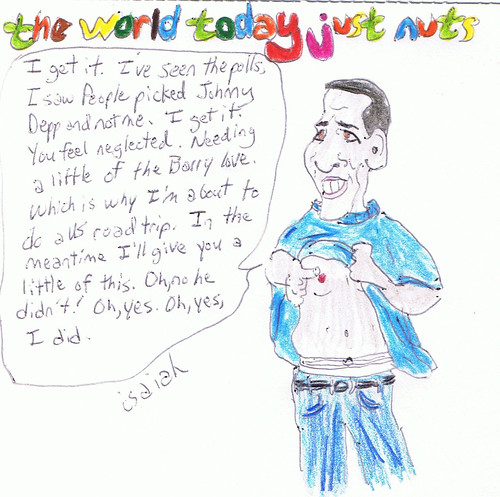
I actually have a backstory there. It was ten p.m. and the phone rang. I had just gotten into bed and had the TV on (British comedies, actually). I picked up the phone and it was Isaiah. He wanted to know if I could do a radio report at The Common Ills? I said sure. He apologized for being so late but said he just could not think of a comic. I said it was not a problem and I was happy to help out. I listed some things I was thinking about and asked him if he had an idea that was just too big for a single panel (which does happen to him) or if he just did not have any ideas? He said it was the latter and explained Barack returned at the end of last week but he had just basically laid low as if hiding from --
"Ruth!"
Yes.
"I have an idea! Are you okay with not doing a radio report?"
I laughed and said it was not a problem at all. (And it was not a problem either way.) So he drew the comic and when I logged on this morning, I could not stop laughing.
This is from Michael W. Macleod-Ball's "Rally the Grassroots to Stop Stupak" (ACLU's Blog of Rights):
Well, the battle is now joined. With the addition of the Stupak Amendment to the House's health care reform bill, we are reminded once again that the fight to preserve women's reproductive rights remains literally a constant struggle. Now the nation's attention turns to the Senate, where there will be votes in the coming weeks on whether or not the health care reform bill will substantially narrow women's reproductive health choices for the first time since the adoption of the Hyde Amendment that barred federal funding for abortions except in the case of rape, incest, or when the life of the mother is at risk. The Stupak Amendment, in fact, takes that next limiting step by extending the Hyde restrictions to millions more women.
The House health care reform bill creates an exchange — a roster of health insurance plans available to those individuals who are entitled to receive federal subsidies to help them afford such coverage. The exchange will also be open to those who receive no federal subsidies — though it is expected that at the outset 85 percent will receive some subsidy and 15 percent will be purchasing without public dollars. Rep. Stupak's amendment, however, bars the use of any federal subsidies to purchase any plan that includes coverage for abortion services. Moreover, there are limitations on the plans a company can offer on the exchange. Accordingly, insurance companies — being profit-oriented - are more likely to compete for the 85 percent of that pool of participants than the 15 percent. And that means that abortion coverage will effectively be denied to that 15 percent of exchange participants — thousands of women — who would be using their own money to purchase health coverage. And, of course, there is the absolute bar to abortion coverage to the 85 percent who will receive a federal subsidy — no matter how small the subsidy. And over time, the exchange will become available to larger businesses (with up to and perhaps over 100 employees), thereby extending the reach of this abortion coverage ban.
Go read Ava and C.I.'s wonderful "TV: The excellent and the nutty" and having read NOW's homepage I think we may need to do a hypocrisy edition two weeks running at Third. I say that because there is nothing calling out the Senate for what they did on Saturday. Women are easily half the population in this country. The Democrats need to stop selling us out and calling that 'realism.'
This is C.I.'s "Iraq snapshot" for today:
Monday, November 23, 2009. Chaos and violence continue, the 'intended' elections remain in disarray, the US military announces a death, Nouri parades forward more show confessions, and more.
On Sunday, the US military announced: "FORWARD OPERATING BASE KALSU, Iraq -- A Multi-National Division South Soldier was killed in action, Nov. 22.The name of the deceased is being withheld pending notification of next of kin and release by the Department of Defense. The names of service members are announced through the U.S. Department of Defense official website at http://www.defenselink.mil/releases/. The announcements are made on the Web site no earlier than 24 hours after notification of the service member's primary next of kin.The incident is under investigation." The announcement brought the number of service members killed in Iraq since the start of the illegal war to 4365.
Turning to the issue of the 'intended' January elections. As Carole King sings ("Chalis Borealis," Speeding Time), "Didn't work out quite the way you wanted, how were you to know?" Last week, Tareq al-Hashemi vetoed the election law citing the law's refusal to recognize the large number of Iraqi refugees. Saturday the Parliament met to resolve the issue and . . . nothing. AFP reported, "The vote is postponed until tomorrow, parliament speaker Iyad al-Samarrai told reporters on Saturday, after a further day of meetings failed to resolve a dispute on a key provision in the law which will govern the national poll." Waleed Ibrahim, Ahmed Rasheed, Khalid al-Ansary, Michael Christie and Sonya Hepinstall (Reuters) explained, "Parliament must now either address Hashemi's complaints and amend the law, which may invite other interest groups to demand other changes, or send it back to him unchanged only for him to possibly veto it again." DPA added "According to [MP Ezzeddin] al-Dawla, MPs were divided during Saturday's discussions, with 'a majority calling for a rejection of al-Hashemi's demand.' A few, al-Dawla said, 'sought a compromise of reserving 10 per cent of the seats for expatriates'." Sunday saw a repeat of the stagnation with Waleed Ibrahim, Michael Christie and Janet Lawrence (Reuters) reporting the Parliament is still at "an impasse" and plans to take up the matter (again) tomorrow. Some motion took place today with Waleed Ibrahim, Michael Christie and Jon Hemming (Reuters) reporting this morning that the Parliament has finally passed an election law but that it doesn't appear to address the issues that led to the presidency council's veto and may (yet again) be vetoed.
Sahar Issa and Warren P. Strobel (McClatchy Newspapers) observe that the elections could be "delayed by weeks, if not longer" following today's vote which "cut Sunni Muslim voting power even more in several major provinces. More than 50 parliament members walked out in protest, most of them Sunnis, but including a smattering of secular lawmakers and Shiites as well." Nada Bakri (Washington Post) quotes Sunni MP Oussan al-Nujaifi stating, "We're going to veto the law because it's unconstitutional. And that means a delay in the election." Steven Lee Myers (New York Times) insists that the "effort to hold parliamentary elections on schedule in January collapsed on Monday" and explains, "The failure to agree on even the terms of the national election has inflamed ethnic and sectarian tensions that had waned somewhat in the last year or so." BBC News adds, "Our correspondent [Jim Muir] says most MPs seem to be determined to reject the veto this time, meaning the law should eventually go through."
Today at the US State Dept, Secretary of State Hillary Clinton met with the Bulgarian Foreign Minister Rumiana Zheleva and after the two delivered remarks to the press, the issue of Iraq arose.
AFP's Lachlan Carmichael: Madame Secretary, since we have an opportunity to talk to you, perhaps on another subject, Iraq? There's a prospect of the electoral law being vetoed again. What kinds of concerns do you have about that? And do you have any -- can you use your influence to help get it passed, iron out the differences among the factions?
Secretary of State Hillary Clinton: Well, Lachlan, we support the Iraqi government's efforts to pass an election law so that they can proceed with planned elections. We know that there are some continuing concerns as expressed by the vice president that have to be addressed. We will continue working with all of the parties. Our ambassador, Chris Hill, on the ground has been deeply involved in doing so already. This morning, I met and heard a report about the way forward. There are a number of ideas that we will be presenting. There's an interim period because the Council of Representatives will not be meeting for a number of days that we think provide the opportunity for all the parties to come together, and with the help of not just the United States, but UNAMI and others to work out these continuing differences. We believe on balance that there will be elections. They might slip by some period of time until this is worked out, because at some point the law has to be in place for the planning to begin, and so there necessarily needs to be a period of time in which the planning can occur. But we have every reason to believe that elections will be held, which will be another milestone on the journey that Iraqis are taking toward full and comprehensive democracy.
And since Hillary raised the timeline, let's note it because it changed and no one seems to have noticed that (more likely, they've chosen not to raise the issue). Waleed Ibrahim, Michael Christie and Janet Lawrence (Reuters) reported Sunday, "There are only a couple of days left for parliament to address Vice-President Tareq al-Hashemi's veto of an election law, as the law must be passed 60 days before a vote and Jan. 23 is viewed by Iraq's majority Shi'ite Muslims as the last possible date in January for the ballot to take place."
How does it happen
I don't know
It's so hard to understand
Now you see it
Now you don't
Is this a case of sleight of hand
Sleight of hand
-- "Sleight of Hand," written by Carly Simon and Don Sebesky
B-b-but . . . What happened to 90 days? Salah Hemeid (Al-Ahram Weekly) reported a month ago, "The commission, responsible for organizing polls in Iraq, has said that it needs 90 days to print and distribute ballots. Iraqi and UN officials fear that the election could be delayed if lawmakers fail to pass a revised election law this week." October 29th, Renee Montagne talked about the timeline with Quil Lawrence (NPR's Morning Edition):
Renee Montagne: What, Quil, is at stake with the delay of this election law?Quil Lawrence: Well, as you say, the Iraqi prime minister and his government's term run out on January 31st so the election commission here has said they need 90 days to organize a legitimate poll and Parliament is deadlocked on over a dozen or so complicated issues regarding the election. They may vote on it today. If the elections are delayed or if they are rushed, there's a risk that Iraq's government could be deemed illegitimate and then a whole Pandora's Box of problems can open up -- issues of legitimacy of the government, maybe even a crisis like we've seen in Afghanistan.
How does 90 days become 60? And why did the press never notice the missing thirty? "Sleight of Hand" indeed. Carly Simon's latest album is Never Been Gone (Kat sang its praises here) and this week only you can download the entire album at Amazon for $5.00. That's all 12 tracks. Never Been Gone finds Carly revisiting her songwriting canon to re-imagine some of her best loved hits including "You're So Vain," "Anticipation," "Let The River Run," "Coming Around Again," "The Right Thing To Do," "That's The Way I've Always Heard It Should Be" and "You Belong To Me." Tomorrow Carly Will be at J&R Music World in New York (23 Park Row) signing copies of Never Been Gone beginning at 6:00 pm. Carly will be on Greater Boston (WGBH) Wednesday and Thursday (Thanksgiving day) she'll be performing in the Macy's Parade on the Care Bear's Float as well as be on Extra for part-two of her interview.
You should notice that the reporter who raised the issue of Iraq with Hillary Clinton was from a foreign news agency (AFP). Domestic reporters just don't give a damn. Doubt it? At the White House today, a bunch of trained yammers (with few exceptions) stroked and fondled Robert Gibbs with questions of such easy nature as could he explain "diplomatic entertaining" and State dinners. They had plenty of time to make like In Style magazine but damn little time to make like actual reporters. It was the usual embarrassment everyone's come to expect and that can be blamed only partly on Robert Gibbs. Blame? Hillary mentioned Chris Hill, US Ambassador to Iraq, in her comments and this may have been the first time his name has come up in the last few days. For example, the New York Times' awful editorial last week didn't mention him when it called out Iraq for the delay. Shouldn't Hill have been on this issue from day one? Yes, he should have. And who picked Hill? Who picked Hill over qualified people -- many, many other qualified people? Barack Obama. So the candy ass White House press corps should have pressed on the issue of Iraq. Instead they wasted everyone's time and, with few exceptions, better hope their editors and producers don't study that transcript. And on Chris Hill, let's remember one more time that the Republicans in the Senate structured their objections to Hill very carefully and very precisely. They knew he could be the anchor that could hang around Barack's neck. But no one wanted to pay attention back then and now it appears it may be too late. If Iraq falls to pieces, Republicans running for office will not blame military generals. They will, however, go to town on a US civilian like Hill. And they laid the groundwork for that back in his confirmation hearing.
Meanwhile, thug of the occupation Nouri al-Maliki hasn't come out with a color-coded terror chart, but like the Bully Boy who installed him, he schedules 'media events' to increase his electoral prospects. Most recently? Sunday saw the broadcast of excerpts of more forced confessions. The for-show confessions act as a kind of political advertisement for Nouri and, to no surprise, the forced confessions said exactly what Nouri had said about the Baghdad bombings on 'Bloody Sunday'. AP rightly notes that this is Nouri's "latest anti-Ba'athist attack" and that "Al-Maliki's intensified rhetoric worsens one of Iraq's most dangerous sectarian fault lines -- one which the United States has long struggled to calm." Jomana Karadsheh (CNN) notes, "In recent months the Iraqi government has played a number of such videos for reporters. Many Iraqis have voiced skepticism about their authenticity. [. . .] In recent weeks, the government and Iraqi Prime Minister Nuri al-Maliki have stepped up the anti-Baath rhetoric ahead of the country's upcoming national elections, an escalation that some fear is a political ploy to keep some Sunni Arab candidates from running in the elections."
Turning to some of the violence Nouri seems to breed like bunnies . . .
Bombings?
Sahar Issa (McClatchy Newspapers) reports a Baghdad roadside bombing which left two people wounded, another one that left two people wounded, a third one which left two people wounded, a Baghad sticky bombing which wounded four people, a fourth Baghdad roadside bombing which wounded person, a second Baghdad sticky bombing which injured two people, a Mosul roadside bombing which claimed the life of 1 Iraqi service member and left one person wounded, a Kikuk assassination attempt on Aras Mohammed ("deputy chief of criminal investigation) which he survived and a Kirkuk assassination attempt on Rajim Awa (police chief) which he survived but which "damaged a number of civilians cars and caused material damages to the nearby houses." Reuters drops back to Sunday to note a Baghdad car bombing which left 1 police officer injured.
Shootings?
Sahar Issa (McClatchy Newspapers) reports an assassination attempt on Ayad Allawi that injured two of his body guards (Allawi is the former Iraqi Prime Minister and also a rival of Nouri al-Maliki's) and an assassination attempt on journalist Emad al-Abadi in which he was shot "in the head, neck and shoulder" and is now in critical condition. Reuters notes US forces and Iraqi forces killed 1 suspect in Mosul while arresting five others
Kidnappings?
Sahar Issa (McClatchy Newspapers) reports 1 55-year-old Iraqi Christian was kidnapped in Kirkuk today.
Returning to the topic of elections, the most recent Inside Iraq (Al Jazeera) began airing Friday night. Host Jasim al-Azzawi addressed the issue with guests MP Mustafa al-Hiti with the Iraqi National Movement and analyst Fereydun Hilmi.
Jasim al-Azzawi: Mustafa al-Hiti, let us get the Constitutional and the legal aspect out of it. al-Hashimi is within his Constitutional right to veto the bill -- either in its entirety or part of it. So I don't understand why al-Maliki is questioning his privileges as Vice President in power to do so.
Mustafa al-Hiti: Well really Tariq al-Hashimi is doing his job according to the Constitution and certainly he is one of the Iraqis who should feel, like others, the rights of the Iraqi refugees whether they are outside Iraq or anywhere. So you know all the refugees live under really hostile conditions abroad because they are not even, in the Arab countries, they are legal -- what you call it -- refugees. So he was doing the right thing and he is with the Constitution -- he is very really complying with the Constitution and he is not out of that.
Jasim al-Azzawi: The hue and cry caused by Hashimi's action, Fereydun Hilmi, there must be sort of a political calculus on some political machination behind it. It is not in the interest of most of the current blocs in Iraq for this four and a half million or maybe five million Iraqis to be included in the political process.
Fereydun Hilmi: Well that's right. Hashimi was presiding over the displacement of these millions of people that he's now worried about and crying over. He was in power when they were driven out of their homes. He didn't do anything to stop that. And now he's in a political jam because the group that he came with to power is no longer supporting him. He is -- I believe he is no longer with the Islamic Party that actually put him in his place and he needs support. And that's why he's now trying to drum up the support from the people who are outside Iraq -- the refugees -- and those people that he's trying to get the vote for but he's one of the people responsible for driving these people out of the country in the first place.
Jasim al-Azzawi: Mustafa al-Hiti, Fereydun Hilmi is alluding to something very important and very critical and that is, Tariq al-Hashimi, when he was with the Islamic Party, which he is no longer with, he has a new party called the Renewal, his vote at the time to approve the Constitution was absolutely critical. Had he said "no," that entire Constitution would have gone no where. Is it, in retrospect, he's trying to reclaim something?
Mustafa al-Hiti: Well really we are talking about two things. Upon his responsibility for accepting this Constitution and all the material -- and you know that four years ago, yes, we can say he's responsible about the Constitution. What we are talking now is whether he is complying with the Constitution according to this veto or not? This is a different story. Yes, he was responsible for that bad Constitution and should be reformed. I agree with Mr. Fereydun about that. But regarding this objection or veto, he is indeed right and it is not just his idea, by the way. We were talking about this Constitution -- about the election law a long time ago. I mean, for the last three months, we were talking. And he had heard, certainly, the opinion of most blocs -- political blocs -- in the Iraqi Parliament who were objecting to two main things regarding the Iraqi Kirkuk and the percentage for the refugees. Although Kirkuk was the main issue but, I mean, this issue regarding ten or five or fifteen percent of those seats for the refugees and the quota for other religious parties in Iraq. So, in fact, Constitutionally he's going right and today, as I have heard, that the Constitutional Court, they were really with al-Hashimi regarding his veto or objection because it is very clear in the Constitution saying that each seat for a parliamentary member should be represented by 100,000 Iraqis people. So --
Jasim al-Azzawi: If that is the case, Mustafa al-Hiti, let me ask Fereydun, we do understand why Hashimi is objecting to the law, explain to me why the Kurds are objecting to the law. One leading member of the Kurdistan Regional Government says that we are not going to participate in this election.
Fereydun Hilmi: The Kurds are taking advantage of this situation, obviously, because they have never been happy about the election law. They are not happy about the way the government is run. They are trying to get maximum -- maximum advantage out of this whole situation of chaos. It is actually chaos. I mean it doesn't matter that there's been a government or something called a government for the past seven years but to this day there is a lot of services that are missing. There are many, many important things that are not being catered for. There are many, many hundreds of very rich contracts being signed away by the so-called politicians today. The wealth of the country is now in the hands of the foreigners and the people who occupy the country --
Jasim al-Azzawi: But Fereydun --
Fereydun Hilmi: -- so there are some --
Jasim al-Azzawi: -- the Kurds, specifically what they are saying is that the annual growth for Suleimaniah, Erbil and Dohuk does not tally with the rest of the country. The rest of the country -- some of it is going to be three percent, five percent, ten percent. For instance, Suleimaniah is stagnant. Can you comment on that one, Fereydun?
Fereydun Hilmi: Yes. I mean, if -- I actually wrote a book about the elections and also, in that book, there are population growth figures that show that, after the fall of Saddam, Suleimaniah, Erbil and Dohuk had a very big rise in population. Far above the average rise in the other cities. And of course you understand that because a lot of Kurds were outside Kurdistan or they were in different, displaced places. But now, of course, the situation has reversed. They -- those areas are stagnant because they already had the population surge into the cities and the areas. Whereas the other parts had a migration of a lot of people, Sunnis and other people who were being driven out of their own homes and they had to go to the safer areas of Kurdistan and Mosul and that sort of areas. So that explains why you have this sort of different surges at different times.
Jasim al-Azzawi: Mustafa?
Mustafa al-Hiti: Mr. Jasim, if Mr. Fereydun excuse me for this point really, I want to emphasize two things regarding the Kurdish objection upon the law. First of all, they are, the Kurdish -- the immigrant Kurdish people outside of Iraq -- they are like the other Iraqis. They live really under very hostile conditions. So we have to treat all of the people of Iraq as the same. They have the same conditions, they escape the country because one reason or another, really. And this migration started a long time ago so you cannot say that the Iraqis, they were immigrant after 2003. They were really leaving the country in excessive waves starting from 1958 until now -- under different conditions. This is in one hand. So they are objecting upon that because they need their people as well to have the rightful voting. Second, as Mr. Fereydun said, the 2.6% rate of growth in Iraq which is -- this is the common WHO [World Health Organization] figures -- there -- I mean, we should have all the Iraqis to have an annual increment which is about 2.6 or sometimes they call it 3%. So, in any case, this should be applied on all Iraqis, to be in the right way. You shouldn't depend only upon this food ration coupon which is under the law we should follow that. If you want to be more precise or accurate we have to go for the census for Iraq which is really will tell you the truth, what's going on.
Winding down, we'll note this from David Bacon's "St. Francis Hotel Workers Strike" (Under The Name of Reason):About 650 workers at the St. Francis Hotel, one of the city's oldest and most luxurious, walked out on strike on November 18. This was the third of what may be many strikes hit San Francisco's Class A hotels. The contract with the workers' union, UNITE HERE Local 2, expired on August 14. Since then, Local 2 has been trying to bargain a new agreement in the middle of an economic depression.
San Francisco's largest hotels are demanding cuts in health and retirement benefits, and increased workloads, saying that the economic crisis has reduced tourism in the city. The luxury hotel chains want workers begin paying for their healthcare premiums -- $35/month this year, $115/month next year, and $200/month the year after. A typical San Francisco hotel worker earns $30,000 per year, and many can't work a full 40-hour week.
Over the first nine months of 2009, Starwood Hotels and Resorts, which manages the Westin St. Francis, earned $180 million in profits. Starwood also manages three other San Francisco Class A hotels. The owner of the St. Francis, Strategic Hotels and Resorts, saw $11 million in earnings during the same period. The company bought the hotel for $439 million in 2006.David Bacon's latest book is Illegal People -- How Globalization Creates Migration and Criminalizes Immigrants (Beacon Press) which just won the CLR James Award. Bacon can be heard on KPFA's The Morning Show (over the airwaves in the Bay Area, streaming online) each Wednesday morning (begins airing at 7:00 am PST). Oops, I lied. Aimee Allison is co-host of The Morning Show. She and David Solnit paired up to write the amazing Army Of None. With his sister Rebecca Solnit, of Courage to Resist, David has
written the just-released book The Battle of the Story of the Battle of Seattle. If you're having trouble finding a copy of it, you're not alone and let's assume that's a good sign and meaning there's a large audience out there for this important book. But in the meantime, there are several actions David Solnit is noting.
Today from seven to nine pm at the First Unitarian Universalist Church in San Francisco (1187 Franklin St) -- admission $10 to $25 but "no one turned away for lack of funds" organizing efforts for today and the "spirit of Seattle" will be addresed by David, Rebecca, Jia Ching Chen, Kevin Danaher, Anuradha Mittal (Oakland Institute) and Claire Greensfelder, Jerry Mander and Victor Menotti (IFG). Tomorrow in Oakland (Humanist Hall, 390 27th St) at 6:30 pm, there will be a teach-in and they're asking for $5 to $10 dollars but "no one turned away for lack of funds":
On December 7, 2009, world leaders and international NGOs will meet in Copenhagen to chart out a course for a new global climate deal, and in doing so, try to set up a new post-WTO framework for economic globalization. Outside the conference halls, a convergences of climate justice activists from the Global South will be waiting to say "Another World is Possible." Join environmental and climate justice activists for a lead up discussion to the November 30th day of action and on the road to Copenhagen .
Both of those events are wheelchair accessible. A third tomorrow at 5:30 is at a location yet to be determined but will be preparation for a national day of action for Climate Justice and you can click here for more information.
iraq
afpdpareuterswaleed ibrahimahmed rasheedkhalid al-ansarymichael christiesonya hepinstall
mcclatchy newspaperssahar issa
warren p. strobel
the washington postnada bakri
the new york timessteven lee myers
salah hemeid
nprmorning editionrenee montagnequil lawrence
carly simonnever been gone
jomana karadsheh
al jazeera
inside iraq
jasim al-azzawi
david baconkpfathe morning show
david solnitaimee allisoncourage to resist
I actually have a backstory there. It was ten p.m. and the phone rang. I had just gotten into bed and had the TV on (British comedies, actually). I picked up the phone and it was Isaiah. He wanted to know if I could do a radio report at The Common Ills? I said sure. He apologized for being so late but said he just could not think of a comic. I said it was not a problem and I was happy to help out. I listed some things I was thinking about and asked him if he had an idea that was just too big for a single panel (which does happen to him) or if he just did not have any ideas? He said it was the latter and explained Barack returned at the end of last week but he had just basically laid low as if hiding from --
"Ruth!"
Yes.
"I have an idea! Are you okay with not doing a radio report?"
I laughed and said it was not a problem at all. (And it was not a problem either way.) So he drew the comic and when I logged on this morning, I could not stop laughing.
This is from Michael W. Macleod-Ball's "Rally the Grassroots to Stop Stupak" (ACLU's Blog of Rights):
Well, the battle is now joined. With the addition of the Stupak Amendment to the House's health care reform bill, we are reminded once again that the fight to preserve women's reproductive rights remains literally a constant struggle. Now the nation's attention turns to the Senate, where there will be votes in the coming weeks on whether or not the health care reform bill will substantially narrow women's reproductive health choices for the first time since the adoption of the Hyde Amendment that barred federal funding for abortions except in the case of rape, incest, or when the life of the mother is at risk. The Stupak Amendment, in fact, takes that next limiting step by extending the Hyde restrictions to millions more women.
The House health care reform bill creates an exchange — a roster of health insurance plans available to those individuals who are entitled to receive federal subsidies to help them afford such coverage. The exchange will also be open to those who receive no federal subsidies — though it is expected that at the outset 85 percent will receive some subsidy and 15 percent will be purchasing without public dollars. Rep. Stupak's amendment, however, bars the use of any federal subsidies to purchase any plan that includes coverage for abortion services. Moreover, there are limitations on the plans a company can offer on the exchange. Accordingly, insurance companies — being profit-oriented - are more likely to compete for the 85 percent of that pool of participants than the 15 percent. And that means that abortion coverage will effectively be denied to that 15 percent of exchange participants — thousands of women — who would be using their own money to purchase health coverage. And, of course, there is the absolute bar to abortion coverage to the 85 percent who will receive a federal subsidy — no matter how small the subsidy. And over time, the exchange will become available to larger businesses (with up to and perhaps over 100 employees), thereby extending the reach of this abortion coverage ban.
Go read Ava and C.I.'s wonderful "TV: The excellent and the nutty" and having read NOW's homepage I think we may need to do a hypocrisy edition two weeks running at Third. I say that because there is nothing calling out the Senate for what they did on Saturday. Women are easily half the population in this country. The Democrats need to stop selling us out and calling that 'realism.'
This is C.I.'s "Iraq snapshot" for today:
Monday, November 23, 2009. Chaos and violence continue, the 'intended' elections remain in disarray, the US military announces a death, Nouri parades forward more show confessions, and more.
On Sunday, the US military announced: "FORWARD OPERATING BASE KALSU, Iraq -- A Multi-National Division South Soldier was killed in action, Nov. 22.The name of the deceased is being withheld pending notification of next of kin and release by the Department of Defense. The names of service members are announced through the U.S. Department of Defense official website at http://www.defenselink.mil/releases/. The announcements are made on the Web site no earlier than 24 hours after notification of the service member's primary next of kin.The incident is under investigation." The announcement brought the number of service members killed in Iraq since the start of the illegal war to 4365.
Turning to the issue of the 'intended' January elections. As Carole King sings ("Chalis Borealis," Speeding Time), "Didn't work out quite the way you wanted, how were you to know?" Last week, Tareq al-Hashemi vetoed the election law citing the law's refusal to recognize the large number of Iraqi refugees. Saturday the Parliament met to resolve the issue and . . . nothing. AFP reported, "The vote is postponed until tomorrow, parliament speaker Iyad al-Samarrai told reporters on Saturday, after a further day of meetings failed to resolve a dispute on a key provision in the law which will govern the national poll." Waleed Ibrahim, Ahmed Rasheed, Khalid al-Ansary, Michael Christie and Sonya Hepinstall (Reuters) explained, "Parliament must now either address Hashemi's complaints and amend the law, which may invite other interest groups to demand other changes, or send it back to him unchanged only for him to possibly veto it again." DPA added "According to [MP Ezzeddin] al-Dawla, MPs were divided during Saturday's discussions, with 'a majority calling for a rejection of al-Hashemi's demand.' A few, al-Dawla said, 'sought a compromise of reserving 10 per cent of the seats for expatriates'." Sunday saw a repeat of the stagnation with Waleed Ibrahim, Michael Christie and Janet Lawrence (Reuters) reporting the Parliament is still at "an impasse" and plans to take up the matter (again) tomorrow. Some motion took place today with Waleed Ibrahim, Michael Christie and Jon Hemming (Reuters) reporting this morning that the Parliament has finally passed an election law but that it doesn't appear to address the issues that led to the presidency council's veto and may (yet again) be vetoed.
Sahar Issa and Warren P. Strobel (McClatchy Newspapers) observe that the elections could be "delayed by weeks, if not longer" following today's vote which "cut Sunni Muslim voting power even more in several major provinces. More than 50 parliament members walked out in protest, most of them Sunnis, but including a smattering of secular lawmakers and Shiites as well." Nada Bakri (Washington Post) quotes Sunni MP Oussan al-Nujaifi stating, "We're going to veto the law because it's unconstitutional. And that means a delay in the election." Steven Lee Myers (New York Times) insists that the "effort to hold parliamentary elections on schedule in January collapsed on Monday" and explains, "The failure to agree on even the terms of the national election has inflamed ethnic and sectarian tensions that had waned somewhat in the last year or so." BBC News adds, "Our correspondent [Jim Muir] says most MPs seem to be determined to reject the veto this time, meaning the law should eventually go through."
Today at the US State Dept, Secretary of State Hillary Clinton met with the Bulgarian Foreign Minister Rumiana Zheleva and after the two delivered remarks to the press, the issue of Iraq arose.
AFP's Lachlan Carmichael: Madame Secretary, since we have an opportunity to talk to you, perhaps on another subject, Iraq? There's a prospect of the electoral law being vetoed again. What kinds of concerns do you have about that? And do you have any -- can you use your influence to help get it passed, iron out the differences among the factions?
Secretary of State Hillary Clinton: Well, Lachlan, we support the Iraqi government's efforts to pass an election law so that they can proceed with planned elections. We know that there are some continuing concerns as expressed by the vice president that have to be addressed. We will continue working with all of the parties. Our ambassador, Chris Hill, on the ground has been deeply involved in doing so already. This morning, I met and heard a report about the way forward. There are a number of ideas that we will be presenting. There's an interim period because the Council of Representatives will not be meeting for a number of days that we think provide the opportunity for all the parties to come together, and with the help of not just the United States, but UNAMI and others to work out these continuing differences. We believe on balance that there will be elections. They might slip by some period of time until this is worked out, because at some point the law has to be in place for the planning to begin, and so there necessarily needs to be a period of time in which the planning can occur. But we have every reason to believe that elections will be held, which will be another milestone on the journey that Iraqis are taking toward full and comprehensive democracy.
And since Hillary raised the timeline, let's note it because it changed and no one seems to have noticed that (more likely, they've chosen not to raise the issue). Waleed Ibrahim, Michael Christie and Janet Lawrence (Reuters) reported Sunday, "There are only a couple of days left for parliament to address Vice-President Tareq al-Hashemi's veto of an election law, as the law must be passed 60 days before a vote and Jan. 23 is viewed by Iraq's majority Shi'ite Muslims as the last possible date in January for the ballot to take place."
How does it happen
I don't know
It's so hard to understand
Now you see it
Now you don't
Is this a case of sleight of hand
Sleight of hand
-- "Sleight of Hand," written by Carly Simon and Don Sebesky
B-b-but . . . What happened to 90 days? Salah Hemeid (Al-Ahram Weekly) reported a month ago, "The commission, responsible for organizing polls in Iraq, has said that it needs 90 days to print and distribute ballots. Iraqi and UN officials fear that the election could be delayed if lawmakers fail to pass a revised election law this week." October 29th, Renee Montagne talked about the timeline with Quil Lawrence (NPR's Morning Edition):
Renee Montagne: What, Quil, is at stake with the delay of this election law?Quil Lawrence: Well, as you say, the Iraqi prime minister and his government's term run out on January 31st so the election commission here has said they need 90 days to organize a legitimate poll and Parliament is deadlocked on over a dozen or so complicated issues regarding the election. They may vote on it today. If the elections are delayed or if they are rushed, there's a risk that Iraq's government could be deemed illegitimate and then a whole Pandora's Box of problems can open up -- issues of legitimacy of the government, maybe even a crisis like we've seen in Afghanistan.
How does 90 days become 60? And why did the press never notice the missing thirty? "Sleight of Hand" indeed. Carly Simon's latest album is Never Been Gone (Kat sang its praises here) and this week only you can download the entire album at Amazon for $5.00. That's all 12 tracks. Never Been Gone finds Carly revisiting her songwriting canon to re-imagine some of her best loved hits including "You're So Vain," "Anticipation," "Let The River Run," "Coming Around Again," "The Right Thing To Do," "That's The Way I've Always Heard It Should Be" and "You Belong To Me." Tomorrow Carly Will be at J&R Music World in New York (23 Park Row) signing copies of Never Been Gone beginning at 6:00 pm. Carly will be on Greater Boston (WGBH) Wednesday and Thursday (Thanksgiving day) she'll be performing in the Macy's Parade on the Care Bear's Float as well as be on Extra for part-two of her interview.
You should notice that the reporter who raised the issue of Iraq with Hillary Clinton was from a foreign news agency (AFP). Domestic reporters just don't give a damn. Doubt it? At the White House today, a bunch of trained yammers (with few exceptions) stroked and fondled Robert Gibbs with questions of such easy nature as could he explain "diplomatic entertaining" and State dinners. They had plenty of time to make like In Style magazine but damn little time to make like actual reporters. It was the usual embarrassment everyone's come to expect and that can be blamed only partly on Robert Gibbs. Blame? Hillary mentioned Chris Hill, US Ambassador to Iraq, in her comments and this may have been the first time his name has come up in the last few days. For example, the New York Times' awful editorial last week didn't mention him when it called out Iraq for the delay. Shouldn't Hill have been on this issue from day one? Yes, he should have. And who picked Hill? Who picked Hill over qualified people -- many, many other qualified people? Barack Obama. So the candy ass White House press corps should have pressed on the issue of Iraq. Instead they wasted everyone's time and, with few exceptions, better hope their editors and producers don't study that transcript. And on Chris Hill, let's remember one more time that the Republicans in the Senate structured their objections to Hill very carefully and very precisely. They knew he could be the anchor that could hang around Barack's neck. But no one wanted to pay attention back then and now it appears it may be too late. If Iraq falls to pieces, Republicans running for office will not blame military generals. They will, however, go to town on a US civilian like Hill. And they laid the groundwork for that back in his confirmation hearing.
Meanwhile, thug of the occupation Nouri al-Maliki hasn't come out with a color-coded terror chart, but like the Bully Boy who installed him, he schedules 'media events' to increase his electoral prospects. Most recently? Sunday saw the broadcast of excerpts of more forced confessions. The for-show confessions act as a kind of political advertisement for Nouri and, to no surprise, the forced confessions said exactly what Nouri had said about the Baghdad bombings on 'Bloody Sunday'. AP rightly notes that this is Nouri's "latest anti-Ba'athist attack" and that "Al-Maliki's intensified rhetoric worsens one of Iraq's most dangerous sectarian fault lines -- one which the United States has long struggled to calm." Jomana Karadsheh (CNN) notes, "In recent months the Iraqi government has played a number of such videos for reporters. Many Iraqis have voiced skepticism about their authenticity. [. . .] In recent weeks, the government and Iraqi Prime Minister Nuri al-Maliki have stepped up the anti-Baath rhetoric ahead of the country's upcoming national elections, an escalation that some fear is a political ploy to keep some Sunni Arab candidates from running in the elections."
Turning to some of the violence Nouri seems to breed like bunnies . . .
Bombings?
Sahar Issa (McClatchy Newspapers) reports a Baghdad roadside bombing which left two people wounded, another one that left two people wounded, a third one which left two people wounded, a Baghad sticky bombing which wounded four people, a fourth Baghdad roadside bombing which wounded person, a second Baghdad sticky bombing which injured two people, a Mosul roadside bombing which claimed the life of 1 Iraqi service member and left one person wounded, a Kikuk assassination attempt on Aras Mohammed ("deputy chief of criminal investigation) which he survived and a Kirkuk assassination attempt on Rajim Awa (police chief) which he survived but which "damaged a number of civilians cars and caused material damages to the nearby houses." Reuters drops back to Sunday to note a Baghdad car bombing which left 1 police officer injured.
Shootings?
Sahar Issa (McClatchy Newspapers) reports an assassination attempt on Ayad Allawi that injured two of his body guards (Allawi is the former Iraqi Prime Minister and also a rival of Nouri al-Maliki's) and an assassination attempt on journalist Emad al-Abadi in which he was shot "in the head, neck and shoulder" and is now in critical condition. Reuters notes US forces and Iraqi forces killed 1 suspect in Mosul while arresting five others
Kidnappings?
Sahar Issa (McClatchy Newspapers) reports 1 55-year-old Iraqi Christian was kidnapped in Kirkuk today.
Returning to the topic of elections, the most recent Inside Iraq (Al Jazeera) began airing Friday night. Host Jasim al-Azzawi addressed the issue with guests MP Mustafa al-Hiti with the Iraqi National Movement and analyst Fereydun Hilmi.
Jasim al-Azzawi: Mustafa al-Hiti, let us get the Constitutional and the legal aspect out of it. al-Hashimi is within his Constitutional right to veto the bill -- either in its entirety or part of it. So I don't understand why al-Maliki is questioning his privileges as Vice President in power to do so.
Mustafa al-Hiti: Well really Tariq al-Hashimi is doing his job according to the Constitution and certainly he is one of the Iraqis who should feel, like others, the rights of the Iraqi refugees whether they are outside Iraq or anywhere. So you know all the refugees live under really hostile conditions abroad because they are not even, in the Arab countries, they are legal -- what you call it -- refugees. So he was doing the right thing and he is with the Constitution -- he is very really complying with the Constitution and he is not out of that.
Jasim al-Azzawi: The hue and cry caused by Hashimi's action, Fereydun Hilmi, there must be sort of a political calculus on some political machination behind it. It is not in the interest of most of the current blocs in Iraq for this four and a half million or maybe five million Iraqis to be included in the political process.
Fereydun Hilmi: Well that's right. Hashimi was presiding over the displacement of these millions of people that he's now worried about and crying over. He was in power when they were driven out of their homes. He didn't do anything to stop that. And now he's in a political jam because the group that he came with to power is no longer supporting him. He is -- I believe he is no longer with the Islamic Party that actually put him in his place and he needs support. And that's why he's now trying to drum up the support from the people who are outside Iraq -- the refugees -- and those people that he's trying to get the vote for but he's one of the people responsible for driving these people out of the country in the first place.
Jasim al-Azzawi: Mustafa al-Hiti, Fereydun Hilmi is alluding to something very important and very critical and that is, Tariq al-Hashimi, when he was with the Islamic Party, which he is no longer with, he has a new party called the Renewal, his vote at the time to approve the Constitution was absolutely critical. Had he said "no," that entire Constitution would have gone no where. Is it, in retrospect, he's trying to reclaim something?
Mustafa al-Hiti: Well really we are talking about two things. Upon his responsibility for accepting this Constitution and all the material -- and you know that four years ago, yes, we can say he's responsible about the Constitution. What we are talking now is whether he is complying with the Constitution according to this veto or not? This is a different story. Yes, he was responsible for that bad Constitution and should be reformed. I agree with Mr. Fereydun about that. But regarding this objection or veto, he is indeed right and it is not just his idea, by the way. We were talking about this Constitution -- about the election law a long time ago. I mean, for the last three months, we were talking. And he had heard, certainly, the opinion of most blocs -- political blocs -- in the Iraqi Parliament who were objecting to two main things regarding the Iraqi Kirkuk and the percentage for the refugees. Although Kirkuk was the main issue but, I mean, this issue regarding ten or five or fifteen percent of those seats for the refugees and the quota for other religious parties in Iraq. So, in fact, Constitutionally he's going right and today, as I have heard, that the Constitutional Court, they were really with al-Hashimi regarding his veto or objection because it is very clear in the Constitution saying that each seat for a parliamentary member should be represented by 100,000 Iraqis people. So --
Jasim al-Azzawi: If that is the case, Mustafa al-Hiti, let me ask Fereydun, we do understand why Hashimi is objecting to the law, explain to me why the Kurds are objecting to the law. One leading member of the Kurdistan Regional Government says that we are not going to participate in this election.
Fereydun Hilmi: The Kurds are taking advantage of this situation, obviously, because they have never been happy about the election law. They are not happy about the way the government is run. They are trying to get maximum -- maximum advantage out of this whole situation of chaos. It is actually chaos. I mean it doesn't matter that there's been a government or something called a government for the past seven years but to this day there is a lot of services that are missing. There are many, many important things that are not being catered for. There are many, many hundreds of very rich contracts being signed away by the so-called politicians today. The wealth of the country is now in the hands of the foreigners and the people who occupy the country --
Jasim al-Azzawi: But Fereydun --
Fereydun Hilmi: -- so there are some --
Jasim al-Azzawi: -- the Kurds, specifically what they are saying is that the annual growth for Suleimaniah, Erbil and Dohuk does not tally with the rest of the country. The rest of the country -- some of it is going to be three percent, five percent, ten percent. For instance, Suleimaniah is stagnant. Can you comment on that one, Fereydun?
Fereydun Hilmi: Yes. I mean, if -- I actually wrote a book about the elections and also, in that book, there are population growth figures that show that, after the fall of Saddam, Suleimaniah, Erbil and Dohuk had a very big rise in population. Far above the average rise in the other cities. And of course you understand that because a lot of Kurds were outside Kurdistan or they were in different, displaced places. But now, of course, the situation has reversed. They -- those areas are stagnant because they already had the population surge into the cities and the areas. Whereas the other parts had a migration of a lot of people, Sunnis and other people who were being driven out of their own homes and they had to go to the safer areas of Kurdistan and Mosul and that sort of areas. So that explains why you have this sort of different surges at different times.
Jasim al-Azzawi: Mustafa?
Mustafa al-Hiti: Mr. Jasim, if Mr. Fereydun excuse me for this point really, I want to emphasize two things regarding the Kurdish objection upon the law. First of all, they are, the Kurdish -- the immigrant Kurdish people outside of Iraq -- they are like the other Iraqis. They live really under very hostile conditions. So we have to treat all of the people of Iraq as the same. They have the same conditions, they escape the country because one reason or another, really. And this migration started a long time ago so you cannot say that the Iraqis, they were immigrant after 2003. They were really leaving the country in excessive waves starting from 1958 until now -- under different conditions. This is in one hand. So they are objecting upon that because they need their people as well to have the rightful voting. Second, as Mr. Fereydun said, the 2.6% rate of growth in Iraq which is -- this is the common WHO [World Health Organization] figures -- there -- I mean, we should have all the Iraqis to have an annual increment which is about 2.6 or sometimes they call it 3%. So, in any case, this should be applied on all Iraqis, to be in the right way. You shouldn't depend only upon this food ration coupon which is under the law we should follow that. If you want to be more precise or accurate we have to go for the census for Iraq which is really will tell you the truth, what's going on.
Winding down, we'll note this from David Bacon's "St. Francis Hotel Workers Strike" (Under The Name of Reason):About 650 workers at the St. Francis Hotel, one of the city's oldest and most luxurious, walked out on strike on November 18. This was the third of what may be many strikes hit San Francisco's Class A hotels. The contract with the workers' union, UNITE HERE Local 2, expired on August 14. Since then, Local 2 has been trying to bargain a new agreement in the middle of an economic depression.
San Francisco's largest hotels are demanding cuts in health and retirement benefits, and increased workloads, saying that the economic crisis has reduced tourism in the city. The luxury hotel chains want workers begin paying for their healthcare premiums -- $35/month this year, $115/month next year, and $200/month the year after. A typical San Francisco hotel worker earns $30,000 per year, and many can't work a full 40-hour week.
Over the first nine months of 2009, Starwood Hotels and Resorts, which manages the Westin St. Francis, earned $180 million in profits. Starwood also manages three other San Francisco Class A hotels. The owner of the St. Francis, Strategic Hotels and Resorts, saw $11 million in earnings during the same period. The company bought the hotel for $439 million in 2006.David Bacon's latest book is Illegal People -- How Globalization Creates Migration and Criminalizes Immigrants (Beacon Press) which just won the CLR James Award. Bacon can be heard on KPFA's The Morning Show (over the airwaves in the Bay Area, streaming online) each Wednesday morning (begins airing at 7:00 am PST). Oops, I lied. Aimee Allison is co-host of The Morning Show. She and David Solnit paired up to write the amazing Army Of None. With his sister Rebecca Solnit, of Courage to Resist, David has
written the just-released book The Battle of the Story of the Battle of Seattle. If you're having trouble finding a copy of it, you're not alone and let's assume that's a good sign and meaning there's a large audience out there for this important book. But in the meantime, there are several actions David Solnit is noting.
Today from seven to nine pm at the First Unitarian Universalist Church in San Francisco (1187 Franklin St) -- admission $10 to $25 but "no one turned away for lack of funds" organizing efforts for today and the "spirit of Seattle" will be addresed by David, Rebecca, Jia Ching Chen, Kevin Danaher, Anuradha Mittal (Oakland Institute) and Claire Greensfelder, Jerry Mander and Victor Menotti (IFG). Tomorrow in Oakland (Humanist Hall, 390 27th St) at 6:30 pm, there will be a teach-in and they're asking for $5 to $10 dollars but "no one turned away for lack of funds":
On December 7, 2009, world leaders and international NGOs will meet in Copenhagen to chart out a course for a new global climate deal, and in doing so, try to set up a new post-WTO framework for economic globalization. Outside the conference halls, a convergences of climate justice activists from the Global South will be waiting to say "Another World is Possible." Join environmental and climate justice activists for a lead up discussion to the November 30th day of action and on the road to Copenhagen .
Both of those events are wheelchair accessible. A third tomorrow at 5:30 is at a location yet to be determined but will be preparation for a national day of action for Climate Justice and you can click here for more information.
iraq
afpdpareuterswaleed ibrahimahmed rasheedkhalid al-ansarymichael christiesonya hepinstall
mcclatchy newspaperssahar issa
warren p. strobel
the washington postnada bakri
the new york timessteven lee myers
salah hemeid
nprmorning editionrenee montagnequil lawrence
carly simonnever been gone
jomana karadsheh
al jazeera
inside iraq
jasim al-azzawi
david baconkpfathe morning show
david solnitaimee allisoncourage to resist


Friday, November 20, 2009
The bribes
This is from Bonnie Erbe's "Landrieu’s Medicaid Deal Hurts Middle Class Taxpayers Everywhere" (U.S. News & World Reports):
I know politics is the art of the possible and compromise is key. But I'm sickened by the taxpayer cash being doled out as "walking around money" to lure Democrats into the healthcare fold. Here's what the Wall Street Journal said:
Take Louisiana Senator Mary Landrieu. She's now likely to vote with Mr. Reid on Saturday after an amendment was inserted to increase her state's federal Medicaid subsidies by $100 million. The amendment devotes two pages to language making certain that only Louisiana would be entitled to the extra cash.
A Senator's healthcare vote should be based on whether he or she believes in public subsidies, from middle class and wealthy taxpayers, to provide healthcare for low income Americans. It should not be based on the government equivalent of a bribe.
As Ms. Erbe points out, this is supposed to about health care but instead it is about trade offs and who can line their pockets (or at least their home districts) the best.
What happened to the plans for a discussion? Remember when Barack Obama promied an open discussion on all things health related? That was so long ago and most have forgotten his promise.
Here's C.I.'s "Iraq snapshot:"
Friday, November 20, 2009. Chaos and violence continue, the US Defense Dept announces a death in Iraq, the 'intended' January elections remain murky, a War Hawk is denied a title, another War Hawk refuses to meet with the parent of a child kidnapped in Iraq, Congress explores the wounded, and more.
Today the Defense Department issued a release noting "the death of a sailor who was supporting Operation Iraqi Freedom. Petty Officer 2nd Class Brian M. Patton, 37, of Freeport, Ill., died Nov. 19 in Kuwait in a non-combat accident." M-NF missed announcing the death (DoD is only supposed to identify the fallen) and the announcement brings to
4363 the number of US service members killed in Iraq since the start of the illegal war.
"According to the Defense Manpower Data Center, at the Department of Defense, approximately 35,000 service members have been wounded in Iraq and Afghanistan," explained US House Rep Stephanie Herseth Sandlin yesterday afternoon. She was opening the House Veterans Affairs' Subcommittee on Economic Development's hearing entitled Adaptive Housing Grants. What are Adaptive Housing Grants? The VA explains: "Veterans or servicemembers who have specific service-connected disabilities may be entitled to a grant from the Department of Veterans Affairs (VA) for the purpose of constructing an adapted home or modifying an existing home to meet their adaptive needs. The goals of the Specially Adapted Housing (SAH) Grant Program is to provide a barrier-free living environment that affords the veterans or servicemembers a level of independent living he or she may not normally enjoy."
The first panel was composed of Disabled American Veterans' John L. Wilson, Paralyzed Veterans of America's Richard Daley, Blinded Veterans Association's Thomas Zampieri and Homes For Our Troops' John S. Gonsalves. From Daley's opening statement, we'll note this section:
The $63,700 currently available using the Specially Adapted Housing grant is a significant help for a veteran to make the needed modifications to their existing home or newly purchased previously owned home. Since it is difficult to find an existing home that can be made totally accessible, some veterans choose to design a new house incorporating accessibility into the plans. Often financial considerations or a convenient living location near family members may preclude designing a new home. In those situations the often monumental task of making the existing structure accessible must be considered. Guidance and information to make modifications for accessibility can be found in the VA's newly issued VA pamphlet 26-13, Handbook for Design: Specially Adapted Housing for Wheelchair Users, which was also reviewed by PVA's Architecture Department before its publication.
Many existing homes can be modified to improve access for a wheelchair user and enhance the function of the home. Some basic alterations would include creating an accessible entrance to the home including an accessible route to the entrance door, a level platform that is large enough for maneuvering during door operation, and enlarging entrance doorways. One bathroom would need complete renovation including plumbing arrangements if an accessible roll-in shower is required. The movement of an existing wall may be necessary for a person in a wheelchair to use each fixture of the bathroom, allow room for door operation and general circulation in the bathroom. Similar construction alterations would be required for the kitchen to be accessible and usable, and perhaps alterations to the master bedroom. The current grant amount of $63,700 in many situations would not pay for the entire project of making a home accessible for a wheelchair user. Since the house must be made accessible for the veteran, they would have no other option than to pay for remaining construction costs from personal savings, arrange a loan from a bank, or borrow needed funds from family members. We have been told that more often, than not, this is the situation the veteran faces.
That provides a general overview of some needs shared by many disabled veterans. We'll now zero in on an example of one person's needs in particular.
Thomas Zampieri: I had an OIF blinded service member that sent me an e-mail about the special housing grant program which I included in my [prepared] testimony because it sort of explains some of the frustration. While he was happy that he got the $10,000 grant in 2007, I actually had to spend $27,000 to do the adapted housing changes that he needed to provide room and space for his computer, the monitors, the scanners, the printers and the magnifiers in order for him to complete his college degree. All of this was great VA adaptive technology that was provided to him as a blind veteran but you have to have a place in order to store it and a way for that equipment to be connected. A lot of the blind veterans have unique, uh, requirements in regards to lighting and electrical work and the current amounts don't cover that.
Today Kerry Feltner (The New Hampshire) reports on Nathan Webster's campus lecture "Can't Give This War Away: Three Iraqi Summers of Change and Conflict." Webster is a photo journalist. Feltner spoke with people who attended the lecture. Gretchen Forbes declared, "It's really unusual to get a first-hand report of the war. You'd think by now it would be our duty to have major news organizations over there to write about the war . . . that really surprises me. I feel like it's the media's responsibility." Betty Nordgren declared, "I'm always interested in hearing about the war and the images were great to see, but I think that the news organizations are in trouble if they don't start covering this war more thoroughly." Both women are correct and it's also true that the least covered in any war are the ones with visible wounds. It's apparently too tempting to look away. That's true of the challenged and disabled population in general but especially true of those members of that population whose wounds derive from a war or military conflict. We'll note the following exchange from the hearing.
Chair Stephanie Herseth Sandlin: One of the concerns, I know that, Dr. Zampieri, you have in terms of the updated version -- Well, maybe not a concern. But maybe you could elaborate for us. With the updated version of the handbook, is that helpful for visually impaired veterans. What further provisions would your organizations like to see in-in the handbook?
Thomas Zampieri: Yeah, the handbook is helpful. A lot of the modifications in regards to lighting and additional electrical outlets and all those things. And then the --
Chair Stephanie Herseth Sandlin: You had mentioned that in your oral statement. That you would like to see those types of adaptions added.
Thomas Zampieri: Right.
Chair Stephanie Herseth Sandlin: So maybe a comprehensive list of what would be available --
Thomas Zampieri: Okay.
Chair Stephanie Herseth Sandlin: Is that?
Thomas Zampieri: Right. And the voice activated types of devices are also, you know, he [John Gonsalves] had mentioned. Especially for blind veterans who now days live alone. All those things add to safety and other things.
Chair Stephanie Herseth Sandlin: And then, Mr. Gonsalves, you had expressed concerns that I think that in terms of some requirements in the grants -- that there are injuries that require some sort of adaptions or its sort of mandatory but to have some additional flexibility in the grants would be helpful.
John Gonsalves: Right.
Chair Stephanie Herseth Sandlin: Is that correct?
John Gonsalves: Yes, and I think some of that may have been taken I hadn't seen the new VA pamphlet. I-I hadn't seen it before the testimony but one of the things that Homes For Our Troops does now -- and you can kind of tell from one of the pictures that we have here -- we have a soldier who actually, before his house is being built -- this is under the Fully Functioning Kitchens For Mobility. We qualify what kind of adaptations are going to happen in a house based on injury. And I guess it would sort of work the way VA rates disability percentage. We -- At the time a service member gets qualified for SAH, we have enough information at that time. And what Homes For Our Troops has done is we have an adaptation check list. We only have five sets of home plans that we build. And the home, the footprint is always the same. The windows are always the same. The floor plan is always the same. But there's an adaptation check list based on what the soldier needs and that's why I provided some photos in here. It really gives you an idea. Obviously a quadriplegic would need a lifting care system where somebody that has the mobility of their upper arms probably doesn't need it. And I think at the time of being qualified for SAH, basically all of the technology is there. We've built for, I think, every type of injury out there from amputees who are blind to different levels of spinal cord injuries. So we know what's available to put in a home and it would be really great to be out in the front once they qualify. A whole checklist be put together.
Chair Stephanie Herseth Sandlin: I think that that's very helpful and you have some ideas and recommendations that would be helpful and would like you to share those with us, with the VA. I think that with addition to what they've done to update their pamphlet, to have someone who's undertaken the mission that you've undertaken doing this work on the ground would be beneficial in creating those types of checklists. I would also think that it would be somewhat beneficial based on the work that you've done in having these checklists for the different types of injuries that the veteran may have suffered from and how to construct a home suitable to his or her needs as it relates to the overall cost of that. And I know that you agree in addition to TRA that the specially adapted housing grant be increased and again that's sort of the historical analysis that you're providing specific in Exhibit One for that grant. What do you -- do you have a ballpark figure? I mean, knowing again that if we adjust ed it to inflation, it would be up to $170,000. But based on the work you've done and the relative cost of doing that, do you have a ballpark figure?
John Gonsalves: Yes. On average, uhm, we've averaged $343,00 for the cost of building a new home.
Chair Stephanie Herseth Sandlin: Okay. So that's even greater than the average new home price.
John Gonsalves: Right. But these are 100% fully adapted homes --
Chair Stephanie Herseth Sandlin: Yes.
John Gonsalves: -- which they do cost a little more to build. You need a little extra square footage compared to what the average home that the census bureau uses.
[. . .]
Chair Stephanie Herseth Sandlin: One last question. Mr -- Dr. Zampiri. Can you explain the difference in changing the Specially Adaptive Housing Grant from 5 - 200 to 20 - 200 with regard to visual impairment?
Thoomas Zampieri: Yes. In fact, thank you very much. I was afraid someone didn't notice that. And also I appreciate that Congressman [John] Boozman [Ranking Member] just coincidentally showed up at the right time [laughter from Zampieri and Boozman]. I'm legally blind. I can't drive. A lot of jobs I can't do. My vision is worse than 20/200. And I don't qualify for anything under this program because the requirement is 5/200 which is really just you can't tell if there's a light on. There's no light/dark perception for lack of a better way to describe it. If somebody has 5/200 and they waive their hand in front of your face and you don't see it, you're quote-quote, 'meet this requirement, "totally blind." Our concern is -- and this is growing thing -- a lot of the Traumatic Brain Injured service members who have significant functional impairments, who need extra lighting and all these other things get zip. When I was in Houston and I was first service-connected for my blindness, for example, because of the 20/200 vision, they said no. So I went and I ended up spending not a whole lot but almost $7,000 to do the modifications to my house in Houston because, you know. And so the total number of service members coming back that would be 5/200 is fairly low. In fact, the Navy says there's less than 20 in the last 8 years out at Bethesda. But there are 140 that are enrolled in the VA with this 20/200 and are told "nope" and -- So it's a frustrating thing. And I realize of course that the magic problem is that if you change this section and you open it up to 20/200 as the definition of blindness then of course, you know, the automatic reaction is "Uh-oh. You're going to expand the costs of the program." And-and, I'm always suspicious of that. It's sort of like a few years ago, a couple of years ago when you did the TRA legislation. I'm sure people initially reacted by saying this is going to cost millions and millions and you're going to have all sorts of veterans applying for this. And the experience that I have is it usually isn't that way. People don't apply automatically. But I think Mr. Boozman may have some thoughts about this problem of the vision complications.
Ranking Member John Boozman: I appreciate you bringing that up and you make such an important comment -- that probably the VA's the only entity in the world that uses that standard versus the 20/200 standard. As an optometrist, I helped start -- in fact I started the School For The Blind's low vision program in Little Rock. And I would say probably about 90% of the kids in there did not -- would not meet the -- did you say 5/200 was the standard? Yeah, I mean, that's the standard I'm familiar with because nobody uses it. But I would say that if you looked at all the kids in blind schools or schools for the impaired, the vast majority, the vast-vast majority, there's no way that they would meet a 5/200. Most people, and lay people don't understand this but, most people that-that are blind have a lot of usable vision that can be worked with. And it truly does, you know, going in and setting up a kitchen or setting up a house so that a person can easily pour a cup of coffee -- you know, do things, that we just take for granted. Somebody might really struggle with that that did not meet this definition of vision which is so stringent in the VA so I think you make a great point.
Thursday's snapshot noted the House Foreign Affairs Subcommittee on the Middle East and South Asia which Kat covered Thursday night. Wednesday's snapshot covered the Senate Veterans Affairs Committee hearing and Kat covered that Wednesday night.
Remember the two women in New Hampshire noting the lack of Iraq coverage in the media? On NPR today, The Diane Rehm Show didn't have time for Iraq but it did have time for Nadia Bilbassy to laugh condescendingly at an e-mailer (Tom from Jacksonville, Florida) caller and presumably all Americans before she went on to declare what American tax payer money should be spent on. Nadia scored a double: She managed to (a) be insulting and (b) also pimp opinion passed off as fact. It was not attractive. And it was cute the way she worked every answer back to her own community and issues -- a fact not revealed on the broadcast. I wonder if the Basques in Spain will next be brought on to lobby for an hour without NPR revealing who they are? Her remarks did not approach journalism. But, hey, she got to be rude and insulting and isn't that what NPR is all about? Strangely, Diane's show last week (with a guest host) told people the vote was on track in Iraq. That's now up in the air so you'd think they would have felt the need to do an update. But possibly when one guest keeps talking about 'her people' (but forgetting to inform the listeners of that) there's very little time for anything else.
Let's turn to the issue of the elections. Jane Arraf (Christian Science Monitor) reported this afternoon that "the country's top election official said that even if lawmakers resolved all their differences, it would be impossible to hold elections in January" and quoted Independent High Electoral Commission's Faraj al-Haydari stating, "We have already stopped all our work." Arraf reminds that both the "IHEC and the United Nations officials have said they need at least 60 days to prepare a credible election."
This morning, the New York Times editorialized on the election issues noting:
The Constitution requires the election by the end of January. Election officials had said that the law needed to be done by Oct. 15 to allow enough time to prepare for the voting. Even though Iraq's Parliament overshot that deadline when it approved compromise legislation, the election was expected to take place between Jan. 18 and Jan. 23.But the Presidency Council (composed of the president, a Kurd, and two vice presidents, a Sunni and a Shiite) has the final say. And Mr. Hashimi chose to exercise his veto power and put in doubt Iraq's second national election, a critical test of whether democracy can endure as the United States withdraws its troops.
The editorial board thinks the Constitution matters . . . sometimes. Sometimes Iraq's Constitution doesn't matter. It appears the editorial board is concerned with the Constitution only when what they want doesn't happen. Refuse to conduct a national census? The editorial board's okay with that. Refuse to resolve the Kirkuk issue (as the Constitution mandated be done by 2007)? The editorial board's okay with that. It's a funny sort of semi-devotion to the Constitution but then the New York Times is a funny sort of news outlet. Sami Moubayed covers the developments in Iraq at Asia Times notes the argument that the Iraqi refugees will be underrepresented in the Parliament (true even if there wasn't an effort to expand the number of seats and to hand the bulk to Shi'ites). Mouybayad explains, "Frantically [Nouri al-] Maliki responded. On Thursday evening, the Constitutional Court (over which Maliki has plenty of influence) overruled Hashemi's veto, calling it 'unconstitutional'." Let's jump to what's happening and then come back to the 'unconstitutional' assertion. Waleed Ibrahim, Suadad al-Salhy, Aseel Kami, David Alexander, Deepa Babington, Samia Nakhoul and Todd Eastham (Reuters) report, "Instead of addressing Hashemi's demand that the law give more seats to Iraqi refugees and minorities, lawmakers squabbled over whether the veto was legal. They scheduled a session Saturday in which they would vote on whether to reject Hashemi's veto and send the law back for approval by the three-person presidency council without changes, said the speaker of parliament, Ayad al-Samarai." Now back to the "unconstitutional" claim. The reporters go on to address the claims Baha al-Araji was making (see yesterday's snapshot) about the veto being "unconstitutional" and how this is "political wrangling" and MP Saleh al-Mutlaq states, "To my knowledge, the federal court did not say the veto is not constitutional. They are trying to create a real political crisis."
Turning to the daily violence. First, a correction. McClatchy was included in yesterday's daily violence and that was Wednesday's daily violence. Not Thursdays. It will not be counted in the weekly total at Third. McClatchy didn't do a violence report on Thursday or, thus far, on Friday. Apparently, there were other things to do. Reuters noted the following violence today a Mosul roadside bombing today which injured a police officer, a Mosul stabbing of "an Egyptian" last night and another civilian shot dead in Mosul last night as well as a Thursday Baghdad bombing which left nine people injured.
Moving to Europe where noted War Hawk Tony Blair was delivered some, for him, bad news. As Middle East Online reports, "Former British premier Tony Blair took a blow after being rejected as EU president, mainly due to his stained repuation after supporting and taking part in the US-led invasion of Iraq in 2003." There is no joy in the killing fields tonight, Poodle Tony has struck out. Blair is the former British prime minister. His roll dog Gordon Brown is the current one. Leicester Mercury reports Brown is refusing to meet with the father of Peter Moore who was kidnapped along with 4 other British citizens in Iraq back in May 2007. The other four are all dead or thought by the government to be dead. Only Peter Moore is assumed to be alive at this point. But Brown has refused to meet with him and the reason given is that the "designated next of kin" is not Graeme Moore. Though some are shocked by Brown's decision, it should be remembered that Gordon is himself a War Hawk and, as such, may not be able to fake compassion very well and just attempting to do so may wear Gordon Brown out. In which case, he needs to limit the occassions on which he fakes sympathy in public.
Yesterday (or last night, for those not on the West Coast), KPFA's Flashpoints Radio spoke with Stephen Funk, Eddie Falcon, Clare Baird and Courage to Resist's Sarah Lazar. Nora Barrows-Freidman was speaking with them about the efforts of Iraq and Afghanistan war resisters to work with Israeli refuseniks. Stephen Funk wrote about this project earlier this month. Stephen is the first known Iraq War resister who self-checked out starting on February 9, 2003 and went public April 1st announcing that he would not deploy. We've noted Stephen Funk here before and will again, but he went public before this site started so we'll note his story in the following excerpt.
Nora Barrows-Freidman: We are now joined on the phone by Stephen Funk. He was one of the earliest who refused to serve in the occupation of Iraq. And, Stephen, thank you so much for being with us again on Flashpoints.
Stephen Funk: Thanks for having me.
Nora Barrows-Freidman: Tell us a little bit about your own history of refusing military service and then what can you say about this international push to dismantle militarism and the specific relationship between the United States and its expanding policies of entrenched occupations in the Middle East and Israel's ongoing and long suffering project of occupation and colonialism? What are the similarities that-that you're seeing there on the ground in Palestine, Israel? And what about the solidarity and the meetings you've been having with Israeli refuseniks?
Stephen Funk: I guess, with my own story, I joined the military after 9-11. I voluntarily enlisted in the Marine Corps. I came from a background of activism. I grew up in Seattle, organized for the WTO and I moved to LA and protested against the Democratic National Committee in 2000 and I also spent two months in the Philippines when their president was being impeached -- that was at the same time George W. Bush was being inaugurated for the first time and I was hoping that the same kind of thing could happen in the United States that was happening in the Philipines. But despite that background, I enlisted. I feel -- maybe as an activist, I thought I could be a more reasonable person in Afghanistan and not be like a racist, hot head which is what I thought a lot of people joining at the time -- there was a lot of a fear going on and lot of people joining at the time were very reactionary about 9-11 and, you know that was -- that was where I was coming from. But when I went to the Marine Corps, I went to the violent training and I had to shout "Kill! Kill! Kill!" all the time and, you know, I also had to deal with being queer in the military. And I realize that I didn't want to be violent and I did not want to participate in any war -- especially the Iraq War for political reasons. But then, that I couldn't aim a gun at anybody and pull the trigger and that, ultimately, that is what I would be doing if I stayed in the marines. I had the option -- because I was gay, I had the option to get out under Don't Ask, Don't Tell. And everybody knew I was gay, everybody thought I was gay. It wouldn't have been difficult. But my issue wasn't that I was being oppressed it was that I was being asked to oppress others. And I felt that it would be more honest to get out under conscientious objection. So I started work on that. I went back to San Francisco and participated in the shut down before the war began and kept on protesting and was speaking out anonymously. But then there wasn't very -- despite all of the rallies that were happening every weekend, despite, you know, all of the worldwide mobilizations and all of the people that were in the streets, the media wasn't paying attention to anybody. And I believe the difference between 2003 and the war began, it was as if everybody in the United States agreed with it -- despite the fact that I was living in San Francisco and clearly people were not happy that the war was happening. So I guess I just talked to people and I decided that I would become a public war resister. And I was the first person to do it. And, you know, the next several months, traveling the country -- I was based in New Orleans -- and I traveled the country. I was eventually sent to jail. That was the long story.
Eddie Falcon is a member of Iraq Veterans Against the War and he writes about the current project that he and others are working on here.
TV notes, NOW on PBS debuts its latest episode Friday on most PBS stations and this one examines:
The Pentagon estimates that as many as one in five American soldiers arecoming home from war zones with traumatic brain injuries, many of whichrequire round-the-clock attention. But lost in the reports of thesereturning soldiers are the stories of family members who often sacrificeeverything to care for them. On Friday, November 20 at 8:30 pm (checklocal listings), NOW reveals how little has been done to help thesefamily caregivers, and reports on dedicated efforts to support them.Washington Week also begins airing on many PBS stations tonight (and throughout the weekend, check local listings) and joining Gwen around the roundtable are John Dickerson (CBS News, Slate), Doyle McManus (Los Angeles Times), David Sanger (New York Times) and Karen Tumulty (Time magazine). Meanwhile Bonnie Erbe will sit down with Avis Jones-Deweever, Page Gardner, and Tara Setmayer to discuss the week's events on PBS' To The Contrary. Check local listings, on many stations, it begins airing tonight. And turning to broadcast TV, Sunday CBS' 60 Minutes offers:
The Cost of DyingMany Americans spend their last days in an intensive care unit, subjected to uncomfortable machines or surgeries to prolong their lives at enormous cost. Steve Kroft reports. Watch Video
WitnessRecently freed after four months of interrogation and torture at the hands of the Iranian Revolutionary Guard, Newsweek reporter Maziar Bahari tells his story to Bob Simon and writes about his ordeal in the next issue of Newsweek.
Cameron's AvatarMorley Safer gets the first broadcast look at how "Titanic" director James Cameron created his $400 million 3D fantasy "Avatar." Watch Video
60 Minutes, Sunday, Nov. 22, at 7 p.m. ET/PT.
iraq
the christian science monitorjane arraf
the new york timesthe asia timessami moubayedwaleed ibrahimsuadad al-salhyaseel kamidavid alexanderdeepa babingtonsami nakhoultodd easthamreuters
60 minutescbs newspbsnow on pbsto the contrarybonnie erbenprthe diane rehm showwashington week
nora barrows friedmanflashpoints
I know politics is the art of the possible and compromise is key. But I'm sickened by the taxpayer cash being doled out as "walking around money" to lure Democrats into the healthcare fold. Here's what the Wall Street Journal said:
Take Louisiana Senator Mary Landrieu. She's now likely to vote with Mr. Reid on Saturday after an amendment was inserted to increase her state's federal Medicaid subsidies by $100 million. The amendment devotes two pages to language making certain that only Louisiana would be entitled to the extra cash.
A Senator's healthcare vote should be based on whether he or she believes in public subsidies, from middle class and wealthy taxpayers, to provide healthcare for low income Americans. It should not be based on the government equivalent of a bribe.
As Ms. Erbe points out, this is supposed to about health care but instead it is about trade offs and who can line their pockets (or at least their home districts) the best.
What happened to the plans for a discussion? Remember when Barack Obama promied an open discussion on all things health related? That was so long ago and most have forgotten his promise.
Here's C.I.'s "Iraq snapshot:"
Friday, November 20, 2009. Chaos and violence continue, the US Defense Dept announces a death in Iraq, the 'intended' January elections remain murky, a War Hawk is denied a title, another War Hawk refuses to meet with the parent of a child kidnapped in Iraq, Congress explores the wounded, and more.
Today the Defense Department issued a release noting "the death of a sailor who was supporting Operation Iraqi Freedom. Petty Officer 2nd Class Brian M. Patton, 37, of Freeport, Ill., died Nov. 19 in Kuwait in a non-combat accident." M-NF missed announcing the death (DoD is only supposed to identify the fallen) and the announcement brings to
4363 the number of US service members killed in Iraq since the start of the illegal war.
"According to the Defense Manpower Data Center, at the Department of Defense, approximately 35,000 service members have been wounded in Iraq and Afghanistan," explained US House Rep Stephanie Herseth Sandlin yesterday afternoon. She was opening the House Veterans Affairs' Subcommittee on Economic Development's hearing entitled Adaptive Housing Grants. What are Adaptive Housing Grants? The VA explains: "Veterans or servicemembers who have specific service-connected disabilities may be entitled to a grant from the Department of Veterans Affairs (VA) for the purpose of constructing an adapted home or modifying an existing home to meet their adaptive needs. The goals of the Specially Adapted Housing (SAH) Grant Program is to provide a barrier-free living environment that affords the veterans or servicemembers a level of independent living he or she may not normally enjoy."
The first panel was composed of Disabled American Veterans' John L. Wilson, Paralyzed Veterans of America's Richard Daley, Blinded Veterans Association's Thomas Zampieri and Homes For Our Troops' John S. Gonsalves. From Daley's opening statement, we'll note this section:
The $63,700 currently available using the Specially Adapted Housing grant is a significant help for a veteran to make the needed modifications to their existing home or newly purchased previously owned home. Since it is difficult to find an existing home that can be made totally accessible, some veterans choose to design a new house incorporating accessibility into the plans. Often financial considerations or a convenient living location near family members may preclude designing a new home. In those situations the often monumental task of making the existing structure accessible must be considered. Guidance and information to make modifications for accessibility can be found in the VA's newly issued VA pamphlet 26-13, Handbook for Design: Specially Adapted Housing for Wheelchair Users, which was also reviewed by PVA's Architecture Department before its publication.
Many existing homes can be modified to improve access for a wheelchair user and enhance the function of the home. Some basic alterations would include creating an accessible entrance to the home including an accessible route to the entrance door, a level platform that is large enough for maneuvering during door operation, and enlarging entrance doorways. One bathroom would need complete renovation including plumbing arrangements if an accessible roll-in shower is required. The movement of an existing wall may be necessary for a person in a wheelchair to use each fixture of the bathroom, allow room for door operation and general circulation in the bathroom. Similar construction alterations would be required for the kitchen to be accessible and usable, and perhaps alterations to the master bedroom. The current grant amount of $63,700 in many situations would not pay for the entire project of making a home accessible for a wheelchair user. Since the house must be made accessible for the veteran, they would have no other option than to pay for remaining construction costs from personal savings, arrange a loan from a bank, or borrow needed funds from family members. We have been told that more often, than not, this is the situation the veteran faces.
That provides a general overview of some needs shared by many disabled veterans. We'll now zero in on an example of one person's needs in particular.
Thomas Zampieri: I had an OIF blinded service member that sent me an e-mail about the special housing grant program which I included in my [prepared] testimony because it sort of explains some of the frustration. While he was happy that he got the $10,000 grant in 2007, I actually had to spend $27,000 to do the adapted housing changes that he needed to provide room and space for his computer, the monitors, the scanners, the printers and the magnifiers in order for him to complete his college degree. All of this was great VA adaptive technology that was provided to him as a blind veteran but you have to have a place in order to store it and a way for that equipment to be connected. A lot of the blind veterans have unique, uh, requirements in regards to lighting and electrical work and the current amounts don't cover that.
Today Kerry Feltner (The New Hampshire) reports on Nathan Webster's campus lecture "Can't Give This War Away: Three Iraqi Summers of Change and Conflict." Webster is a photo journalist. Feltner spoke with people who attended the lecture. Gretchen Forbes declared, "It's really unusual to get a first-hand report of the war. You'd think by now it would be our duty to have major news organizations over there to write about the war . . . that really surprises me. I feel like it's the media's responsibility." Betty Nordgren declared, "I'm always interested in hearing about the war and the images were great to see, but I think that the news organizations are in trouble if they don't start covering this war more thoroughly." Both women are correct and it's also true that the least covered in any war are the ones with visible wounds. It's apparently too tempting to look away. That's true of the challenged and disabled population in general but especially true of those members of that population whose wounds derive from a war or military conflict. We'll note the following exchange from the hearing.
Chair Stephanie Herseth Sandlin: One of the concerns, I know that, Dr. Zampieri, you have in terms of the updated version -- Well, maybe not a concern. But maybe you could elaborate for us. With the updated version of the handbook, is that helpful for visually impaired veterans. What further provisions would your organizations like to see in-in the handbook?
Thomas Zampieri: Yeah, the handbook is helpful. A lot of the modifications in regards to lighting and additional electrical outlets and all those things. And then the --
Chair Stephanie Herseth Sandlin: You had mentioned that in your oral statement. That you would like to see those types of adaptions added.
Thomas Zampieri: Right.
Chair Stephanie Herseth Sandlin: So maybe a comprehensive list of what would be available --
Thomas Zampieri: Okay.
Chair Stephanie Herseth Sandlin: Is that?
Thomas Zampieri: Right. And the voice activated types of devices are also, you know, he [John Gonsalves] had mentioned. Especially for blind veterans who now days live alone. All those things add to safety and other things.
Chair Stephanie Herseth Sandlin: And then, Mr. Gonsalves, you had expressed concerns that I think that in terms of some requirements in the grants -- that there are injuries that require some sort of adaptions or its sort of mandatory but to have some additional flexibility in the grants would be helpful.
John Gonsalves: Right.
Chair Stephanie Herseth Sandlin: Is that correct?
John Gonsalves: Yes, and I think some of that may have been taken I hadn't seen the new VA pamphlet. I-I hadn't seen it before the testimony but one of the things that Homes For Our Troops does now -- and you can kind of tell from one of the pictures that we have here -- we have a soldier who actually, before his house is being built -- this is under the Fully Functioning Kitchens For Mobility. We qualify what kind of adaptations are going to happen in a house based on injury. And I guess it would sort of work the way VA rates disability percentage. We -- At the time a service member gets qualified for SAH, we have enough information at that time. And what Homes For Our Troops has done is we have an adaptation check list. We only have five sets of home plans that we build. And the home, the footprint is always the same. The windows are always the same. The floor plan is always the same. But there's an adaptation check list based on what the soldier needs and that's why I provided some photos in here. It really gives you an idea. Obviously a quadriplegic would need a lifting care system where somebody that has the mobility of their upper arms probably doesn't need it. And I think at the time of being qualified for SAH, basically all of the technology is there. We've built for, I think, every type of injury out there from amputees who are blind to different levels of spinal cord injuries. So we know what's available to put in a home and it would be really great to be out in the front once they qualify. A whole checklist be put together.
Chair Stephanie Herseth Sandlin: I think that that's very helpful and you have some ideas and recommendations that would be helpful and would like you to share those with us, with the VA. I think that with addition to what they've done to update their pamphlet, to have someone who's undertaken the mission that you've undertaken doing this work on the ground would be beneficial in creating those types of checklists. I would also think that it would be somewhat beneficial based on the work that you've done in having these checklists for the different types of injuries that the veteran may have suffered from and how to construct a home suitable to his or her needs as it relates to the overall cost of that. And I know that you agree in addition to TRA that the specially adapted housing grant be increased and again that's sort of the historical analysis that you're providing specific in Exhibit One for that grant. What do you -- do you have a ballpark figure? I mean, knowing again that if we adjust ed it to inflation, it would be up to $170,000. But based on the work you've done and the relative cost of doing that, do you have a ballpark figure?
John Gonsalves: Yes. On average, uhm, we've averaged $343,00 for the cost of building a new home.
Chair Stephanie Herseth Sandlin: Okay. So that's even greater than the average new home price.
John Gonsalves: Right. But these are 100% fully adapted homes --
Chair Stephanie Herseth Sandlin: Yes.
John Gonsalves: -- which they do cost a little more to build. You need a little extra square footage compared to what the average home that the census bureau uses.
[. . .]
Chair Stephanie Herseth Sandlin: One last question. Mr -- Dr. Zampiri. Can you explain the difference in changing the Specially Adaptive Housing Grant from 5 - 200 to 20 - 200 with regard to visual impairment?
Thoomas Zampieri: Yes. In fact, thank you very much. I was afraid someone didn't notice that. And also I appreciate that Congressman [John] Boozman [Ranking Member] just coincidentally showed up at the right time [laughter from Zampieri and Boozman]. I'm legally blind. I can't drive. A lot of jobs I can't do. My vision is worse than 20/200. And I don't qualify for anything under this program because the requirement is 5/200 which is really just you can't tell if there's a light on. There's no light/dark perception for lack of a better way to describe it. If somebody has 5/200 and they waive their hand in front of your face and you don't see it, you're quote-quote, 'meet this requirement, "totally blind." Our concern is -- and this is growing thing -- a lot of the Traumatic Brain Injured service members who have significant functional impairments, who need extra lighting and all these other things get zip. When I was in Houston and I was first service-connected for my blindness, for example, because of the 20/200 vision, they said no. So I went and I ended up spending not a whole lot but almost $7,000 to do the modifications to my house in Houston because, you know. And so the total number of service members coming back that would be 5/200 is fairly low. In fact, the Navy says there's less than 20 in the last 8 years out at Bethesda. But there are 140 that are enrolled in the VA with this 20/200 and are told "nope" and -- So it's a frustrating thing. And I realize of course that the magic problem is that if you change this section and you open it up to 20/200 as the definition of blindness then of course, you know, the automatic reaction is "Uh-oh. You're going to expand the costs of the program." And-and, I'm always suspicious of that. It's sort of like a few years ago, a couple of years ago when you did the TRA legislation. I'm sure people initially reacted by saying this is going to cost millions and millions and you're going to have all sorts of veterans applying for this. And the experience that I have is it usually isn't that way. People don't apply automatically. But I think Mr. Boozman may have some thoughts about this problem of the vision complications.
Ranking Member John Boozman: I appreciate you bringing that up and you make such an important comment -- that probably the VA's the only entity in the world that uses that standard versus the 20/200 standard. As an optometrist, I helped start -- in fact I started the School For The Blind's low vision program in Little Rock. And I would say probably about 90% of the kids in there did not -- would not meet the -- did you say 5/200 was the standard? Yeah, I mean, that's the standard I'm familiar with because nobody uses it. But I would say that if you looked at all the kids in blind schools or schools for the impaired, the vast majority, the vast-vast majority, there's no way that they would meet a 5/200. Most people, and lay people don't understand this but, most people that-that are blind have a lot of usable vision that can be worked with. And it truly does, you know, going in and setting up a kitchen or setting up a house so that a person can easily pour a cup of coffee -- you know, do things, that we just take for granted. Somebody might really struggle with that that did not meet this definition of vision which is so stringent in the VA so I think you make a great point.
Thursday's snapshot noted the House Foreign Affairs Subcommittee on the Middle East and South Asia which Kat covered Thursday night. Wednesday's snapshot covered the Senate Veterans Affairs Committee hearing and Kat covered that Wednesday night.
Remember the two women in New Hampshire noting the lack of Iraq coverage in the media? On NPR today, The Diane Rehm Show didn't have time for Iraq but it did have time for Nadia Bilbassy to laugh condescendingly at an e-mailer (Tom from Jacksonville, Florida) caller and presumably all Americans before she went on to declare what American tax payer money should be spent on. Nadia scored a double: She managed to (a) be insulting and (b) also pimp opinion passed off as fact. It was not attractive. And it was cute the way she worked every answer back to her own community and issues -- a fact not revealed on the broadcast. I wonder if the Basques in Spain will next be brought on to lobby for an hour without NPR revealing who they are? Her remarks did not approach journalism. But, hey, she got to be rude and insulting and isn't that what NPR is all about? Strangely, Diane's show last week (with a guest host) told people the vote was on track in Iraq. That's now up in the air so you'd think they would have felt the need to do an update. But possibly when one guest keeps talking about 'her people' (but forgetting to inform the listeners of that) there's very little time for anything else.
Let's turn to the issue of the elections. Jane Arraf (Christian Science Monitor) reported this afternoon that "the country's top election official said that even if lawmakers resolved all their differences, it would be impossible to hold elections in January" and quoted Independent High Electoral Commission's Faraj al-Haydari stating, "We have already stopped all our work." Arraf reminds that both the "IHEC and the United Nations officials have said they need at least 60 days to prepare a credible election."
This morning, the New York Times editorialized on the election issues noting:
The Constitution requires the election by the end of January. Election officials had said that the law needed to be done by Oct. 15 to allow enough time to prepare for the voting. Even though Iraq's Parliament overshot that deadline when it approved compromise legislation, the election was expected to take place between Jan. 18 and Jan. 23.But the Presidency Council (composed of the president, a Kurd, and two vice presidents, a Sunni and a Shiite) has the final say. And Mr. Hashimi chose to exercise his veto power and put in doubt Iraq's second national election, a critical test of whether democracy can endure as the United States withdraws its troops.
The editorial board thinks the Constitution matters . . . sometimes. Sometimes Iraq's Constitution doesn't matter. It appears the editorial board is concerned with the Constitution only when what they want doesn't happen. Refuse to conduct a national census? The editorial board's okay with that. Refuse to resolve the Kirkuk issue (as the Constitution mandated be done by 2007)? The editorial board's okay with that. It's a funny sort of semi-devotion to the Constitution but then the New York Times is a funny sort of news outlet. Sami Moubayed covers the developments in Iraq at Asia Times notes the argument that the Iraqi refugees will be underrepresented in the Parliament (true even if there wasn't an effort to expand the number of seats and to hand the bulk to Shi'ites). Mouybayad explains, "Frantically [Nouri al-] Maliki responded. On Thursday evening, the Constitutional Court (over which Maliki has plenty of influence) overruled Hashemi's veto, calling it 'unconstitutional'." Let's jump to what's happening and then come back to the 'unconstitutional' assertion. Waleed Ibrahim, Suadad al-Salhy, Aseel Kami, David Alexander, Deepa Babington, Samia Nakhoul and Todd Eastham (Reuters) report, "Instead of addressing Hashemi's demand that the law give more seats to Iraqi refugees and minorities, lawmakers squabbled over whether the veto was legal. They scheduled a session Saturday in which they would vote on whether to reject Hashemi's veto and send the law back for approval by the three-person presidency council without changes, said the speaker of parliament, Ayad al-Samarai." Now back to the "unconstitutional" claim. The reporters go on to address the claims Baha al-Araji was making (see yesterday's snapshot) about the veto being "unconstitutional" and how this is "political wrangling" and MP Saleh al-Mutlaq states, "To my knowledge, the federal court did not say the veto is not constitutional. They are trying to create a real political crisis."
Turning to the daily violence. First, a correction. McClatchy was included in yesterday's daily violence and that was Wednesday's daily violence. Not Thursdays. It will not be counted in the weekly total at Third. McClatchy didn't do a violence report on Thursday or, thus far, on Friday. Apparently, there were other things to do. Reuters noted the following violence today a Mosul roadside bombing today which injured a police officer, a Mosul stabbing of "an Egyptian" last night and another civilian shot dead in Mosul last night as well as a Thursday Baghdad bombing which left nine people injured.
Moving to Europe where noted War Hawk Tony Blair was delivered some, for him, bad news. As Middle East Online reports, "Former British premier Tony Blair took a blow after being rejected as EU president, mainly due to his stained repuation after supporting and taking part in the US-led invasion of Iraq in 2003." There is no joy in the killing fields tonight, Poodle Tony has struck out. Blair is the former British prime minister. His roll dog Gordon Brown is the current one. Leicester Mercury reports Brown is refusing to meet with the father of Peter Moore who was kidnapped along with 4 other British citizens in Iraq back in May 2007. The other four are all dead or thought by the government to be dead. Only Peter Moore is assumed to be alive at this point. But Brown has refused to meet with him and the reason given is that the "designated next of kin" is not Graeme Moore. Though some are shocked by Brown's decision, it should be remembered that Gordon is himself a War Hawk and, as such, may not be able to fake compassion very well and just attempting to do so may wear Gordon Brown out. In which case, he needs to limit the occassions on which he fakes sympathy in public.
Yesterday (or last night, for those not on the West Coast), KPFA's Flashpoints Radio spoke with Stephen Funk, Eddie Falcon, Clare Baird and Courage to Resist's Sarah Lazar. Nora Barrows-Freidman was speaking with them about the efforts of Iraq and Afghanistan war resisters to work with Israeli refuseniks. Stephen Funk wrote about this project earlier this month. Stephen is the first known Iraq War resister who self-checked out starting on February 9, 2003 and went public April 1st announcing that he would not deploy. We've noted Stephen Funk here before and will again, but he went public before this site started so we'll note his story in the following excerpt.
Nora Barrows-Freidman: We are now joined on the phone by Stephen Funk. He was one of the earliest who refused to serve in the occupation of Iraq. And, Stephen, thank you so much for being with us again on Flashpoints.
Stephen Funk: Thanks for having me.
Nora Barrows-Freidman: Tell us a little bit about your own history of refusing military service and then what can you say about this international push to dismantle militarism and the specific relationship between the United States and its expanding policies of entrenched occupations in the Middle East and Israel's ongoing and long suffering project of occupation and colonialism? What are the similarities that-that you're seeing there on the ground in Palestine, Israel? And what about the solidarity and the meetings you've been having with Israeli refuseniks?
Stephen Funk: I guess, with my own story, I joined the military after 9-11. I voluntarily enlisted in the Marine Corps. I came from a background of activism. I grew up in Seattle, organized for the WTO and I moved to LA and protested against the Democratic National Committee in 2000 and I also spent two months in the Philippines when their president was being impeached -- that was at the same time George W. Bush was being inaugurated for the first time and I was hoping that the same kind of thing could happen in the United States that was happening in the Philipines. But despite that background, I enlisted. I feel -- maybe as an activist, I thought I could be a more reasonable person in Afghanistan and not be like a racist, hot head which is what I thought a lot of people joining at the time -- there was a lot of a fear going on and lot of people joining at the time were very reactionary about 9-11 and, you know that was -- that was where I was coming from. But when I went to the Marine Corps, I went to the violent training and I had to shout "Kill! Kill! Kill!" all the time and, you know, I also had to deal with being queer in the military. And I realize that I didn't want to be violent and I did not want to participate in any war -- especially the Iraq War for political reasons. But then, that I couldn't aim a gun at anybody and pull the trigger and that, ultimately, that is what I would be doing if I stayed in the marines. I had the option -- because I was gay, I had the option to get out under Don't Ask, Don't Tell. And everybody knew I was gay, everybody thought I was gay. It wouldn't have been difficult. But my issue wasn't that I was being oppressed it was that I was being asked to oppress others. And I felt that it would be more honest to get out under conscientious objection. So I started work on that. I went back to San Francisco and participated in the shut down before the war began and kept on protesting and was speaking out anonymously. But then there wasn't very -- despite all of the rallies that were happening every weekend, despite, you know, all of the worldwide mobilizations and all of the people that were in the streets, the media wasn't paying attention to anybody. And I believe the difference between 2003 and the war began, it was as if everybody in the United States agreed with it -- despite the fact that I was living in San Francisco and clearly people were not happy that the war was happening. So I guess I just talked to people and I decided that I would become a public war resister. And I was the first person to do it. And, you know, the next several months, traveling the country -- I was based in New Orleans -- and I traveled the country. I was eventually sent to jail. That was the long story.
Eddie Falcon is a member of Iraq Veterans Against the War and he writes about the current project that he and others are working on here.
TV notes, NOW on PBS debuts its latest episode Friday on most PBS stations and this one examines:
The Pentagon estimates that as many as one in five American soldiers arecoming home from war zones with traumatic brain injuries, many of whichrequire round-the-clock attention. But lost in the reports of thesereturning soldiers are the stories of family members who often sacrificeeverything to care for them. On Friday, November 20 at 8:30 pm (checklocal listings), NOW reveals how little has been done to help thesefamily caregivers, and reports on dedicated efforts to support them.Washington Week also begins airing on many PBS stations tonight (and throughout the weekend, check local listings) and joining Gwen around the roundtable are John Dickerson (CBS News, Slate), Doyle McManus (Los Angeles Times), David Sanger (New York Times) and Karen Tumulty (Time magazine). Meanwhile Bonnie Erbe will sit down with Avis Jones-Deweever, Page Gardner, and Tara Setmayer to discuss the week's events on PBS' To The Contrary. Check local listings, on many stations, it begins airing tonight. And turning to broadcast TV, Sunday CBS' 60 Minutes offers:
The Cost of DyingMany Americans spend their last days in an intensive care unit, subjected to uncomfortable machines or surgeries to prolong their lives at enormous cost. Steve Kroft reports. Watch Video
WitnessRecently freed after four months of interrogation and torture at the hands of the Iranian Revolutionary Guard, Newsweek reporter Maziar Bahari tells his story to Bob Simon and writes about his ordeal in the next issue of Newsweek.
Cameron's AvatarMorley Safer gets the first broadcast look at how "Titanic" director James Cameron created his $400 million 3D fantasy "Avatar." Watch Video
60 Minutes, Sunday, Nov. 22, at 7 p.m. ET/PT.
iraq
the christian science monitorjane arraf
the new york timesthe asia timessami moubayedwaleed ibrahimsuadad al-salhyaseel kamidavid alexanderdeepa babingtonsami nakhoultodd easthamreuters
60 minutescbs newspbsnow on pbsto the contrarybonnie erbenprthe diane rehm showwashington week
nora barrows friedmanflashpoints
Subscribe to:
Posts (Atom)